
A senior engineer reviews the current plan and notices that one key control is missing. The team is focused on roles and permissions. Which recommendation is most appropriate?
Select an answer to reveal the explanation.
Short Explanation and Infographic
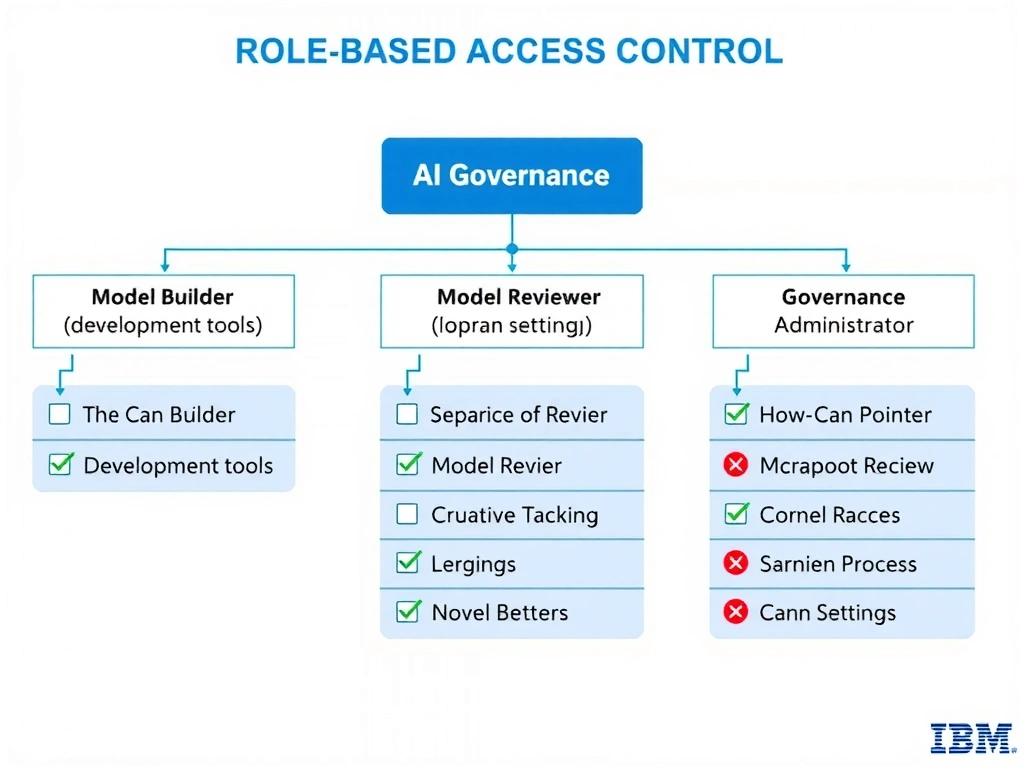
Governance roles are like hospital access badges — housekeeping doesn't need keys to the pharmacy, and pharmacists don't need access to the surgical suite. IBM watsonx.governance requires that roles reflect actual job responsibilities, enforce separation of duties between builders and approvers, and grant only the minimum access necessary for each function. Making everyone an owner or sharing a single admin account destroys the separation of duties that makes your approval process defensible. Lock down roles correctly and your governance program becomes audit-proof!
Full explanation below image
Full Explanation
The correct answer is B. Assign governance roles based on responsibility, separation of duties, and least privilege. IBM watsonx.governance's Configure objective mandates structured role assignment to maintain governance integrity. Separation of duties ensures that the same person who builds a model cannot also be the sole approver of that model for production deployment — this control prevents conflicts of interest and unauthorized changes. Least privilege limits each role to only the permissions needed for its function, reducing the blast radius of accidental or malicious actions. Option A is incorrect because making every project member an owner eliminates access controls entirely, meaning anyone can modify governance records, approve their own models, or delete evidence — all of which undermine the credibility of the governance program. Option C is incorrect because shared accounts eliminate individual accountability, make audit trails meaningless, and violate basic security principles that regulators expect in any enterprise AI governance framework. Option D is incorrect because allowing model builders to erase approval evidence is a fundamental governance violation — it enables the destruction of the audit trail that regulators, executives, and customers rely on to verify that appropriate controls were followed. IBM's Configure watsonx.governance objective specifically covers role configuration as a prerequisite for trustworthy governance operations.