
A consultant is advising a customer that wants a scalable implementation. The team is focused on trustworthy AI pillars. Which recommendation is most appropriate?
Select an answer to reveal the explanation.
Short Explanation and Infographic
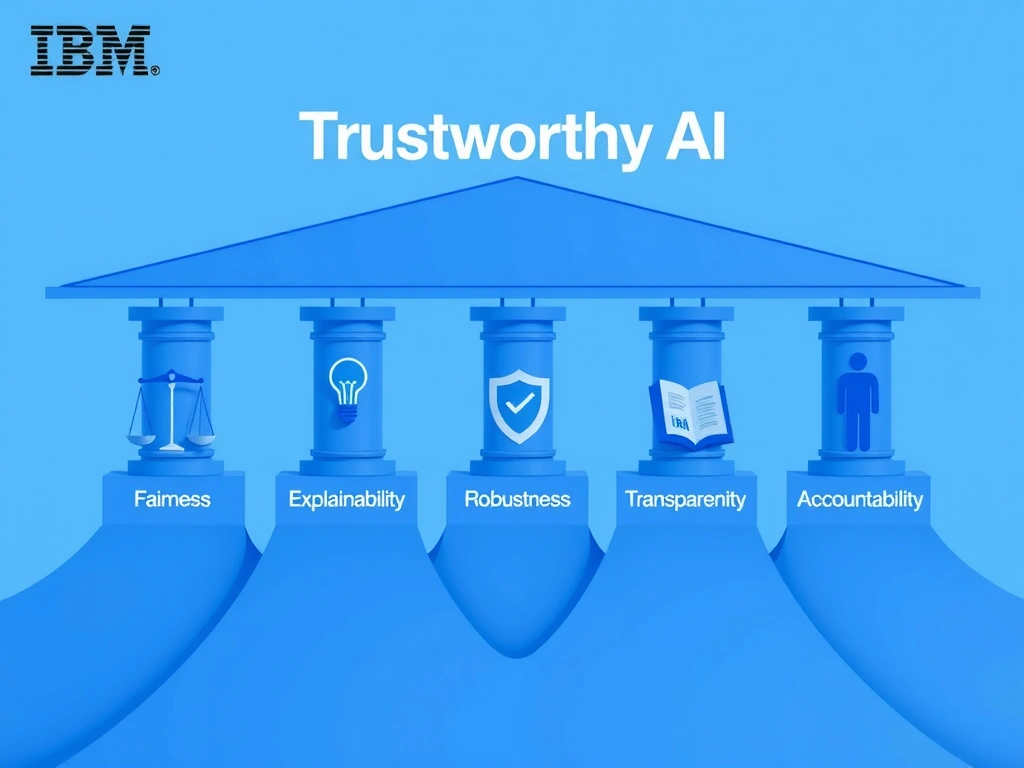
The five trustworthy AI pillars are like the load-bearing walls of a building — remove even one, and the whole structure becomes unsafe to occupy. IBM's framework requires fairness (no discriminatory outcomes), explainability (decisions humans can understand), robustness (resistance to adversarial inputs), transparency (open documentation), and accountability (named responsible parties). Accuracy matters, but it doesn't tell you if the model is treating everyone equitably. Know all five pillars and you'll frame governance conversations like a pro on exam day!
Full explanation below image
Full Explanation
The correct answer is A. Use fairness, explainability, robustness, transparency, and accountability to frame AI governance controls. IBM's AI Governance Overview establishes these five pillars as the foundational framework for designing and evaluating governance programs. Fairness ensures that model outputs do not produce disparate harm across demographic groups. Explainability enables humans to understand why a model produces a given output. Robustness ensures the model behaves reliably under varied or adversarial conditions. Transparency provides stakeholders with clear documentation of model design, data, and decisions. Accountability assigns named responsibility for oversight and remediation. Option B is incorrect because accuracy is a single performance metric that measures how often a model is correct on average — it does not capture whether outcomes are fair, whether decisions can be explained to affected individuals, or whether the model can be trusted under distributional shift. Option C is incorrect because restricting governance to production dashboards ignores the entire pre-production lifecycle where risk controls are most impactful and cost-effective. Option D is incorrect because accountability must remain with the deploying organization — regulators and standards bodies hold the organization responsible, not the vendor, regardless of contractual arrangements. IBM's AI Governance Overview objective is clear that all five pillars must be addressed for a governance program to be trustworthy.