
A deployed fraud detection model's input feature distributions have shifted significantly relative to training data, but labeled feedback data shows quality metrics remain within acceptable thresholds. Which type of drift does this scenario describe?
Select an answer to reveal the explanation.
Short Explanation and Infographic
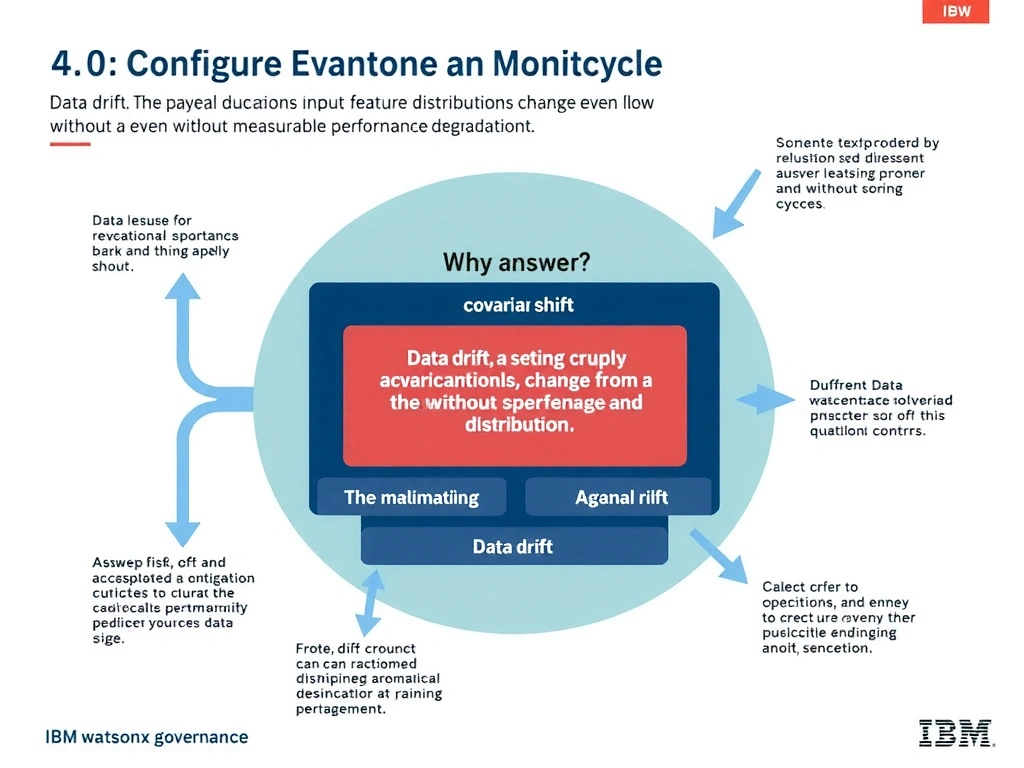
Think of it this way: in real-world AI governance, data drift, also called covariate shift, occurring when input feature distributions change from the training distribution even without measurable performance degradation is exactly what teams reach for when they need to handle this scenario. Data drift, or covariate shift, refers to changes in the statistical distribution of input features between training and production without corresponding quality metric degradation. On the exam, remember that this falls squarely under the 4.0 Configure Evaluation and Monitoring domain.
Full explanation below image
Full Explanation
Data drift, or covariate shift, refers to changes in the statistical distribution of input features between training and production without corresponding quality metric degradation. It is a leading indicator that model quality drift may follow if the distributional shift continues. watsonx.governance tracks data drift and model quality drift as independent monitors, enabling early intervention before performance actually degrades. The correct answer, "Data drift, also called covariate shift, occurring when input feature distributions change from the training distribution even without measurable performance degradation", directly addresses the scenario described because it aligns with the specific governance requirement in question. The incorrect options ("Model quality drift, detected when performance metrics such as Accuracy or F1 Score degrade below configured thresholds", "Concept drift, occurring when the underlying relationship between input features and target labels changes in the production environment", "Label drift, occurring when the distribution of ground-truth labels in production differs from the training label distribution") may seem plausible but do not satisfy the core requirement. Understanding the distinction between these concepts is critical for IBM watsonx.governance implementations and is frequently tested in the 4.0 Configure Evaluation and Monitoring section of the certification exam.