
Which statement best distinguishes LIME from SHAP in the context of watsonx.governance explainability?
Select an answer to reveal the explanation.
Short Explanation and Infographic
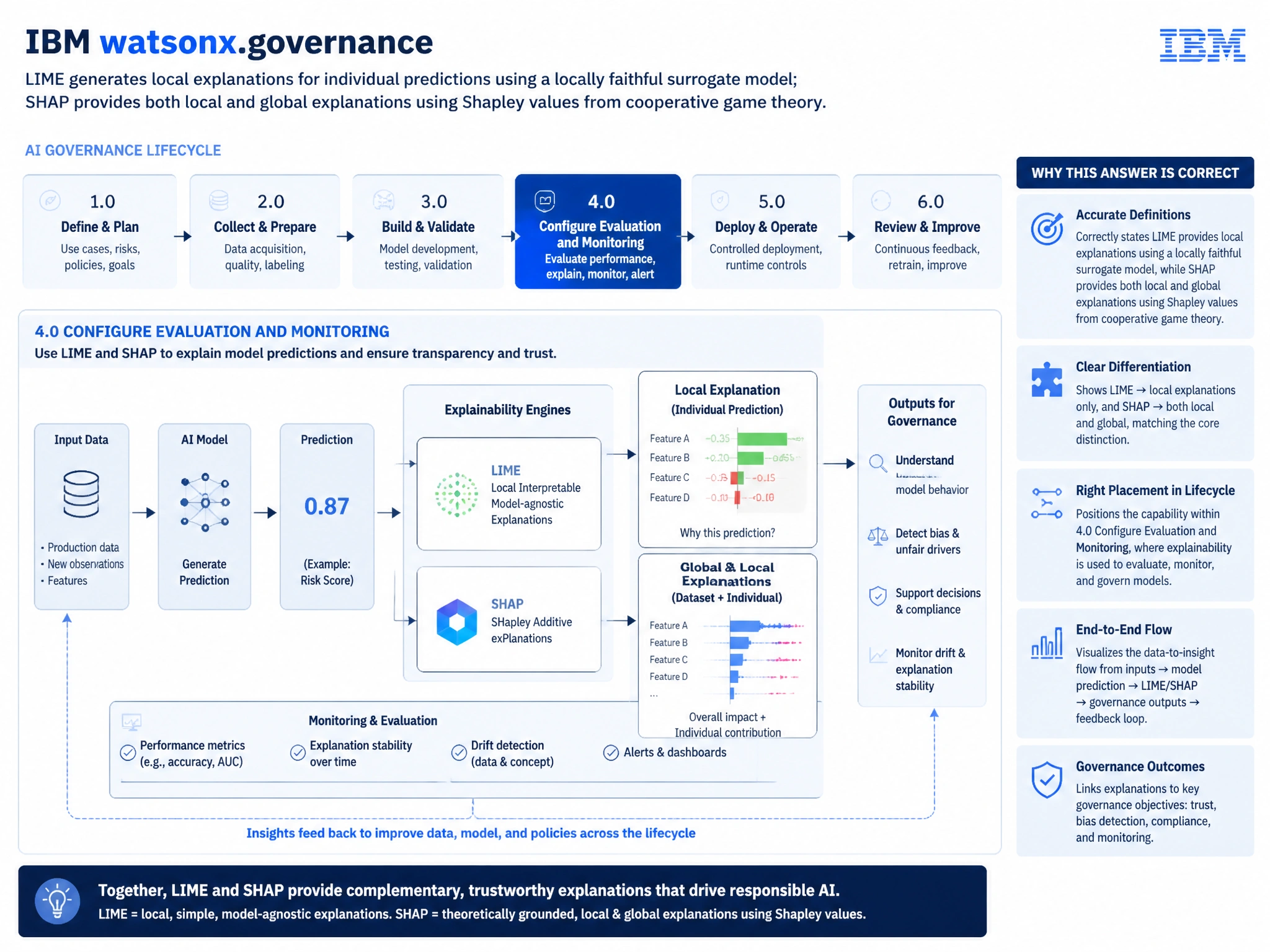
Think of it this way: in real-world AI governance, lime generates local explanations for individual predictions using a locally faithful surrogate model; shap provides both local and global explanations using shapley values from cooperative game theory is exactly what teams reach for when they need to handle this scenario. LIME (Local Interpretable Model-agnostic Explanations) fits a simple surrogate model locally around a single prediction to approximate the complex model's behavior at that point. On the exam, remember that this falls squarely under the 4.0 Configure Evaluation and Monitoring domain.
Full explanation below image
Full Explanation
LIME (Local Interpretable Model-agnostic Explanations) fits a simple surrogate model locally around a single prediction to approximate the complex model's behavior at that point. SHAP (SHapley Additive exPlanations) uses cooperative game theory to attribute each feature's contribution to a prediction and can aggregate these values for global importance rankings. watsonx.governance offers both algorithms to address different explanation requirements. The correct answer, "LIME generates local explanations for individual predictions using a locally faithful surrogate model; SHAP provides both local and global explanations using Shapley values from cooperative game theory", directly addresses the scenario described because it aligns with the specific governance requirement in question. The incorrect options ("LIME provides global feature importance rankings across the full dataset while SHAP is limited to local explanations for individual predictions", "Both LIME and SHAP are global-only methods that rank features across the entire dataset without supporting individual prediction explanations", "SHAP explains predictions only for tree-based models while LIME is the only model-agnostic explainability algorithm supported by watsonx.governance") may seem plausible but do not satisfy the core requirement. Understanding the distinction between these concepts is critical for IBM watsonx.governance implementations and is frequently tested in the 4.0 Configure Evaluation and Monitoring section of the certification exam.