
When configuring a fairness monitor in watsonx.governance, what is the correct definition of the reference group?
Select an answer to reveal the explanation.
Short Explanation and Infographic
Think of it this way: in real-world AI governance, the demographic group that serves as the privileged baseline whose favorable outcome rate is used as the denominator in disparate impact calculations is exactly what teams reach for when they need to handle this scenario. The reference group in watsonx. On the exam, remember that this falls squarely under the 4.0 Configure Evaluation and Monitoring domain.
Full explanation below image
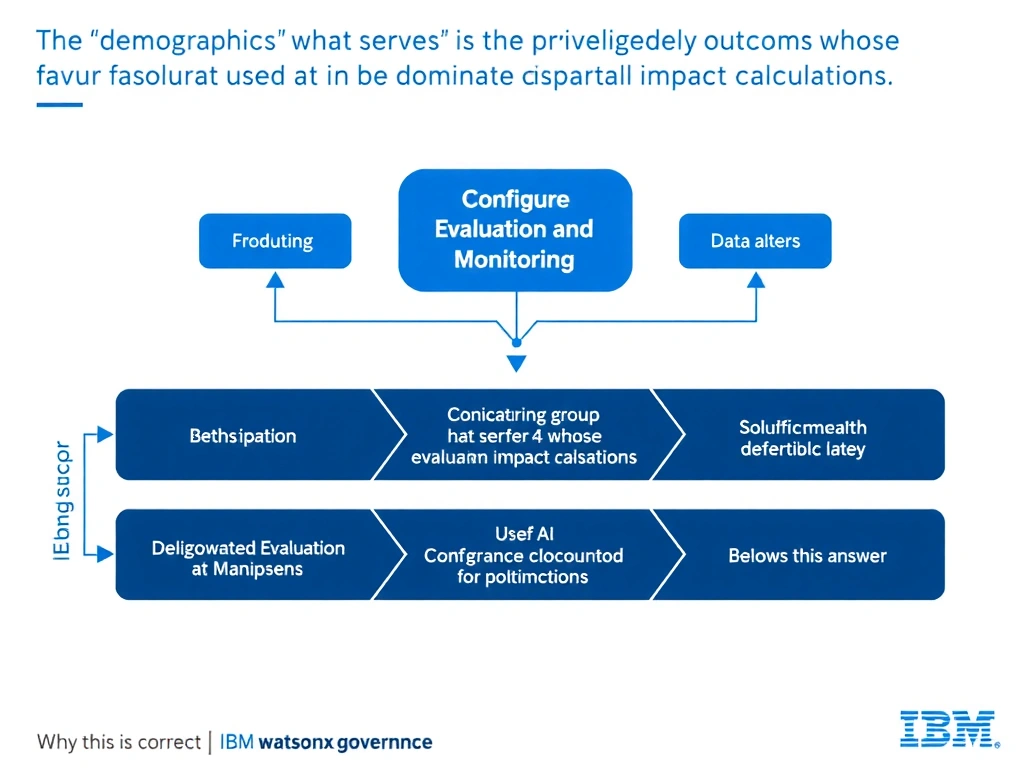
Full Explanation
The reference group in watsonx.governance fairness configuration is the privileged or historically advantaged demographic group whose favorable outcome rate serves as the standard for comparison. Disparate impact ratio and statistical parity difference are both computed relative to this reference group. Incorrectly designating the reference group inverts the direction of any detected bias. The correct answer, "The demographic group that serves as the privileged baseline whose favorable outcome rate is used as the denominator in disparate impact calculations", directly addresses the scenario described because it aligns with the specific governance requirement in question. The incorrect options ("The demographic group with the highest model accuracy in historical training data", "The group designated as potentially disadvantaged that will be evaluated against a baseline for fairness disparities", "A randomly sampled subset of training data used for statistical baseline comparison in drift detection") may seem plausible but do not satisfy the core requirement. Understanding the distinction between these concepts is critical for IBM watsonx.governance implementations and is frequently tested in the 4.0 Configure Evaluation and Monitoring section of the certification exam.