
Following a MEASURE phase that quantified bias and reliability risks in a deployed AI recommendation engine, the operations team is now prioritizing which risks require immediate treatment, implementing threshold adjustments and re-weighting controls, and creating an incident response playbook for residual risks. Which NIST AI RMF function best characterizes these activities?
Select an answer to reveal the explanation.
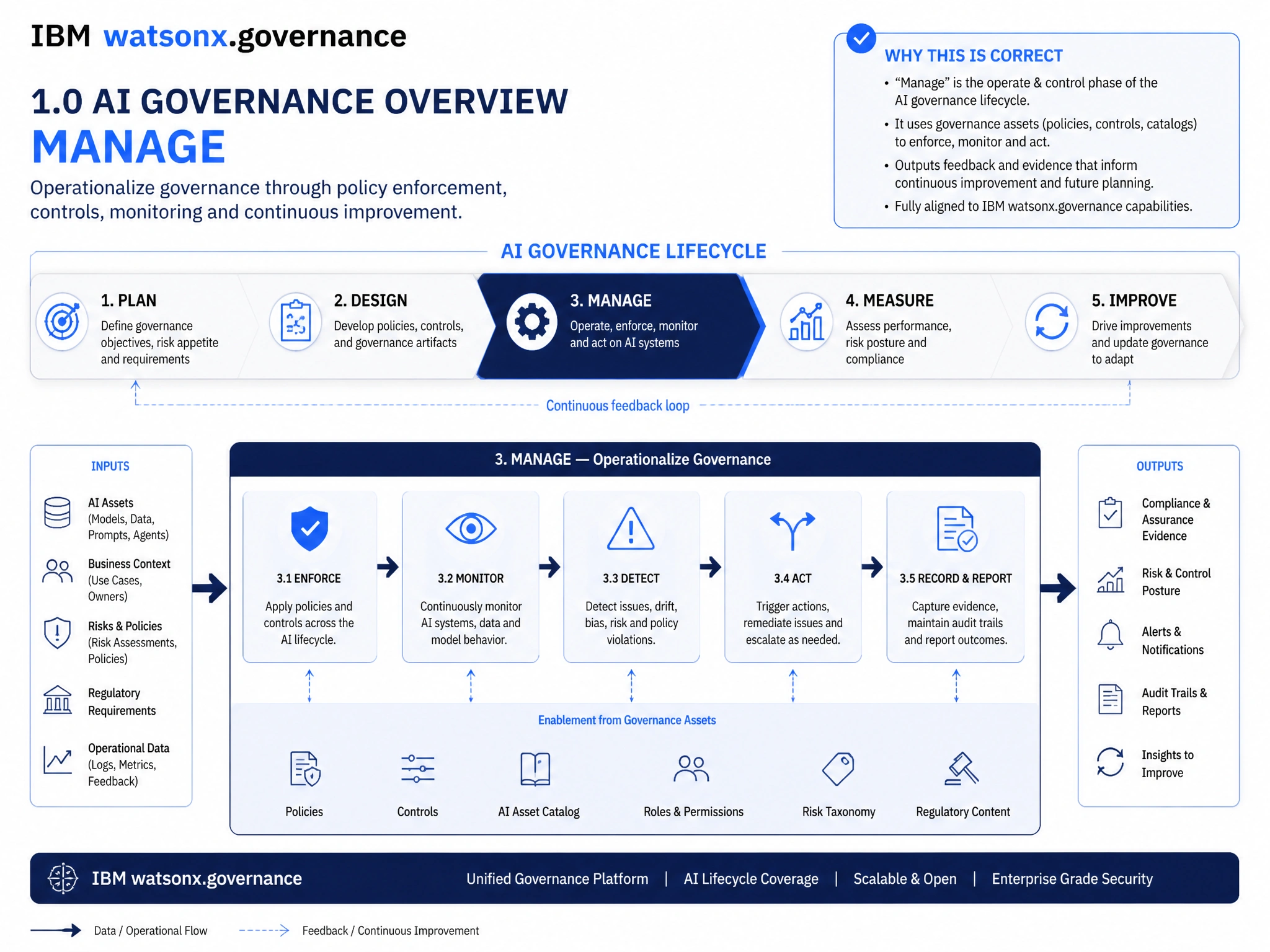
Short Explanation and Infographic
Think of it this way: in real-world AI governance, manage is exactly what teams reach for when they need to handle this scenario. MANAGE is the execution phase of the NIST AI RMF where organizations act on the risk intelligence gathered during MAP and MEASURE by prioritizing treatments, applying mitigations, monitoring residual risk, and planning for incident response and recovery. On the exam, remember that this falls squarely under the 1.0 AI Governance Overview domain.
Full explanation below image
Full Explanation
MANAGE is the execution phase of the NIST AI RMF where organizations act on the risk intelligence gathered during MAP and MEASURE by prioritizing treatments, applying mitigations, monitoring residual risk, and planning for incident response and recovery. The four functions—GOVERN, MAP, MEASURE, MANAGE—are intended to work iteratively with MANAGE feeding lessons learned back into MAP as system conditions evolve over time. IBM's watsonx.governance platform supports MANAGE activities through Watson OpenScale's threshold alerting and automated retraining trigger capabilities. The correct answer, "MANAGE", directly addresses the scenario described because it aligns with the specific governance requirement in question. The incorrect options ("GOVERN", "MAP", "MEASURE") may seem plausible but do not satisfy the core requirement. Understanding the distinction between these concepts is critical for IBM watsonx.governance implementations and is frequently tested in the 1.0 AI Governance Overview section of the certification exam.