
An enterprise AI division wants to obtain internationally recognized third-party certification demonstrating it has implemented a comprehensive AI management system covering governance policies, risk management, performance evaluation, and continual improvement for all AI activities. Which standard provides the basis for this certification?
Select an answer to reveal the explanation.
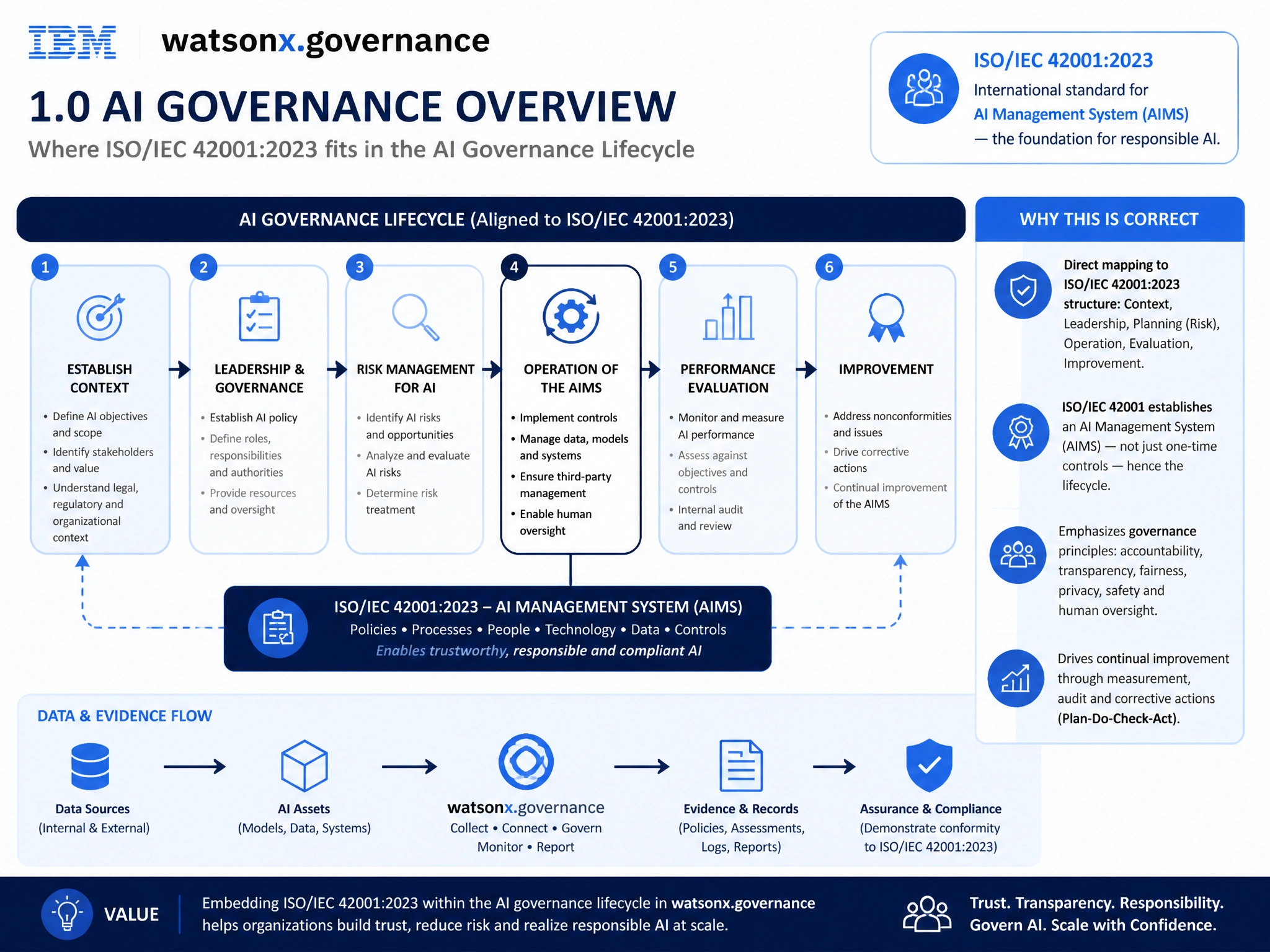
Short Explanation and Infographic
Think of it this way: in real-world AI governance, iso/iec 42001:2023 is exactly what teams reach for when they need to handle this scenario. ISO/IEC 42001:2023 was published in December 2023 as the first dedicated AI management system standard in the ISO/IEC family, enabling organizations to pursue third-party certification analogous to ISO 27001 for information security. On the exam, remember that this falls squarely under the 1.0 AI Governance Overview domain.
Full explanation below image
Full Explanation
ISO/IEC 42001:2023 was published in December 2023 as the first dedicated AI management system standard in the ISO/IEC family, enabling organizations to pursue third-party certification analogous to ISO 27001 for information security. It defines requirements for AI governance policies, risk and impact assessment, AI system lifecycle controls, supplier relationships, and continual improvement and is directly aligned with regulatory frameworks such as the EU AI Act. IBM references ISO/IEC 42001 as a compatible compliance framework within watsonx.governance's regulatory mapping capabilities. The correct answer, "ISO/IEC 42001:2023", directly addresses the scenario described because it aligns with the specific governance requirement in question. The incorrect options ("ISO/IEC 27001:2022", "NIST AI RMF", "ISO 9001:2015") may seem plausible but do not satisfy the core requirement. Understanding the distinction between these concepts is critical for IBM watsonx.governance implementations and is frequently tested in the 1.0 AI Governance Overview section of the certification exam.