
An SRE team wants the Instana Kubernetes agent to automatically monitor all pods in current and future namespaces without requiring agent reconfiguration each time a new namespace is created. How should the agent be configured?
Select an answer to reveal the explanation.
Short Explanation and Infographic
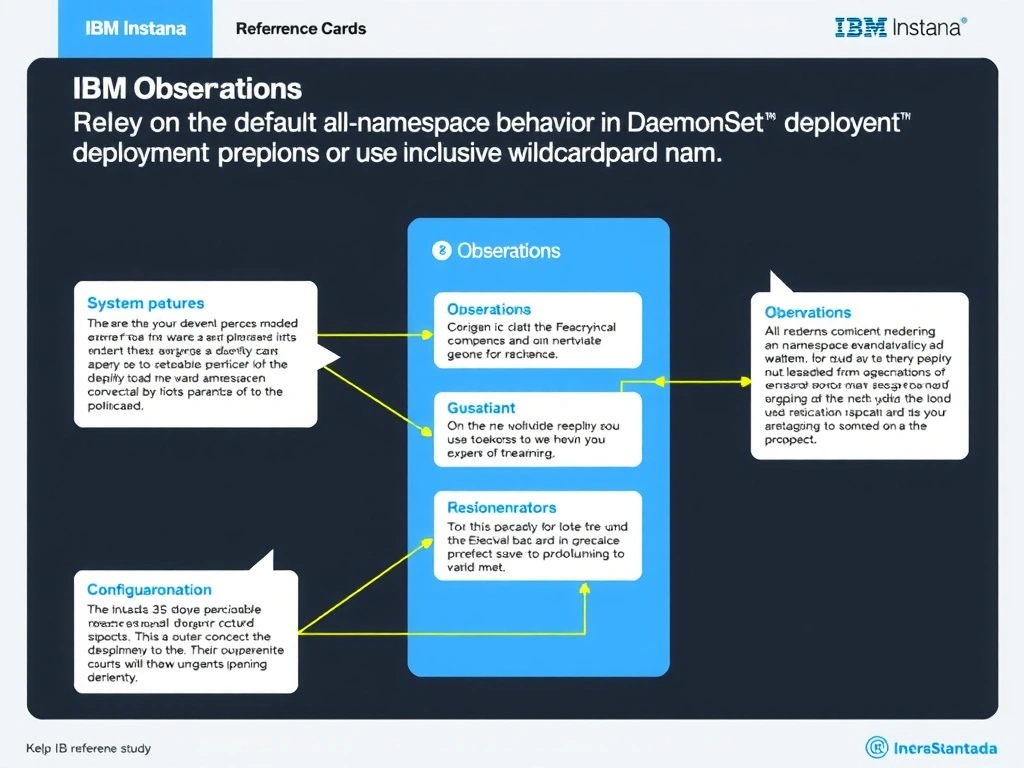
The Instana agent DaemonSet monitors all pods on its nodes across all namespaces by default, so new namespaces are automatically included without any reconfiguration. If namespace-level filtering is used, inclusive wildcard patterns ensure future namespaces are covered. Deploying separate DaemonSets per namespace is an anti-pattern that creates significant operational overhead and is contrary to how Kubernetes DaemonSets are designed to work at cluster scope.
Full explanation below image
Full Explanation
The Instana agent DaemonSet monitors all pods on its nodes across all namespaces by default, so new namespaces are automatically included without any reconfiguration. If namespace-level filtering is used, inclusive wildcard patterns ensure future namespaces are covered. Deploying separate DaemonSets per namespace is an anti-pattern that creates significant operational overhead and is contrary to how Kubernetes DaemonSets are designed to work at cluster scope. The correct answer is 'Rely on the default all-namespace behavior of the DaemonSet deployment or use inclusive wildcard namespace rules'. The incorrect options — 'Deploy a separate Instana agent DaemonSet in each namespace at creation time', 'Register each new namespace with the Instana backend via the REST API when the namespace is created', 'Enable namespace auto-discovery in the Instana web UI under Settings > Kubernetes Integration' — are wrong because they do not align with IBM Instana's architecture or recommended practices for this scenario. Understanding this concept is essential for the Domain 1: Operations domain of the IBM Instana Observability certification.