
A consultant is advising a customer that wants a scalable implementation. The team is focused on deployment options. Which recommendation is most appropriate?
Select an answer to reveal the explanation.
Short Explanation and Infographic
Here's the deal: watsonx.data's architecture is the whole package — object storage for low-cost scale, open table formats (Iceberg) for ACID transactions, query engines for compute, a metadata catalog for governance, and workload management to keep it all running. You can't optimize just one layer and call it a lakehouse; the value comes from coordinating all five components under a unified governance model. The exam tests whether you can see the whole picture, not just one piece.
Full explanation below image
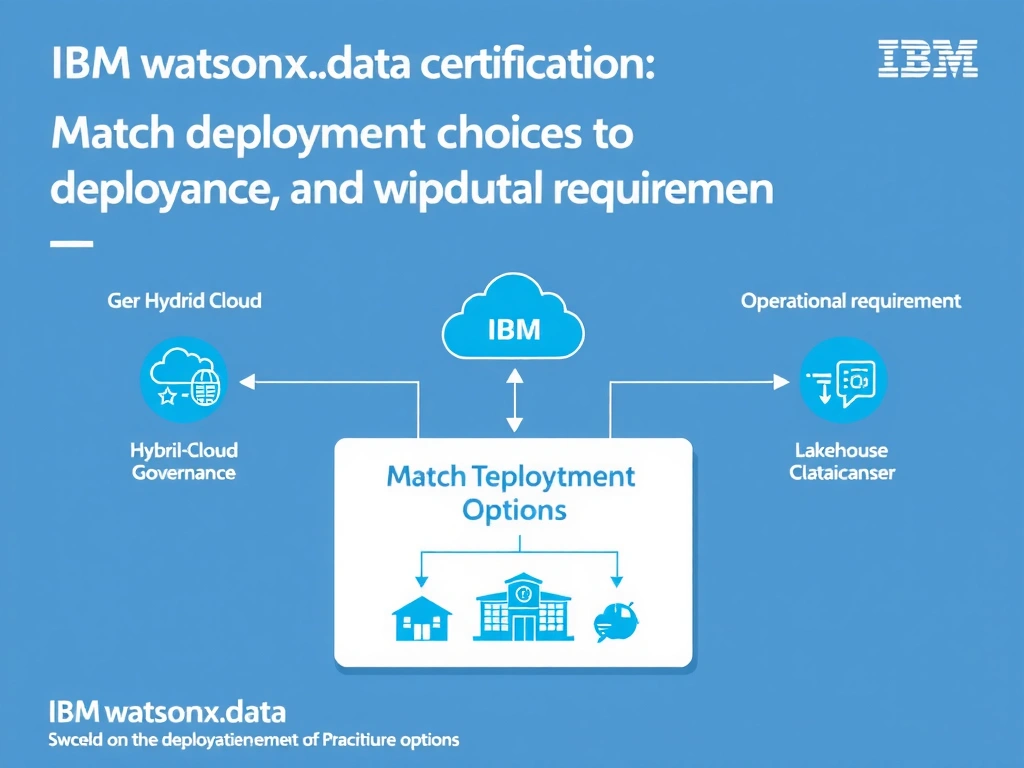
Full Explanation
The correct answer is option C: Match deployment choices to hybrid-cloud, governance, and operational requirements.. This aligns with IBM's IBM watsonx.data platform architecture guidance, which emphasizes match deployment choices to hybrid-cloud, governance, and operational requirements as the recommended approach for production deployments. Option A (Assume all deployments must be single-node local installs) is incorrect because it either bypasses IBM's recommended architecture or introduces operational risk that the correct approach is specifically designed to avoid. Option B (Ignore network and identity integration planning) is incorrect because it either bypasses IBM's recommended architecture or introduces operational risk that the correct approach is specifically designed to avoid. Option D (Choose deployment based only on dashboard color) is incorrect because it either bypasses IBM's recommended architecture or introduces operational risk that the correct approach is specifically designed to avoid. Understanding this distinction is critical for the C9007300 exam: IBM watsonx.data is designed to enforce governance, performance, and operational best practices through its built-in architecture, and the correct answers consistently reflect those architectural constraints rather than shortcut alternatives.