
An administrator is troubleshooting a pilot deployment and wants the most appropriate next step. The team is focused on Infrastructure Manager. Which recommendation is most appropriate?
Select an answer to reveal the explanation.
Short Explanation and Infographic
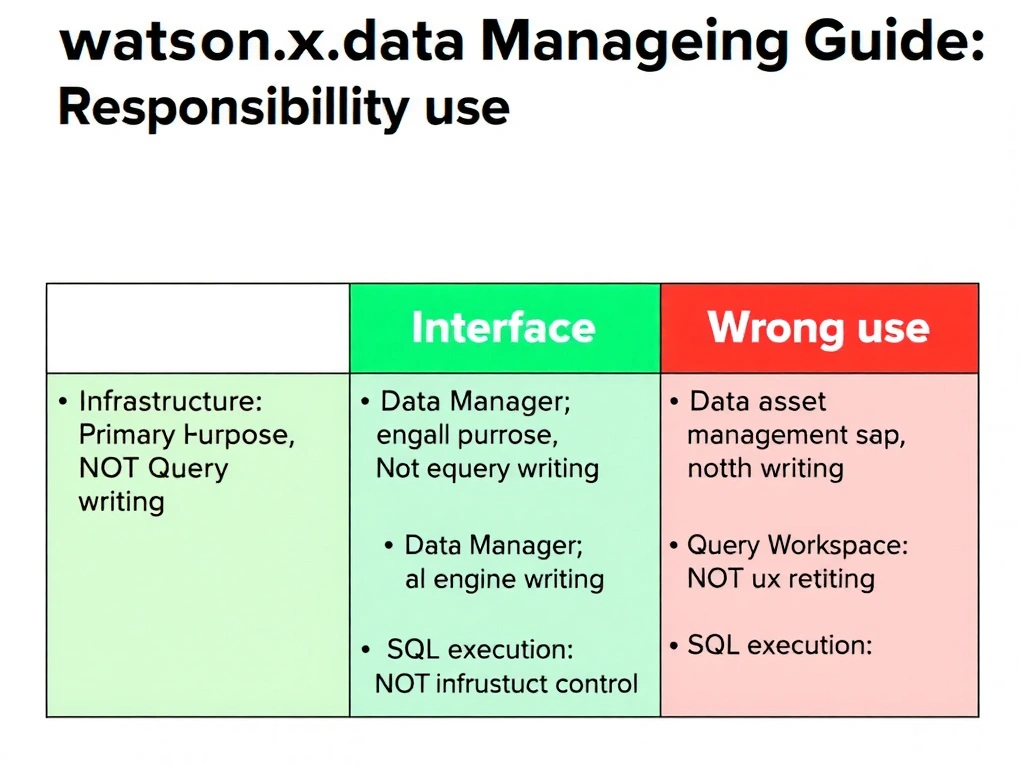
In watsonx.data, operational management runs through dedicated platform tools: Infrastructure Manager handles engine provisioning and service lifecycle, Data Manager handles metadata and catalog operations, and Query Workspace handles SQL execution and history. Using the right tool for the right operational task is both an IBM exam principle and a production best practice. Improvising operational procedures outside these tools creates configuration drift that is hard to audit.
Full explanation below image
Full Explanation
The correct answer is option A: Use Infrastructure Manager to manage engines, services, and related platform resources.. This aligns with IBM's Platform operations and administration guidance, which emphasizes use infrastructure manager to manage engines, services, and related platform resources as the recommended approach for production deployments. Option B (Use query history to provision engines) is incorrect because it either bypasses IBM's recommended architecture or introduces operational risk that the correct approach is specifically designed to avoid. Option C (Edit raw object files to start services) is incorrect because it either bypasses IBM's recommended architecture or introduces operational risk that the correct approach is specifically designed to avoid. Option D (Create BI dashboards to manage infrastructure) is incorrect because it either bypasses IBM's recommended architecture or introduces operational risk that the correct approach is specifically designed to avoid. Understanding this distinction is critical for the C9007300 exam: IBM watsonx.data is designed to enforce governance, performance, and operational best practices through its built-in architecture, and the correct answers consistently reflect those architectural constraints rather than shortcut alternatives.