
A project lead is turning a proof of concept into a governed production workflow. What is the best way to handle ACID table behavior while staying aligned with the certification objectives?
Select an answer to reveal the explanation.
Short Explanation and Infographic
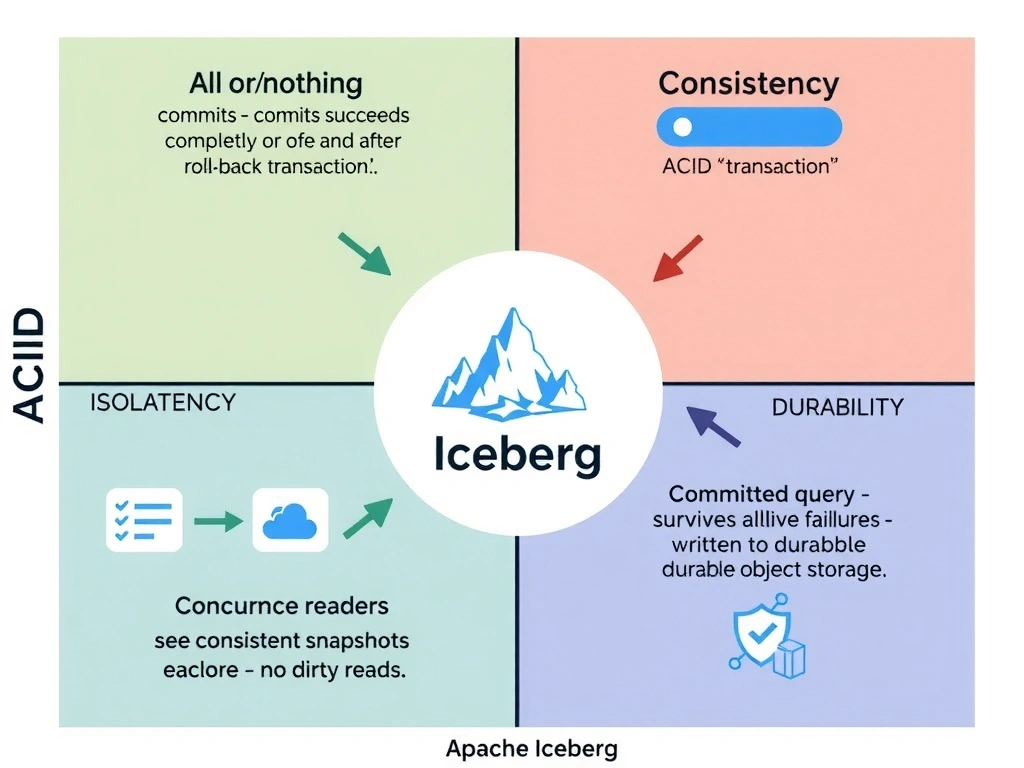
In watsonx.data, open table formats like Apache Iceberg are the technical layer that bridges raw object storage files and database-grade reliability. Iceberg provides ACID-compliant writes through optimistic concurrency control, snapshot isolation for time travel queries, and schema evolution without full table rewrites. The certification tests Iceberg specifically because it is IBM's recommended format and the one that delivers the transactional consistency that distinguishes a lakehouse from a simple data lake.
Full explanation below image
Full Explanation
The correct answer is option B: Use table formats that provide transactional consistency, schema evolution, and reliable concurrent access.. This aligns with IBM's Data lakehouse fundamentals guidance, which emphasizes use table formats that provide transactional consistency, schema evolution, and reliable concurrent access as the recommended approach for production deployments. Option A (Depend on file naming conventions for transactions) is incorrect because it either bypasses IBM's recommended architecture or introduces operational risk that the correct approach is specifically designed to avoid. Option C (Disable metadata tracking to reduce overhead) is incorrect because it either bypasses IBM's recommended architecture or introduces operational risk that the correct approach is specifically designed to avoid. Option D (Allow each query engine to rewrite files independently) is incorrect because it either bypasses IBM's recommended architecture or introduces operational risk that the correct approach is specifically designed to avoid. Understanding this distinction is critical for the C9007300 exam: IBM watsonx.data is designed to enforce governance, performance, and operational best practices through its built-in architecture, and the correct answers consistently reflect those architectural constraints rather than shortcut alternatives.