
A consultant is advising a customer that wants a scalable implementation. The team is focused on open lakehouse architecture. Which recommendation is most appropriate?
Select an answer to reveal the explanation.
Short Explanation and Infographic
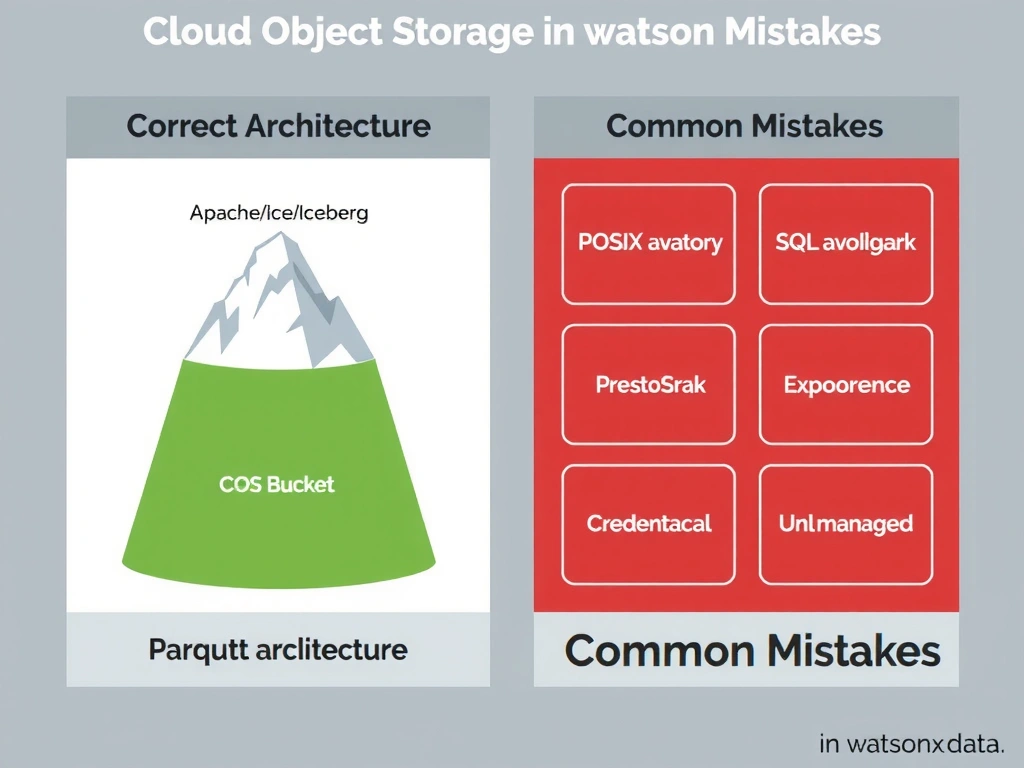
Here's the deal: Apache Iceberg is the table format that transforms watsonx.data from a file dump into an actual database-grade system — it adds ACID transactions, snapshot-based time travel, schema evolution, and partition pruning on top of ordinary object storage files. Without Iceberg (or Delta Lake, or Hudi), your Parquet files are just files. With Iceberg, they become versioned, transactional, queryable tables that multiple engines can read concurrently without stepping on each other.
Full explanation below image
Full Explanation
The correct answer is option A: Use open table formats on object storage with governance and query engines layered above the shared data.. This aligns with IBM's Data lakehouse fundamentals guidance, which emphasizes use open table formats on object storage with governance and query engines layered above the shared data as the recommended approach for production deployments. Option B (Move every workload into a proprietary warehouse) is incorrect because it either bypasses IBM's recommended architecture or introduces operational risk that the correct approach is specifically designed to avoid. Option C (Store only raw files with no table metadata) is incorrect because it either bypasses IBM's recommended architecture or introduces operational risk that the correct approach is specifically designed to avoid. Option D (Copy data into separate marts for every engine) is incorrect because it either bypasses IBM's recommended architecture or introduces operational risk that the correct approach is specifically designed to avoid. Understanding this distinction is critical for the C9007300 exam: IBM watsonx.data is designed to enforce governance, performance, and operational best practices through its built-in architecture, and the correct answers consistently reflect those architectural constraints rather than shortcut alternatives.