
During a design review, an architect asks which choice best matches the IBM guidance. What is the best way to handle access control while staying aligned with the certification objectives?
Select an answer to reveal the explanation.
Short Explanation and Infographic
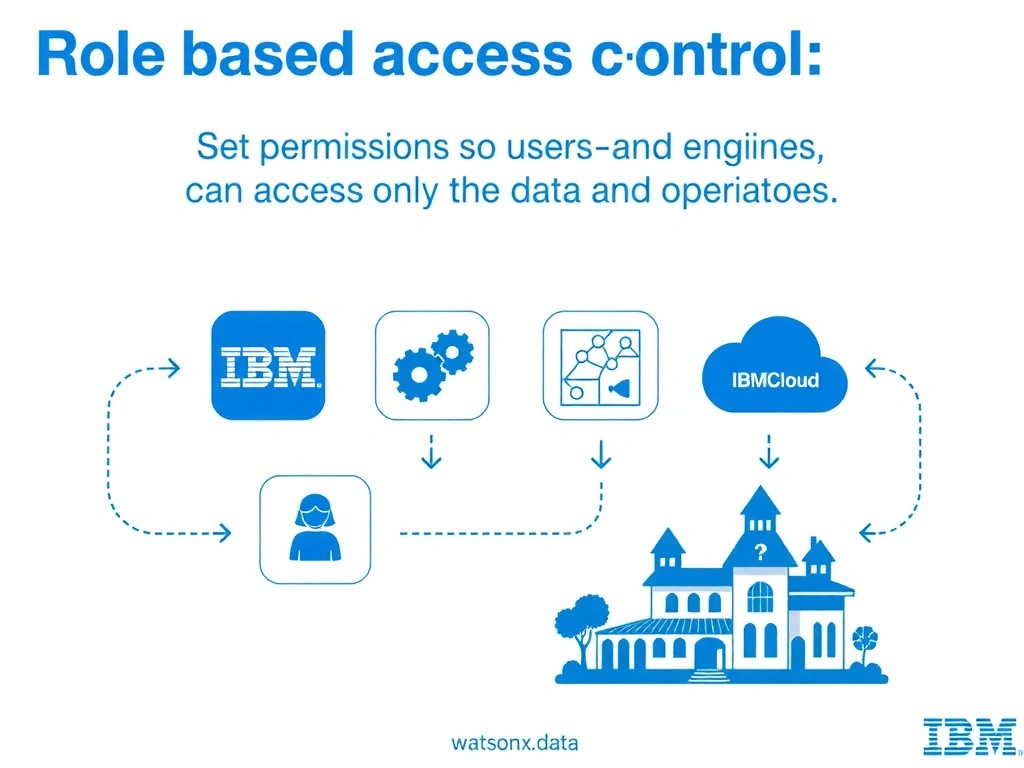
Here's the deal: least-privilege access isn't just a security buzzword — it's the architectural pattern IBM built watsonx.data's governance layer around. Users get access to exactly the data their role requires, engines get the catalog permissions they need for their workloads, and nothing else flows through without explicit policy approval. Broad open permissions feel convenient right up until an auditor or a data breach changes your perspective.
Full explanation below image
Full Explanation
The correct answer is option D: Set permissions so users and engines can access only the data and operations they are allowed to use.. This aligns with IBM's Platform operations and administration guidance, which emphasizes set permissions so users and engines can access only the data and operations they are allowed to use as the recommended approach for production deployments. Option A (Grant broad admin rights for convenience) is incorrect because it either bypasses IBM's recommended architecture or introduces operational risk that the correct approach is specifically designed to avoid. Option B (Put sensitive filters in optional dashboard notes) is incorrect because it either bypasses IBM's recommended architecture or introduces operational risk that the correct approach is specifically designed to avoid. Option C (Use object names as the only security boundary) is incorrect because it either bypasses IBM's recommended architecture or introduces operational risk that the correct approach is specifically designed to avoid. Understanding this distinction is critical for the C9007300 exam: IBM watsonx.data is designed to enforce governance, performance, and operational best practices through its built-in architecture, and the correct answers consistently reflect those architectural constraints rather than shortcut alternatives.