
Many advanced deep learning models suffer from a lack of 'explainability,' often referred to as the 'black box' problem. From a practical and operational standpoint, what does this concern mean?
Select an answer to reveal the explanation.
Short Explanation
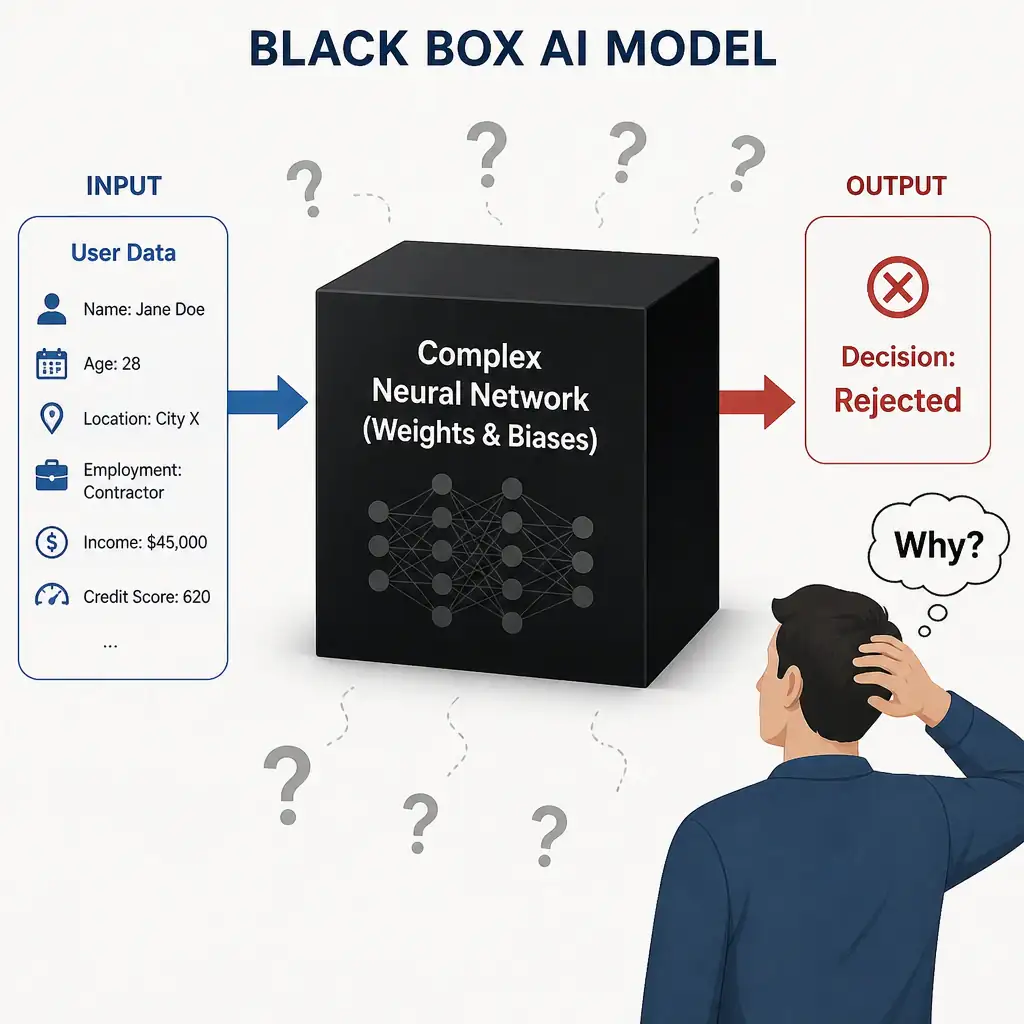
Check this out: you've built a massive deep neural network that predicts with high accuracy but can't show its work. The black box problem means the internal math and feature interactions are too complex for you to trace the exact reasoning behind a specific prediction. That's a real operational problem when regulators, users, or auditors need a human-readable explanation.
Full Explanation
Explainability in artificial intelligence (XAI) refers to the ability to describe the internal mechanics and decision-making logic of an AI system in human-interpretable terms. Many modern machine learning models, particularly deep neural networks, ensemble models like gradient boosted trees, and large language models, are considered 'black boxes.' This is because they feature millions or billions of parameters (weights and biases) interacting through complex, non-linear activation functions. While these models achieve state-of-the-art predictive accuracy, it is practically impossible to trace the exact mathematical reason why a specific input led to a specific output. This lack of explainability raises significant challenges in regulated industries such as finance, healthcare, and criminal justice, where stakeholders must justify decisions (e.g., explaining why a loan was denied or how a diagnosis was made) to ensure fairness, accountability, and compliance with laws like the GDPR's 'right to an explanation.' To address this, techniques like SHAP (SHapley Additive exPlanations) and LIME (Local Interpretable Model-agnostic Explanations) are used to approximate feature importance and build trust. Therefore, the correct concern is the statement that the internal mathematical computations and feature interactions are so complex that humans cannot easily trace or understand the exact reasoning behind a specific prediction. The claim that the model's parameters are too few, meaning it is mathematically incapable of learning complex, non-linear relationships, describes underfitting or a model with low capacity; it is a capacity issue, not a transparency issue. The claim that the model cannot be serialized or compiled into production-ready formats like ONNX for deployment is incorrect because black-box models are deployed in production every day; their complexity does not prevent software serialization or deployment. The claim that the system's loss function is unstable, which guarantees that predictions will degrade to random noise over time, is incorrect because lack of explainability does not mean the predictions are unstable or incorrect; in fact, highly accurate models are often the least explainable. Therefore, the primary practical concern of explainability is the inability to understand the logic behind specific decisions due to system complexity.