
Your organization wants to automate the routing of incoming customer support emails by sorting them into predefined categories like 'Billing,' 'Technical Support,' and 'Account Security.' Which combination of machine learning task and architecture is best suited for this solution?
Select an answer to reveal the explanation.
Short Explanation
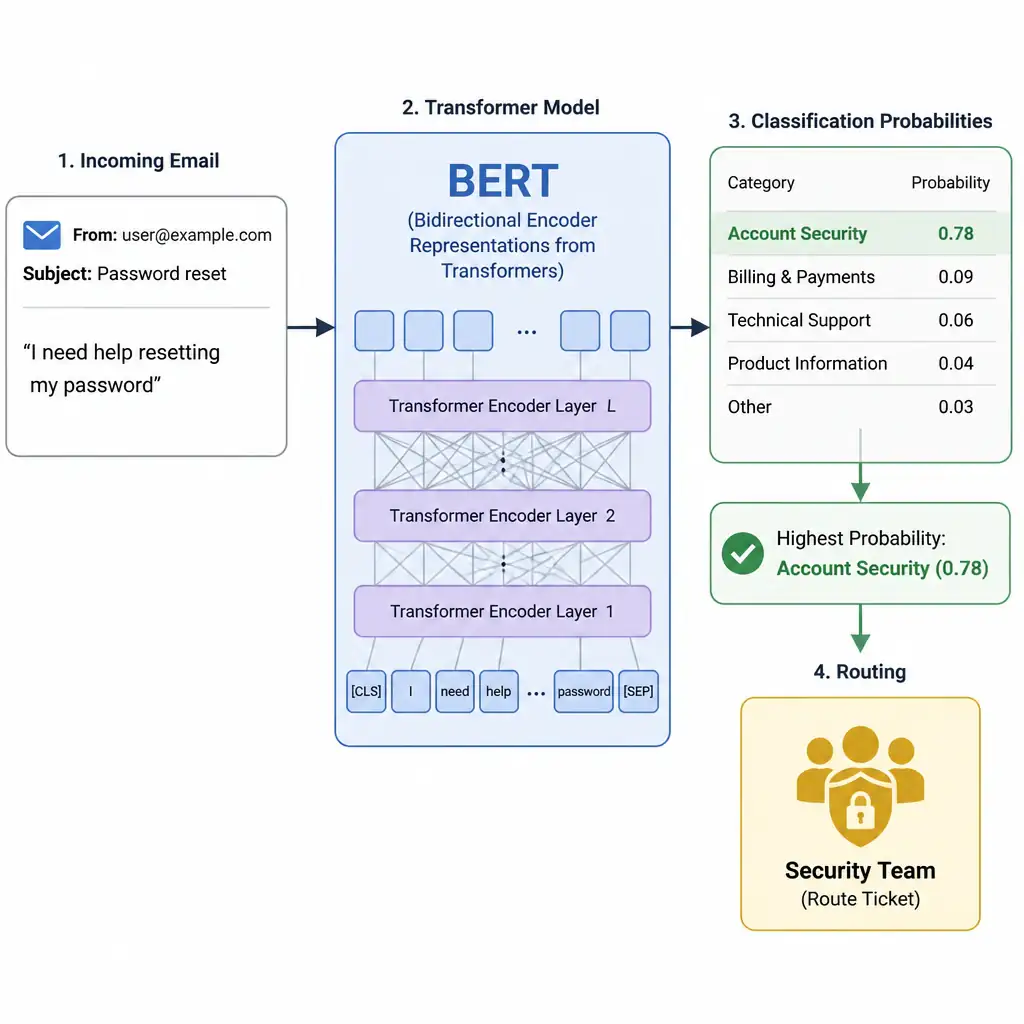
When you're routing emails into predefined categories, you're doing supervised classification. Use a Transformer-based language model like BERT because it understands context and assigns each email to labels such as Billing, Technical Support, or Account Security.
Full Explanation
Automatically categorizing incoming customer support emails into predefined folders such as 'Billing' or 'Technical Support' is a supervised text classification task. In supervised classification, a model is trained on labeled text data to predict discrete category tags for new, unseen text inputs. Modern natural language processing relies heavily on Transformer-based architectures, such as BERT (Bidirectional Encoder Representations from Transformers). Transformers excel at text classification because they use self-attention mechanisms to process words in relation to all other words in a sentence, capturing bidirectional context and semantic nuances. This allows the model to understand the intent behind a customer's query, even if they use colloquial language or complex phrasing. The unsupervised clustering approach with K-Means and raw word frequencies is incorrect because K-Means groups data based on feature similarity but does not assign data to predefined class labels, and it struggles with high-dimensional, unstructured text. The supervised regression approach with linear regression to predict continuous priority scores is incorrect because regression models are used to predict continuous numeric outputs, such as housing prices, not discrete category labels. The reinforcement learning approach with a Q-learning agent that learns through trial-and-error rewards is incorrect because reinforcement learning is designed for agent-environment interactions where an agent learns actions to maximize cumulative rewards; it is highly inefficient and inappropriate for standard text classification tasks where labeled training data is readily available. Thus, supervised classification with a Transformer-based model is the optimal choice.