
Before feeding raw data into a machine learning algorithm for training, engineers spend a significant amount of time on data cleaning and preprocessing. What is the primary objective of this phase?
Select an answer to reveal the explanation.
Short Explanation
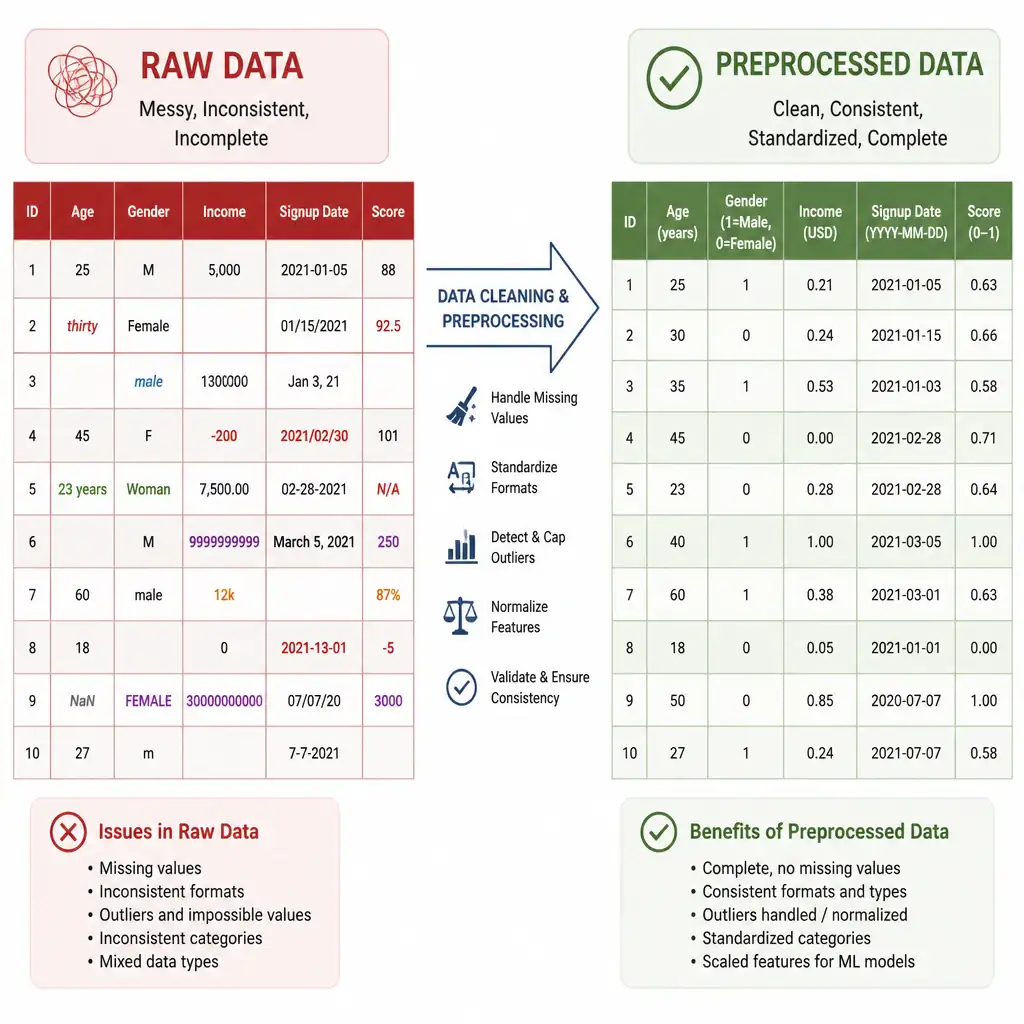
If you throw raw, dirty data at a machine learning model, it's going to spit garbage back at you. You're cleaning and preprocessing to find missing values, strip out noise and outliers, and scale or encode features so the algorithm's math can actually use them. This is where you'll spend most of your time on real-world AI projects, so get comfortable with it.
Full Explanation
In any machine learning project, raw data is rarely ready for direct ingestion by learning algorithms. It often contains missing values, noise, duplicate records, incorrect formats, and unscaled features. The primary objective of the data cleaning and preprocessing phase is to resolve these data quality issues and transform the raw data into a clean, consistent, and standardized format. This includes techniques such as imputation, replacing missing values with statistical measures like mean or median, outlier detection and removal, categorical variable encoding such as one-hot encoding, and feature scaling such as normalization or standardization. Standardizing data prevents features with larger numerical ranges from disproportionately influencing the model's learning process. The option that describes packaging the trained model into a containerized microservice and exposing API endpoints for real-time predictions is incorrect because that work belongs to the MLOps or deployment phase, which happens after the model is trained, not before. The option that describes monitoring model performance metrics like precision, recall, and prediction latency in the production environment is incorrect because that is model monitoring in production, the final stage of the lifecycle. The option that describes running the gradient descent optimization loop to adjust the model's weights and minimize the loss function is incorrect because that is the core function of the model training phase, which relies on already preprocessed data. Therefore, the main goal of preprocessing is handling missing values, filtering noise, and transforming raw data into a usable format.