
Why do machine learning practitioners generally prefer using a Random Forest model over a single, deeply grown decision tree for tabular classification tasks?
Select an answer to reveal the explanation.
Short Explanation
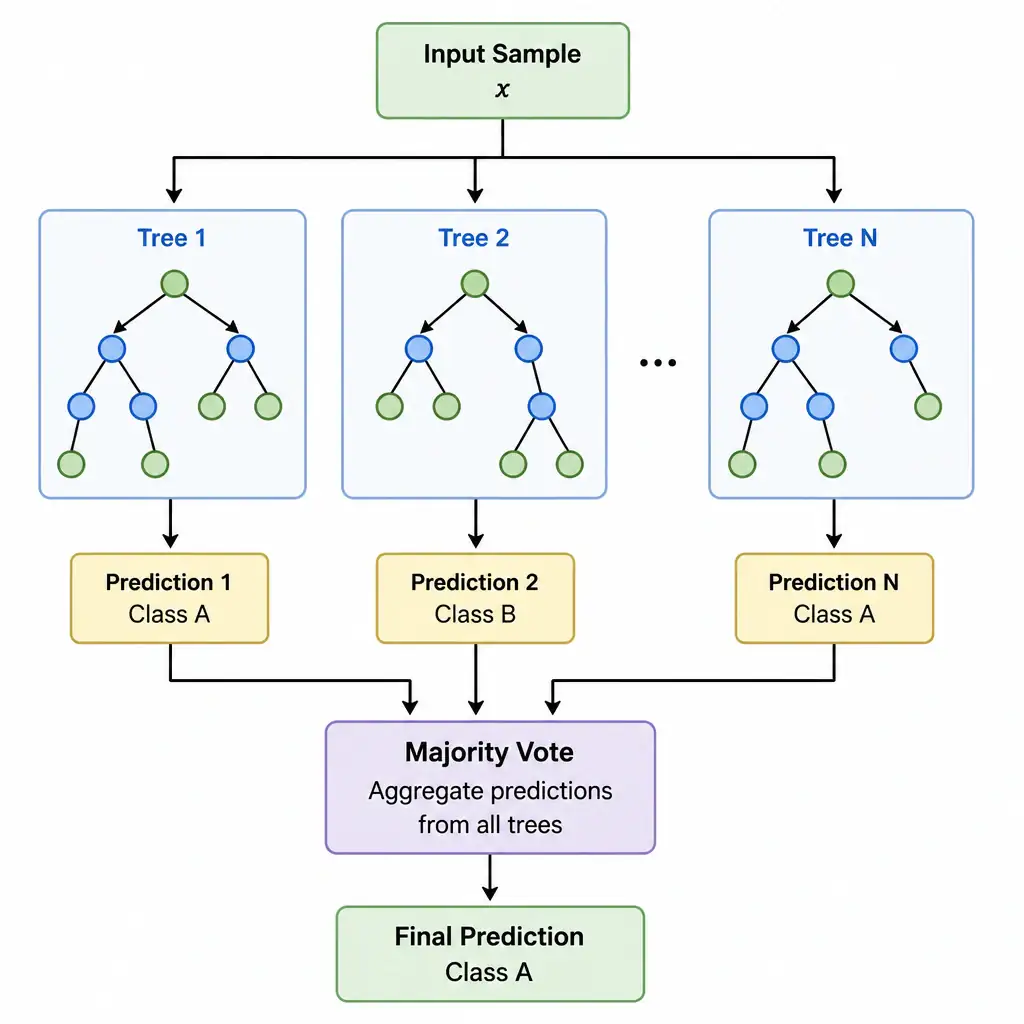
Think of a single deep tree as one opinionated friend who memorizes every detail and overfits. You'd rather ask a whole forest of diverse trees to vote, because bagging and random feature selection cut variance and make the model generalize better.
Full Explanation
Decision trees are non-parametric supervised learning methods that split data based on feature values. While highly interpretable, single decision trees suffer from high variance; if allowed to grow deep enough to capture complex relationships, they easily overfit the training data by memorizing noise. To address this limitation, the Random Forest algorithm was introduced as an ensemble learning technique. It operates on the principle of bootstrap aggregating (bagging) and feature randomness: Bootstrap Aggregation (Bagging): Random Forest trains multiple decision trees in parallel. Each tree is trained on a random subset of the training data selected with replacement (bootstrap sample). Feature Randomness: When splitting nodes in each tree, the algorithm only considers a random subset of features rather than all available features. This decorrelates the trees, ensuring they do not all make the same errors. Voting/Aggregation: For classification tasks, the final prediction is determined by a majority vote across all trees. Mathematically, averaging the predictions of multiple uncorrelated trees reduces the overall model variance without significantly increasing its bias. Consequently, Random Forest models generalize much better to unseen datasets and are far more robust to outliers and noise than single decision trees. The other choices are incorrect: the claim that Random Forest requires a much smaller volume of training data and fewer features to achieve convergence is not correct, because Random Forests typically need similar or larger amounts of data and more computational resources than a single tree. The claim that a Random Forest model is much simpler to visualize, interpret, and explain to non-technical stakeholders than a single decision tree is also incorrect; a single tree is far easier to inspect and explain, while a forest is a complex ensemble. Finally, the claim that the ensemble nature of Random Forest inherently increases the model's bias, making it more prone to overfitting on noisy datasets, is wrong because the ensemble is designed to decrease variance and overfitting, not increase it.