
If you are asked to distinguish between a supervised learning task and an unsupervised learning task in a machine learning pipeline, which key factor should you examine?
Select an answer to reveal the explanation.
Short Explanation
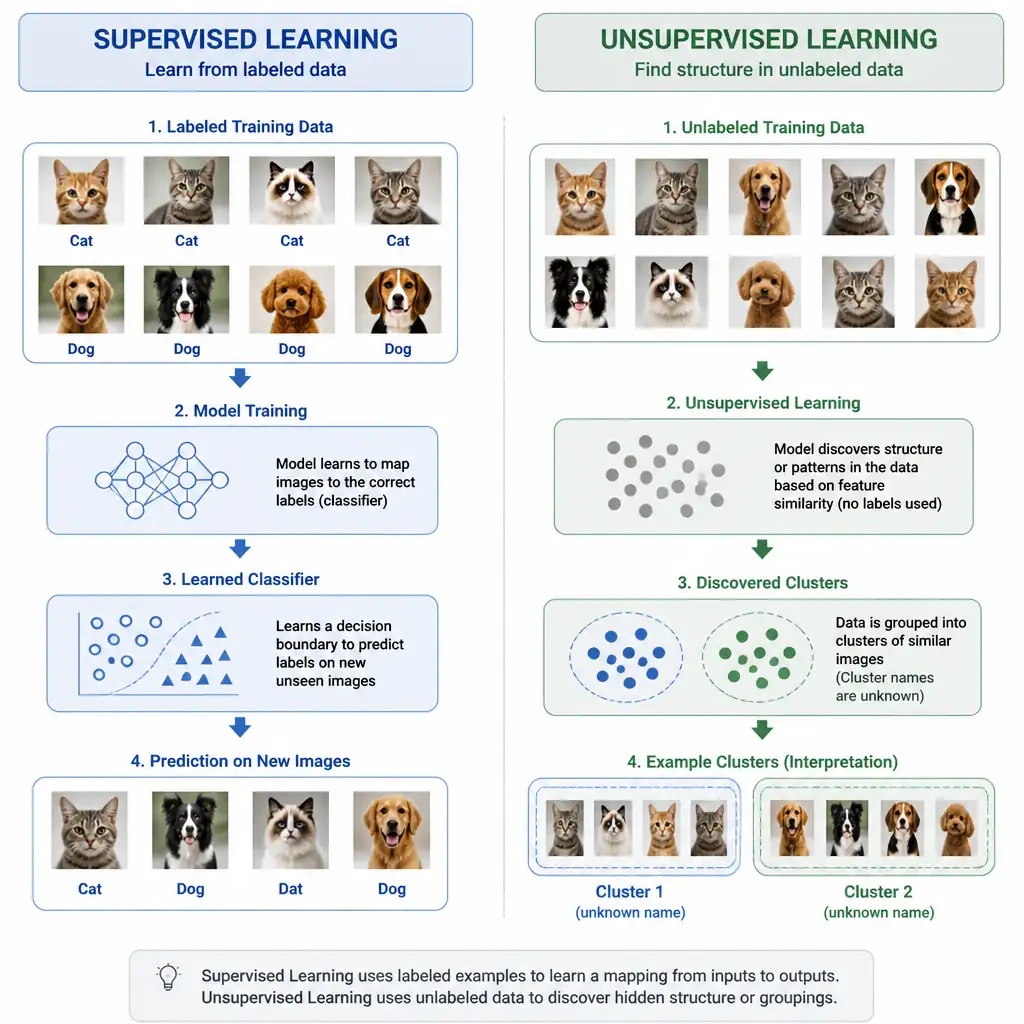
Here's the deal: this is the absolute starting line of machine learning, and it's a guaranteed exam topic. The difference comes down to labels: if the training data has ground-truth targets to guide learning, it's supervised; if it only has features and you're hunting hidden patterns, it's unsupervised.
Full Explanation
The fundamental division in machine learning paradigms is between supervised and unsupervised learning, and this distinction lies entirely in the structure of the training data. Supervised Learning: In this paradigm, the training dataset consists of input features paired with corresponding ground-truth output labels (targets). The model learns a mapping function from the inputs to the outputs by minimizing a loss function that measures the discrepancy between its predictions and the actual labels. Common supervised tasks include classification (predicting discrete categories, such as spam detection) and regression (predicting continuous values, such as housing prices). Unsupervised Learning: Here, the training dataset contains only input features without any corresponding labels. The goal is to discover underlying structures, relationships, or distributions within the data. Because there is no target label, there is no direct feedback loop or loss comparison with a 'ground truth.' Common unsupervised tasks include clustering (grouping similar data points, like K-Means) and dimensionality reduction (simplifying features while retaining variance, like PCA). The other choices are incorrect: the programming language and framework libraries used to build the training script are a tool choice, not a theoretical category; the size and dimensional scale of the input dataset do not dictate the learning paradigm, as both methods can scale to billions of records, and unsupervised learning is not limited to small datasets; and the complexity of the optimization algorithm and the number of layers in the neural network architecture are independent of the presence of labels.