During the training loop of a neural network, the loss function calculates the error between the model's predictions and the true labels. What is the primary role of the optimizer in this process?
Select an answer to reveal the explanation.
Short Explanation and Infographic
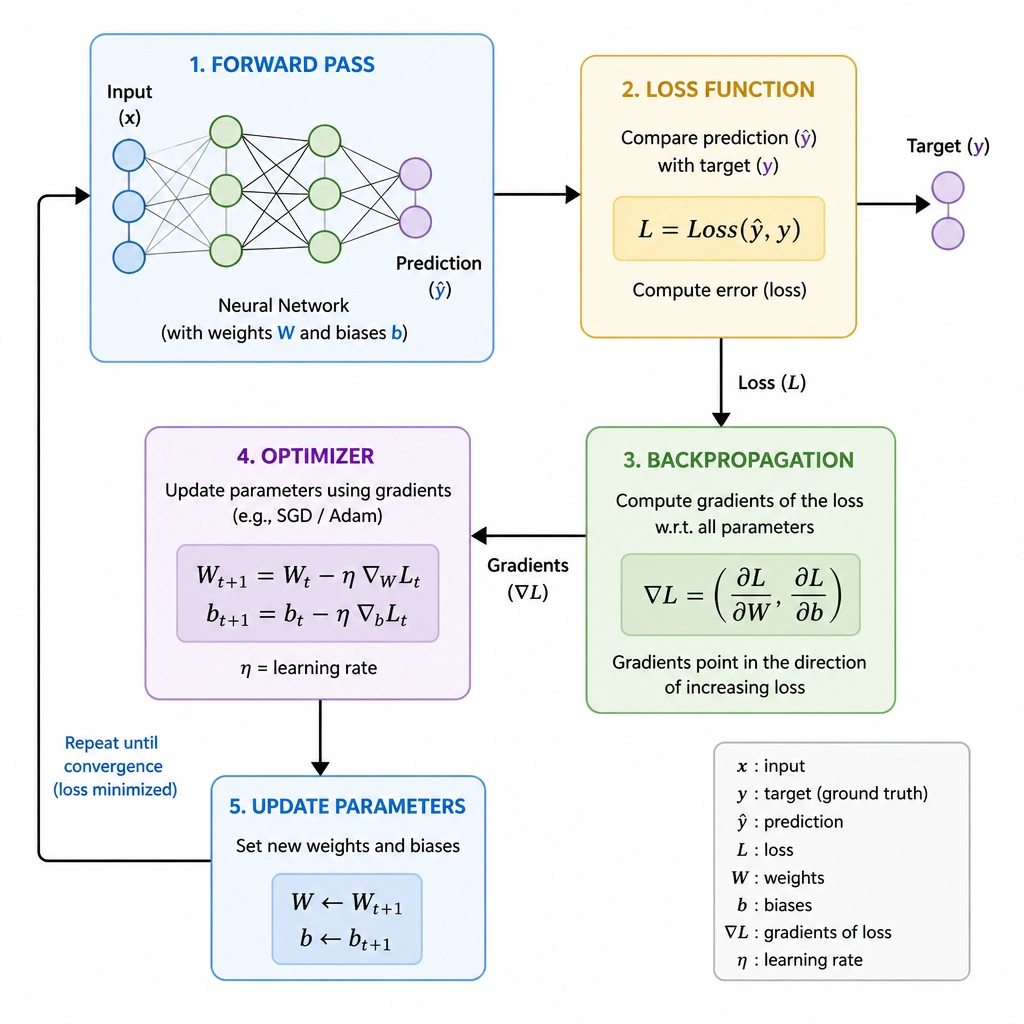
Imagine you're blindfolded on a foggy mountain and you want to find your way down to the valley. The loss function is like a device that tells you your current elevation—it tells you how high up (or how wrong) you are. But knowing you're high up doesn't tell you which way to step! The optimizer is your guide. It takes the slope of the hill (the gradient) and decides exactly how to adjust your steps—or in a neural network, how to update the weights and biases. Popular optimizers like Adam, RMSprop, or Stochastic Gradient Descent (SGD) use different mathematical strategies to guide the weights down the slope as quickly and smoothly as possible. Without an optimizer, your network would just sit there calculating errors without ever learning how to fix them!
Full explanation below image
Full Explanation
In a neural network, training is formulated as an optimization problem where the goal is to find the set of parameters (weights and biases) that minimizes a loss function. The training loop consists of three main steps: the forward pass (generating predictions and calculating the loss), the backward pass (calculating the gradients of the loss with respect to the parameters via backpropagation), and the parameter update. The optimizer is the algorithm responsible for the parameter update step. It uses the gradients computed during backpropagation to determine how the weights and biases should be adjusted. Different optimizers use different strategies to update parameters. Stochastic Gradient Descent (SGD) updates weights by subtracting a fraction of the gradient (controlled by the learning rate). Adam (Adaptive Moment Estimation) maintains adaptive learning rates for each parameter by calculating estimates of the first and second moments of the gradients. Non-linear transformations are performed by activation functions, not optimizers. Evaluating validation accuracy is a validation step, and early stopping is an optimization constraint, but not the role of the optimizer algorithm itself. Calculating the loss function is done by loss functions (like Mean Squared Error or Cross-Entropy), which measure error but do not update the weights. Therefore, the main purpose of the optimizer is to update weights and biases to minimize the loss.