After deploying a machine learning model to predict customer churn, the engineering team notices that the model's prediction accuracy has slowly declined over several months, even though the model code and serving infrastructure have not changed. What is this phenomenon called, and what typically causes it?
Select an answer to reveal the explanation.
Short Explanation and Infographic
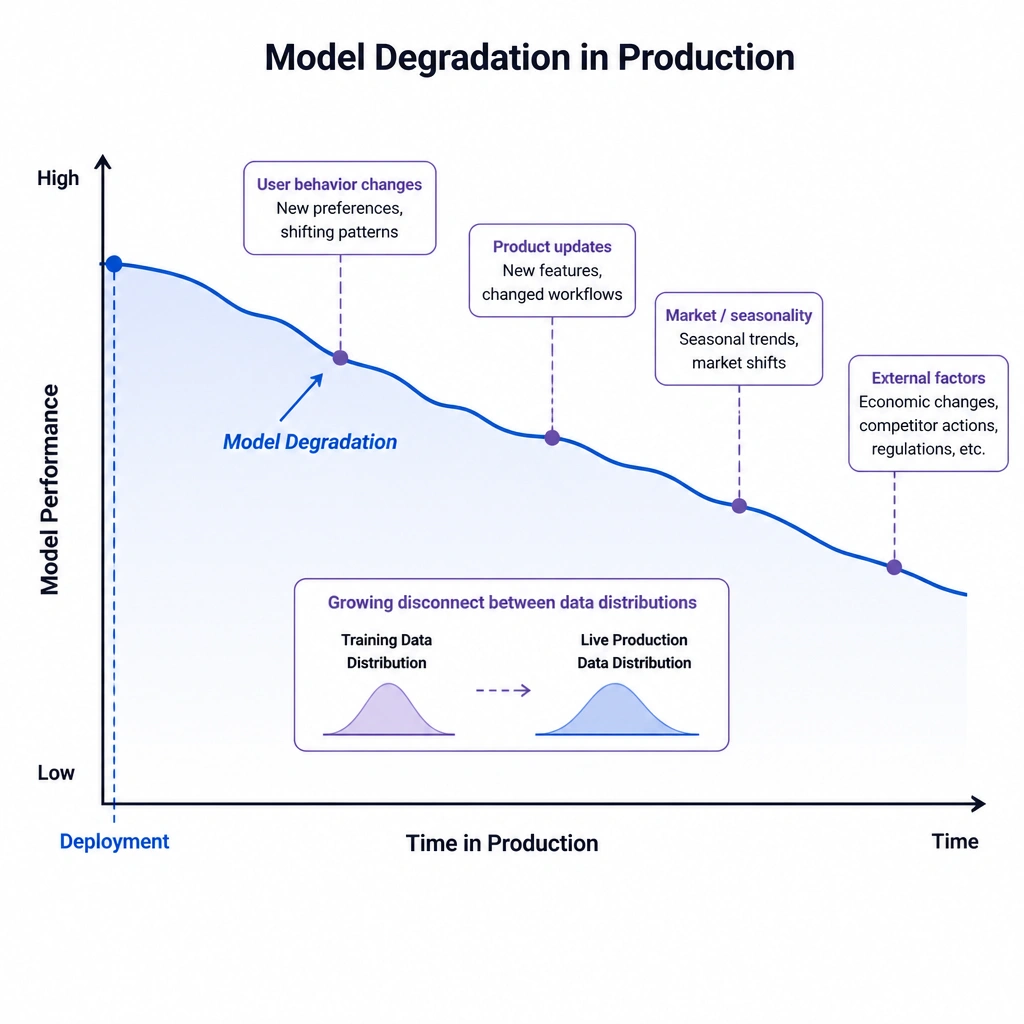
Let me show you how this works in the real world. You build a model, you train it, and it performs beautifully. You deploy it to production, throw a party, and walk away. But here's the deal: the real world doesn't stand still. People change their habits, trends shift, and the data your model sees next month might look completely different from the data you used to train it last year. This is what we call model degradation or model drift. Think of it like a map of a city—if they build new roads and tear down old buildings, that map becomes less useful every day. Your model's accuracy drops because the relationship between the inputs and the target has changed. To fix this, you have to monitor your model and periodically retrain it with fresh data. Never just deploy and forget!
Full explanation below image
Full Explanation
Model degradation (often caused by data drift or concept drift) refers to the decline in a machine learning model's predictive performance after it has been deployed to production. When a model is trained, it learns statistical patterns based on a snapshot of historical data. However, in production, the distribution of incoming feature data (data drift) or the underlying relationship between the features and the target variable (concept drift) can change over time. For example, a model predicting consumer spending habits might degrade during an economic recession because the historical training data no longer reflects current spending behavior. Because the model's static rules no longer align with real-world dynamics, its accuracy, precision, or recall will drop. To prevent model degradation, MLOps teams implement continuous monitoring to detect drift and set up pipelines to retrain models using updated datasets. Refactoring refers to clean-up of code structure without changing its external behavior, not a natural drop in model performance. Overfitting is a training-time issue where the model performs well on training data but poorly on unseen test data from the start, rather than a gradual decline in production performance over time. Model compression is an intentional engineering process (like quantization or pruning) to reduce the model's footprint, not an unintended performance drop. Therefore, model degradation refers to the decrease in performance over time due to shifts in data relationships.