To promote transparency, accountability, and ethical use of artificial intelligence, an AI development team publishes a "Model Card" alongside their newly trained computer vision model. What is the primary purpose of a Model Card?
Select an answer to reveal the explanation.
Short Explanation and Infographic
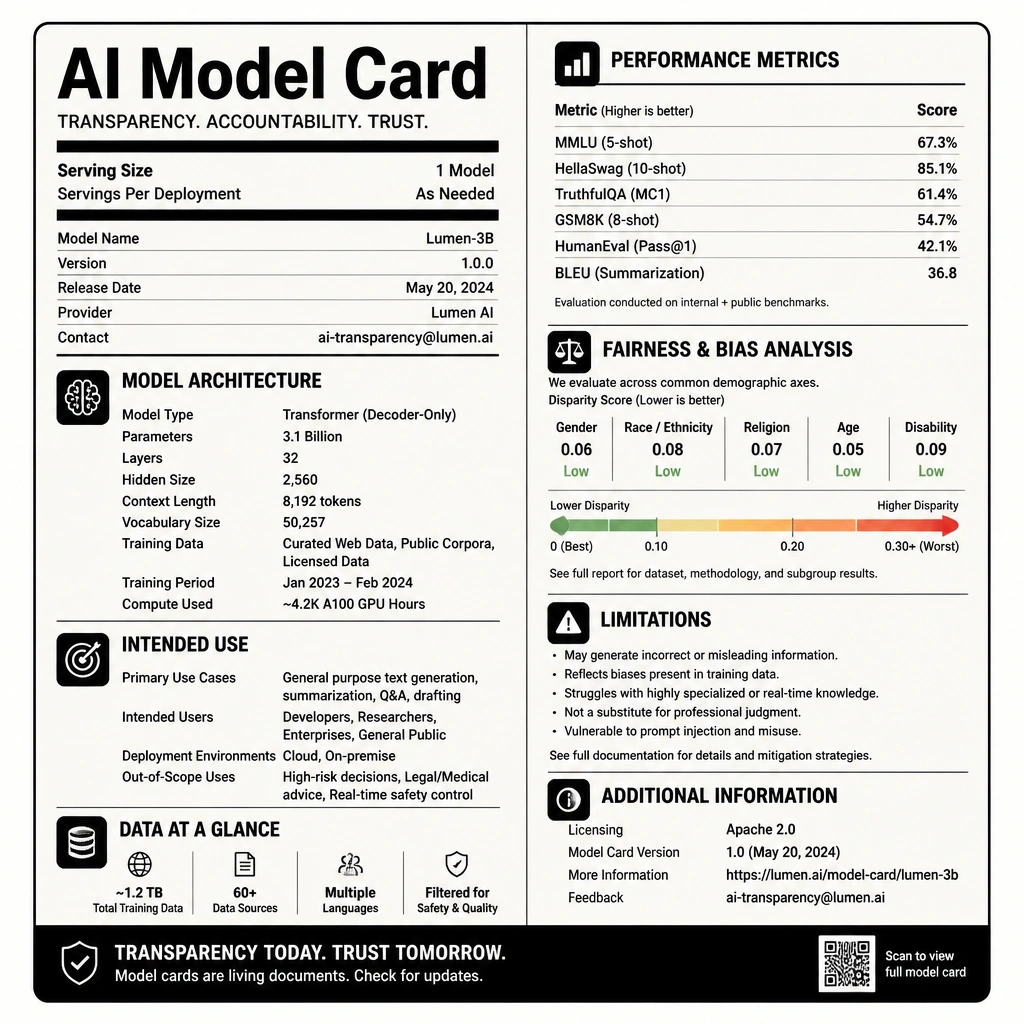
Here's the deal: if you buy a new car, it comes with a manual that tells you what fuel to use, how much it can tow, and where the safety features are. In the AI world, we need something similar to make sure models are used responsibly. That's what a Model Card is. It's a short, transparent document that tells you exactly what the model was built for, where it shouldn't be used, how it performs on different groups of people, and any biases we found during testing. Think of it like a nutrition label for your AI model. It doesn't show you the code or the neural network architecture, and it's definitely not a credit card! It's all about ethical AI and transparency so developers know what they're getting into before they deploy it.
Full explanation below image
Full Explanation
A Model Card is a short document designed to promote transparency, accountability, and responsible AI deployment. The primary goal is to provide a standardized framework for reporting the characteristics, performance, and limitations of machine learning models. A typical Model Card contains key sections including model details (developer, version, license), intended use cases (primary tasks, out-of-scope uses), factors (demographics or environmental factors that might affect performance), metrics (evaluation metrics and why they were chosen), data (information about training and evaluation datasets), quantitative analyses (performance results segmented by demographics to check for fairness), and ethical considerations (risks, privacy concerns). By providing this structured information, Model Cards help downstream users determine if a model is suitable and safe for their specific application, reducing the risk of unintended bias or ethical violations. A diagram of the model architecture is a system block diagram, not a Model Card. A digital payment credential or credit card is a financial instrument. A physical printout of source code is just code documentation, not an ethical reporting framework. Therefore, a Model Card is a document detailing model characteristics, performance, and limitations to promote transparency.