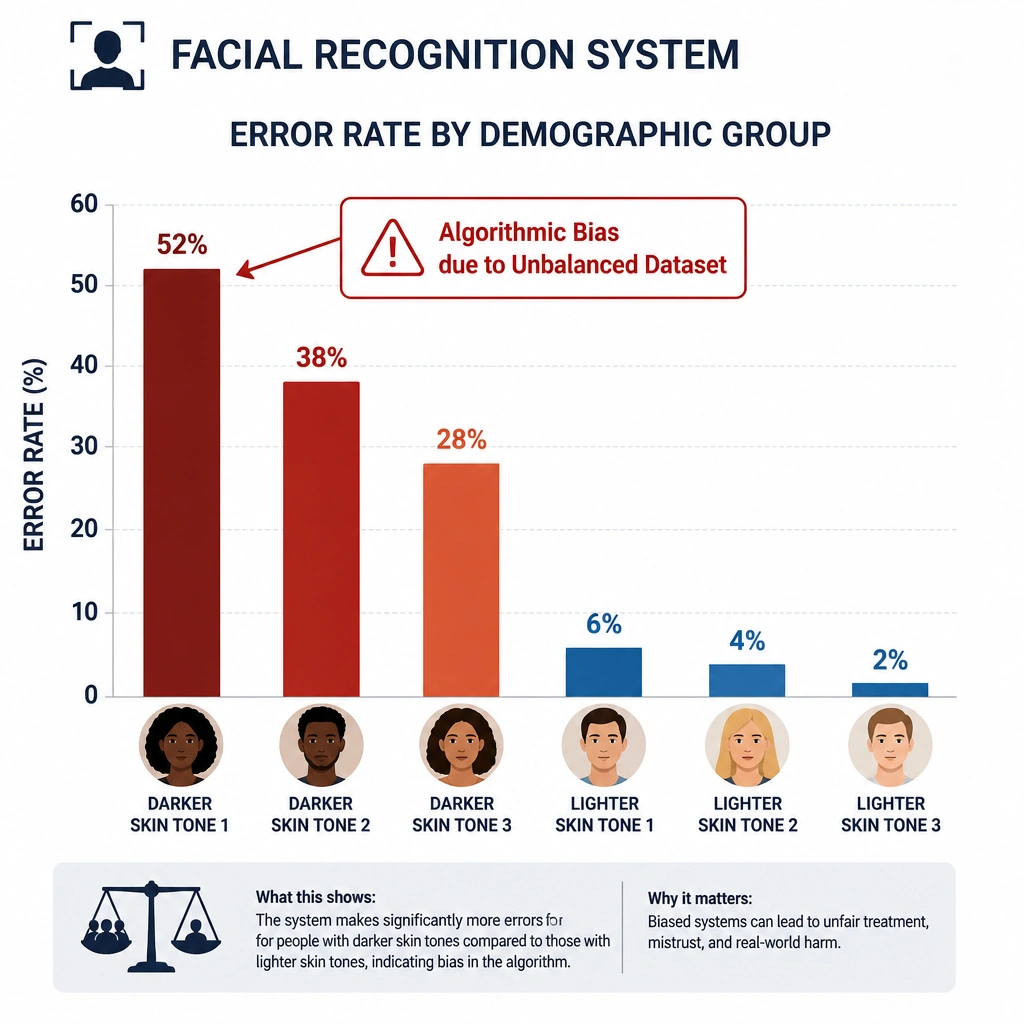
A facial recognition system deployed for identity verification is found to perform poorly and have lower accuracy when processing images of individuals with darker skin tones compared to those with lighter skin tones. What ethical and technical concern does this scenario demonstrate?
Select an answer to reveal the explanation.
Short Explanation and Infographic
Okay, let's dive in. If a facial recognition system works great on light-skinned users but fails miserably on dark-skinned users, that is a textbook case of algorithmic bias. Think of it like a camera sensor that was only calibrated in broad daylight—it's going to fail in the shade. Why does this happen? Usually, it's because the engineers who built the system trained the model on a dataset that was heavily skewed, using mostly photos of lighter-skinned individuals. The algorithm simply didn't get enough examples to learn how to identify darker faces properly. Don't confuse this with data privacy, which is about protecting user consent and storage, or explainability, which is about understanding how a model makes decisions. When a system performs poorly for one specific group of people due to unbalanced training, that is bias in the algorithm. Trust me, you need to watch out for this in production! Let's keep rolling.
Full explanation below image
Full Explanation
The scenario described—where a facial recognition algorithm exhibits disparate error rates across different demographic groups—is a clear manifestation of algorithmic bias. Algorithmic bias refers to systematic and repeatable errors in a computer system that create unfair outcomes, such as privileging one group over another. In computer vision, this issue frequently traces back to the training phase. If the dataset used to train the neural network is dominated by images of a specific demographic (e.g., lighter-skinned individuals), the network will fail to learn the fine-grained facial features and contrast variations necessary to accurately recognize individuals from underrepresented groups. This issue gained widespread attention through studies like 'Gender Shades', which highlighted how commercial facial analysis technologies performed worst on darker-skinned females. Addressing algorithmic bias requires compiling highly diverse, balanced, and representative benchmarks and training sets. Let's analyze the incorrect options: data privacy concerns relate to how personal data is collected, stored, and shared under regulations like GDPR, which is a different ethical issue; a lack of data drift refers to data distributions remaining constant over time, which is a statistical characteristic rather than an ethical concern; explainability (or interpretability) refers to the ability to explain the internal logic and decision-making process of a model to human operators. While deep learning models suffer from explainability challenges, the performance discrepancy based on skin tone is a direct consequence of dataset imbalance and algorithmic bias.