In a binary classification problem (such as identifying fraudulent transactions), what is the key distinction between the precision and recall performance metrics?
Select an answer to reveal the explanation.
Short Explanation and Infographic
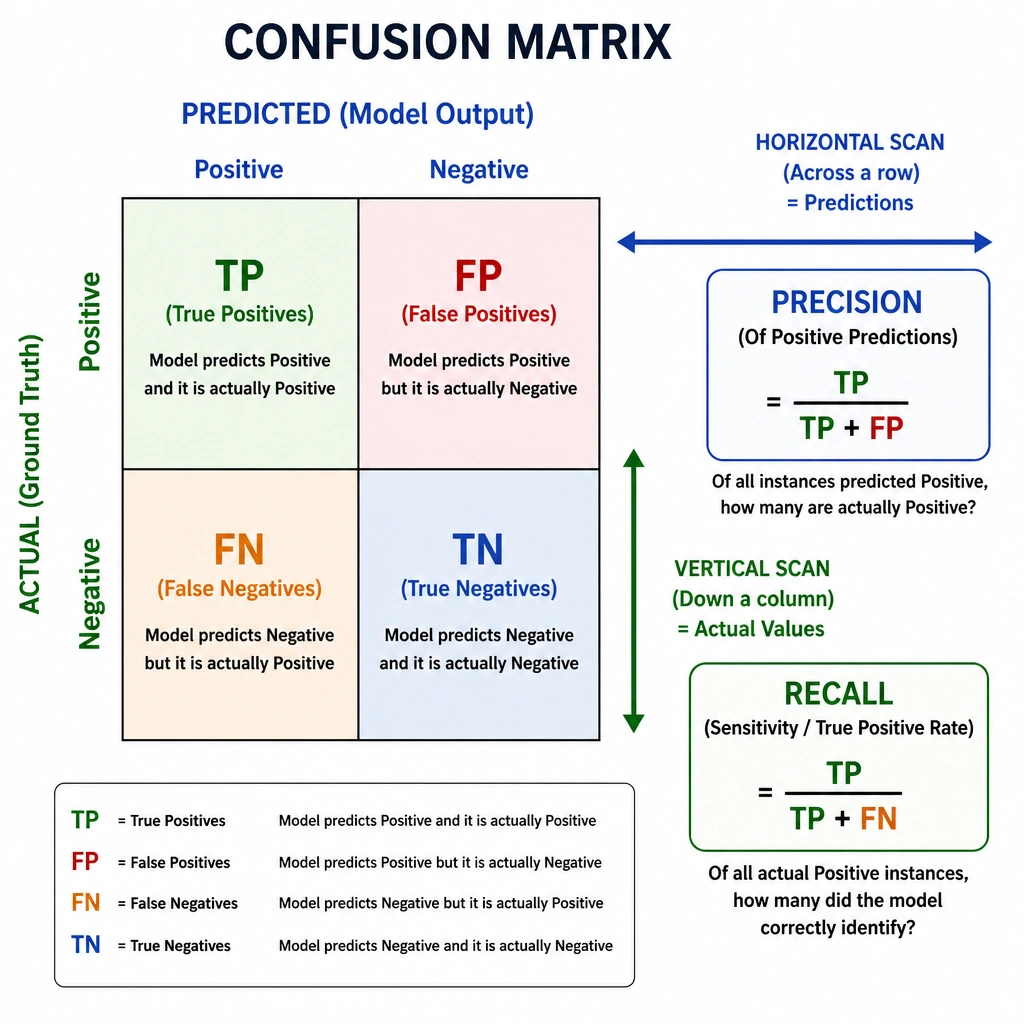
Here's the deal: precision and recall are two of the most confused metrics in machine learning, and they will absolutely show up on your exam. Think of it like a security guard at an airport. If the guard stops everyone who walks by, they're going to catch every single bad guy. That's 100% recall—they didn't miss any actual threats. But their precision is terrible because almost everyone they stopped was innocent! Now, if the guard only stops people they are 99% sure are bad guys, their precision is super high. But they'll miss a lot of bad guys who slipped through—low recall. Precision is all about quality: 'Out of all the positive predictions I made, how many were actually correct?' Recall is all about quantity: 'Out of all the actual positives in the dataset, how many did I manage to catch?' You've got to balance both depending on your project. Got it? Sweet.
Full explanation below image
Full Explanation
In classification tasks, accuracy can be highly misleading when dealing with imbalanced datasets (e.g., detecting rare diseases or credit card fraud). Therefore, machine learning practitioners rely on precision and recall, which are calculated using the components of a confusion matrix: True Positives (TP), False Positives (FP), and False Negatives (FN). Precision (also known as Positive Predictive Value) measures the exactness of the model. Mathematically, it is defined as Precision = TP / (TP + FP). It answers the question: 'Of all instances that the model classified as positive, what fraction actually belonged to the positive class?' High precision is crucial when the cost of a false positive is very high, such as in email spam filters where you do not want legitimate emails incorrectly blocked. Recall (also known as Sensitivity or True Positive Rate) measures the completeness of the model. Mathematically, it is defined as Recall = TP / (TP + FN). It answers the question: 'Of all the actual positive instances present in the dataset, what fraction did the model successfully identify?' High recall is critical when the cost of a false negative is unacceptable, such as in medical screening where missing a sick patient can be life-threatening. Let's analyze why other options are incorrect: regression models use metrics like Root Mean Squared Error (RMSE), not classification metrics like precision and recall; they are not mathematically identical, as precision focuses on false positives while recall focuses on false negatives; training time and inference speed are hardware and computational metrics, completely unrelated to these classification quality metrics.