An organization discovers that its automated AI recruiting model displays systemic bias against certain groups of applicants. What is the most effective approach to mitigate this issue?
Select an answer to reveal the explanation.
Short Explanation and Infographic
Check this out: if you feed an AI model recruiting data from the last 20 years, and that history was biased, your model is going to learn to copy those exact same biases. That's a classic example of 'garbage in, garbage out.' If you want to fix it, swapping languages from Python to Go or hiding the audit reports isn't going to do a thing. You've got to fix the root cause—the data! Think of it like training a runner with a bad diet; you have to change what they're eating. You need to retrain that model using a diverse, balanced dataset that represents everyone fairly. And you don't just deploy it and walk away. You need to set up fairness monitors to audit the model's decisions continuously and catch any new bias before it hurts real people. Trust me, ethics in AI is a huge topic on the exam and in the real world, so make sure you focus on data quality and ongoing monitoring. Let's keep rolling!
Full explanation below image
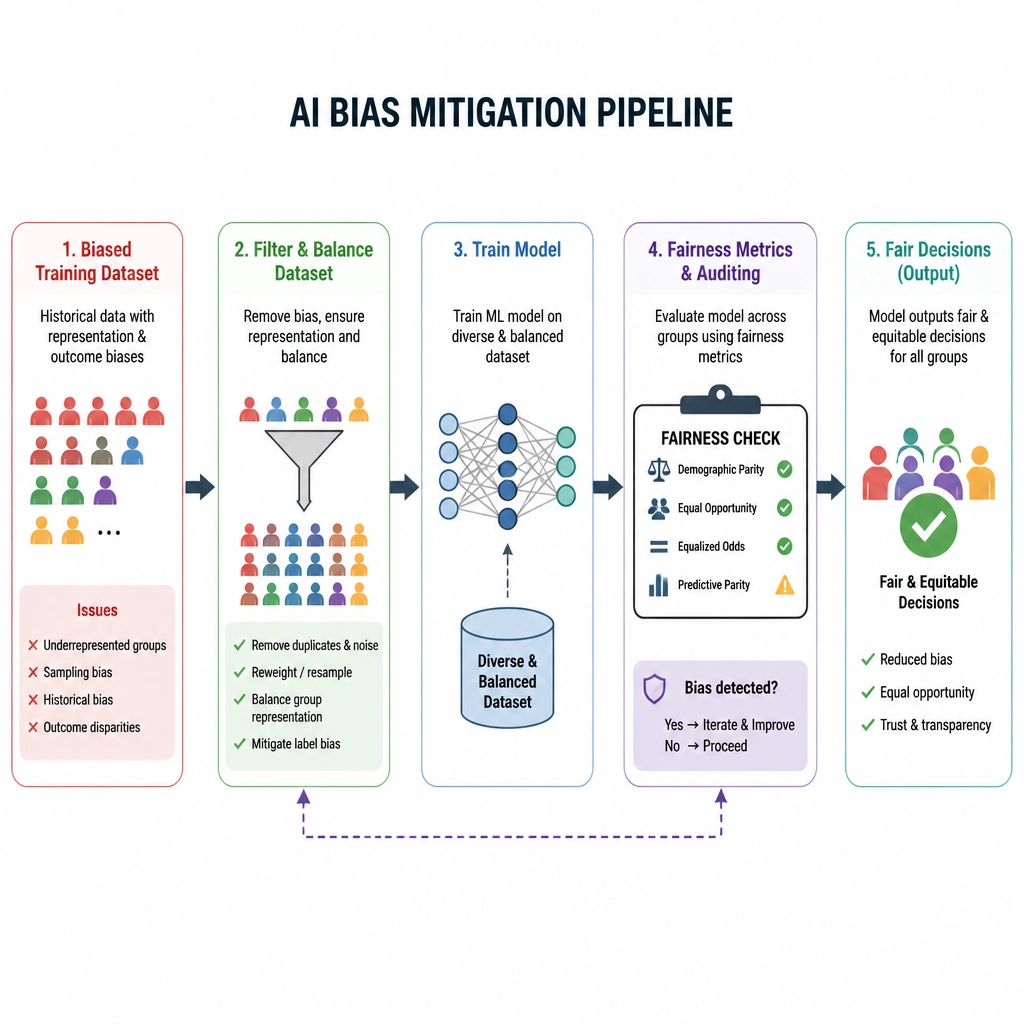
Full Explanation
Algorithmic bias in machine learning occurs when a model produces systematically unfavorable outcomes for specific groups, often reflecting historical human biases present in the training data. In recruitment systems, if historical hiring decisions favored a particular demographic, the model will learn those patterns as predictive features, leading to discrimination. The most effective technical and ethical mitigation strategy is to address the underlying data quality and establish ongoing governance. This involves retraining the model on a dataset that has been carefully balanced and curated to ensure representative diversity across all relevant demographic groups. In addition to data curation, engineers must implement fairness-aware machine learning techniques, such as pre-processing (reweighing data), in-processing (adding fairness constraints to the loss function), or post-processing (adjusting decision thresholds). Furthermore, continuous monitoring and auditing are essential because data distributions and user behavior change over time, which can introduce feedback loops that reinstate bias. Let's examine why the other choices are incorrect: changing the programming language does not affect the model's mathematical behavior or training data; hiding user or system bias is unethical and does not solve the underlying algorithmic issue; deleting the model entirely without addressing the systemic issue fails to build organizational capability or solve the business need, and doesn't investigate the core cause of the bias. Therefore, retraining with balanced datasets combined with continuous fairness auditing is the correct approach to mitigate algorithmic bias.