
An autonomous vehicle manufacturer is designing the emergency collision avoidance module for its self-driving system. What represents the primary ethical consideration that developers and policy makers must address for this critical AI application?
Select an answer to reveal the explanation.
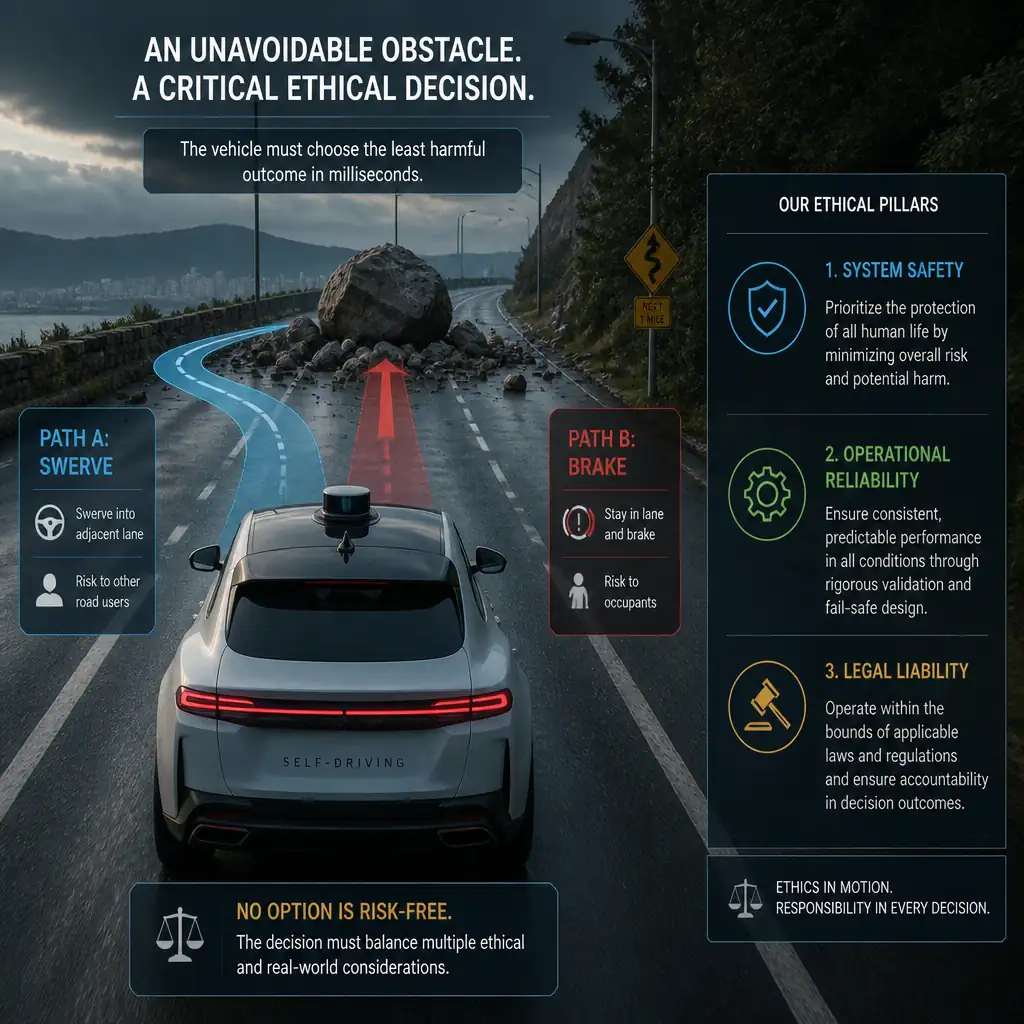
Short Explanation
When you're building an autonomous vehicle, the big ethical issue is what happens when a crash is unavoidable: safety, reliability, and liability. You can't let speed, training data, or cloud costs distract you from protecting human lives and deciding who's accountable.
Full Explanation
When developing AI for safety-critical systems like autonomous vehicles, the primary ethical considerations center on safety, reliability, and liability. Because these systems make decisions in physical environments where human lives are at risk, they must be engineered to minimize harm and operate reliably under unpredictable conditions. The system's safety, reliability, and the determination of liability in the event of an unavoidable accident is correct because developers must address moral decision-making frameworks, such as how the vehicle prioritizes human lives during an unavoidable collision, and establish clear lines of legal and ethical liability among software engineers, manufacturers, and owners. The computational latency of processing real-time sensor streams on edge hardware is a technical engineering constraint, not an ethical consideration. The size and composition of the dataset required to train the object detection model is also a technical engineering constraint, not an ethical consideration. The financial cost of using cloud-based high-performance computing clusters for model training is a business constraint, secondary to the primary ethical duty of protecting human life.