
A Natural Language Processing (NLP) engineer is upgrading a search query parser from a Bag-of-Words (BoW) approach to pre-trained word embeddings. What is the fundamental advantage of utilizing word embeddings over the traditional Bag-of-Words representation?
Select an answer to reveal the explanation.
Short Explanation
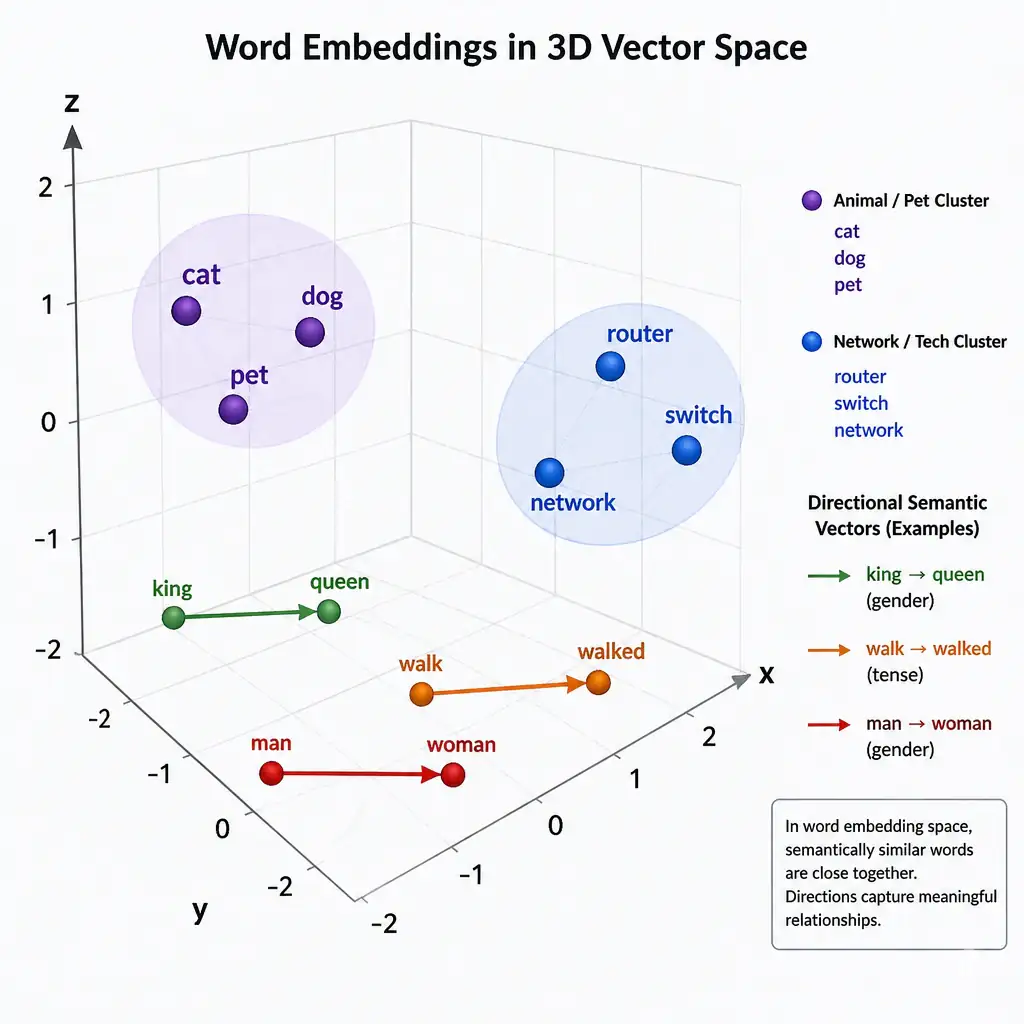
You're moving from a giant vocabulary checklist to vectors that actually know words are related. Word embeddings map words into a continuous vector space, so similar meanings and syntactic roles sit close together. That lets your parser generalize from 'gigabit' to 'megabit' instead of treating every word as an isolated count.
Full Explanation
Word embeddings represent a major advancement over traditional bag-of-words representations in NLP. Bag-of-words models represent words as discrete, high-dimensional, and sparse vectors where the distance between any two different words is identical, ignoring all semantic relationships. The correct advantage is that word embeddings, such as Word2Vec or GloVe, map words to dense, low-dimensional vectors in a continuous space. Words with similar meanings or syntactic roles are positioned close to one another. This geometric proximity allows the model to capture semantic and syntactic relationships, enabling better generalization on unseen text. The claim that word embeddings are highly interpretable because they represent documents using simple sparse matrices of word counts is incorrect because sparse matrices of word counts are the defining characteristic of bag-of-words, not word embeddings, and embeddings are generally less interpretable than direct frequency counts. The claim that word embeddings are faster to generate and require significantly less computational power during training is incorrect because generating and processing dense embeddings involves multi-dimensional vector computations, which require more computational power than bag-of-words. The claim that word embeddings reduce storage requirements by representing text documents as small integer lists is incorrect because storing pre-trained embedding tables, often containing hundreds of dimensions per word for millions of words, requires substantial memory and storage space.