
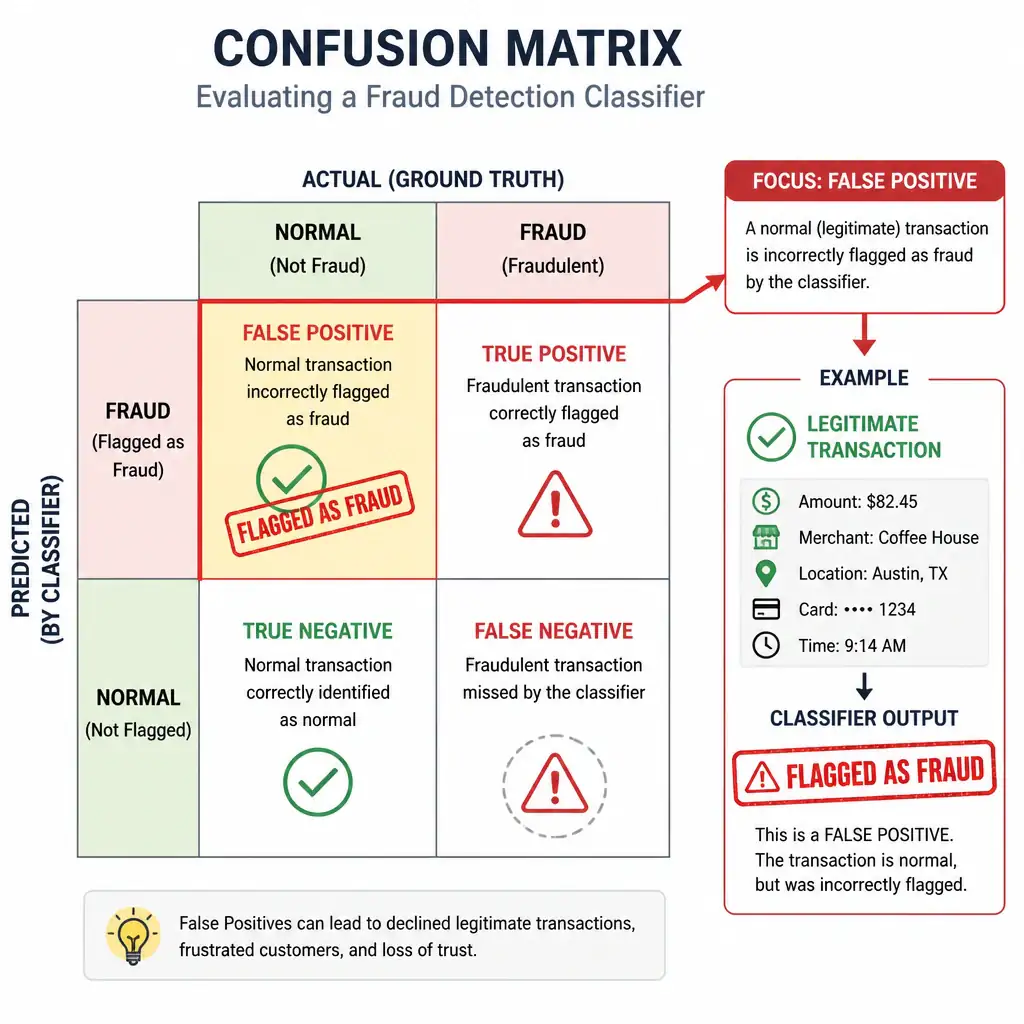
An engineering team is evaluating a binary classification model designed to flag fraudulent financial transactions. During testing, the model flags a completely legitimate purchase made by a user as "fraudulent," resulting in the user's card being temporarily blocked. What type of classification error does this event represent?
Select an answer to reveal the explanation.
Short Explanation
Think of it like a home security system screaming at 2 AM, only to find it was just your cat knocking over a plant. That's a false positive, and here the model screams 'Fraud!' on a completely normal purchase. It's super annoying for the customer, but it's not the false negative where the model sleeps through a real thief.
Full Explanation
In binary classification, model predictions are analyzed using a confusion matrix consisting of four categories: true positives, true negatives, false positives, and false negatives. In this domain, the positive class is the target event we want to detect (fraudulent transaction), and the negative class is the normal state (legitimate transaction). The false positive choice is correct because the model predicted the positive class (fraudulent) for an instance that is actually of the negative class (legitimate). This is also referred to as a Type I error. The false negative choice is incorrect because a false negative occurs when the model predicts the negative class (legitimate) for an instance that is actually positive (fraudulent), representing a missed detection (Type II error). The true negative choice is incorrect because a true negative occurs when the model correctly identifies a legitimate transaction as legitimate. The true positive choice is incorrect because a true positive occurs when the model correctly identifies a fraudulent transaction as fraudulent.