
You are building a machine learning model to predict customer churn. Which of the following activities is an example of feature engineering?
Select an answer to reveal the explanation.
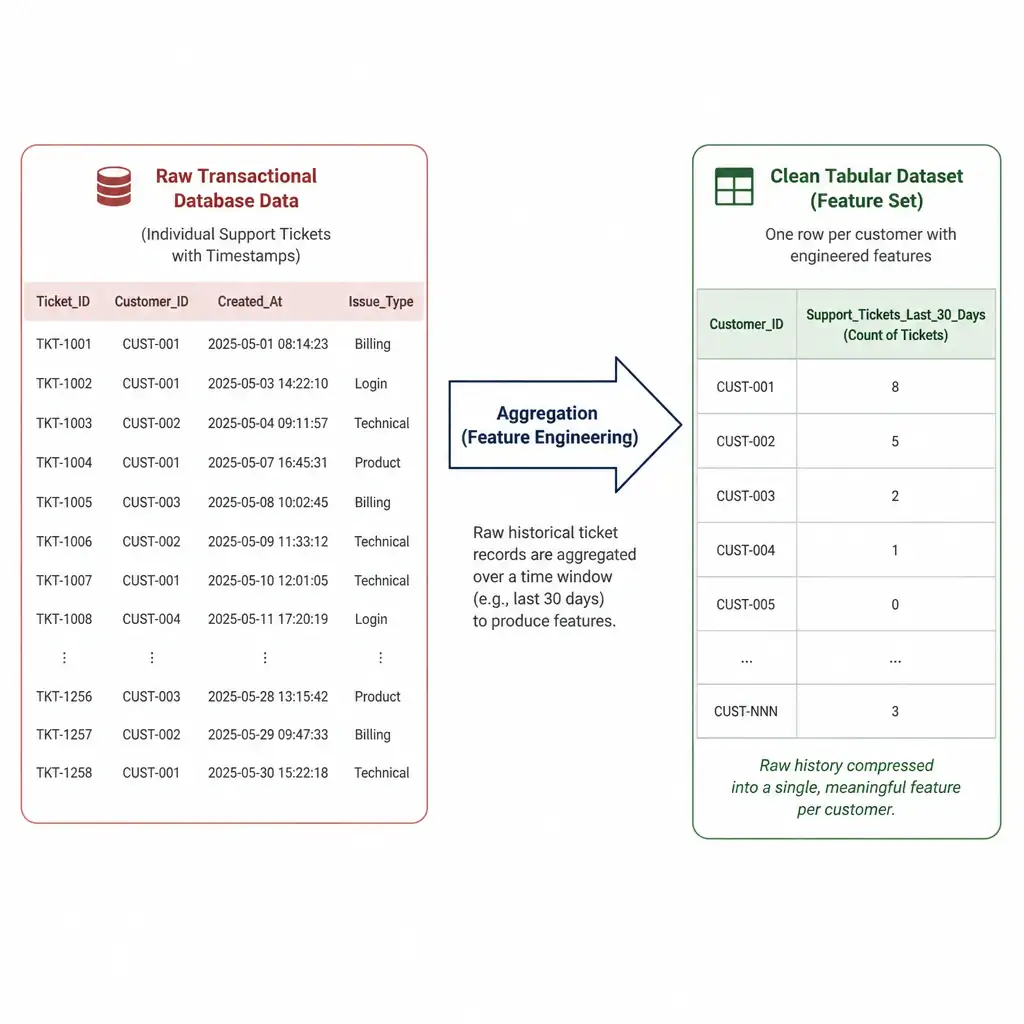
Short Explanation
Think of it like this: if you want your model to predict whether a customer is going to cancel their subscription, feeding it raw, messy logs isn't going to help. Feature engineering is the art of turning raw data into meaningful signals that the model can actually understand. If you take a customer's individual support tickets over the last month and roll them up into a single number—like 'total support calls in 30 days'—you've created a powerful new input feature.
Full Explanation
Feature engineering is the process of transforming raw data into structured features, or predictors, that better represent the underlying problem to the predictive model, thereby improving its accuracy. In machine learning tasks like customer churn prediction, the raw data is often stored in event logs, such as timestamps of user logins, clicks, or customer support submissions. A tabular machine learning algorithm, such as XGBoost or Random Forest, cannot process these unstructured logs directly. By aggregating these logs—for example, calculating the sum of customer support tickets submitted by a user over the past 30 days—the developer extracts a highly informative, structured predictor variable that represents customer friction. This numeric feature correlates directly with the probability of churn and can be easily processed by the classifier. The correct activity is therefore creating a new metric representing the count of customer support tickets submitted by a user over the past 30 days. Deploying the finalized model as a REST API endpoint in a cloud environment is incorrect because it is a deployment and software engineering task that makes the model accessible to client applications, but it does not involve feature creation or manipulation. Implementing a dashboard to monitor prediction latency and feature drift is incorrect because it is an MLOps operational monitoring task performed post-deployment to ensure model health and reliability. Serializing the model weights and saving the output file to a registry is incorrect because it is an artifact management and version control task, which is completely separate from the process of engineering input data features.