
When working with Large Language Models (LLMs), what is the primary objective of performing fine-tuning on a pre-trained base model?
Select an answer to reveal the explanation.
Short Explanation
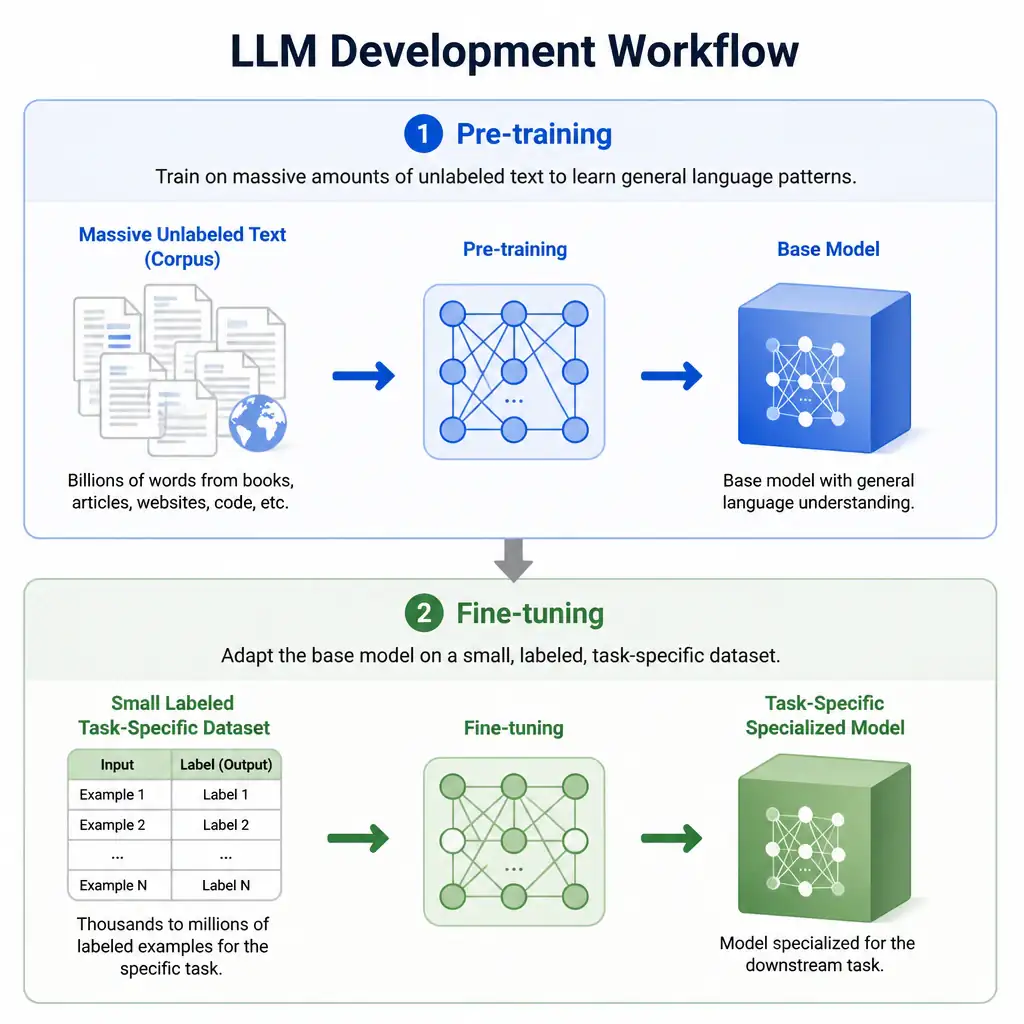
Here's the deal: a pre-trained LLM already knows general language, so you fine-tune it on a smaller, task-specific dataset to sharpen it for a job. You're not starting from scratch, adding layers, or deleting weights.
Full Explanation
Fine-tuning is a critical transfer learning technique in natural language processing (NLP) and Large Language Model (LLM) engineering. During the initial pre-training phase, an LLM is trained on a massive, unstructured corpus of text (often containing trillions of words) using self-supervised learning. This allows the base model to develop a deep, general-purpose understanding of grammar, syntax, reasoning, and world knowledge. However, because it is general, the base model is not optimized for specific tasks or business domains. The correct objective is to adapt the model's pre-existing, general language understanding to a specific downstream task using a smaller, specialized dataset. Fine-tuning adapts this pre-trained base model by training it further on a much smaller, high-quality, task-specific dataset (such as customer service chats, financial reports, or code repositories). This process adjusts the model's weights to optimize its behavior, tone, and output format for the target downstream task, requiring only a fraction of the time and computational budget needed for pre-training. The approach of training the model's weights from a completely random initialization using a massive corpus of raw web text is incorrect because that describes pre-training. Pre-training is highly resource-intensive and requires enormous quantities of raw text, whereas fine-tuning leverages an existing base model. The approach of physically expanding the network's architecture by adding new layers and parameters is incorrect because standard fine-tuning updates the weights of the existing neural network architecture without altering its physical structure, such as adding extra hidden layers or increasing the baseline parameter count. The approach of deleting a large portion of the model's weights and layers to reduce its memory footprint is incorrect because that is pruning. Pruning is a model compression technique designed to optimize inference speed and reduce storage requirements, which is distinct from fine-tuning.