
In the context of artificial intelligence ethics and deployment, what does the term "algorithmic bias" describe?
Select an answer to reveal the explanation.
Short Explanation
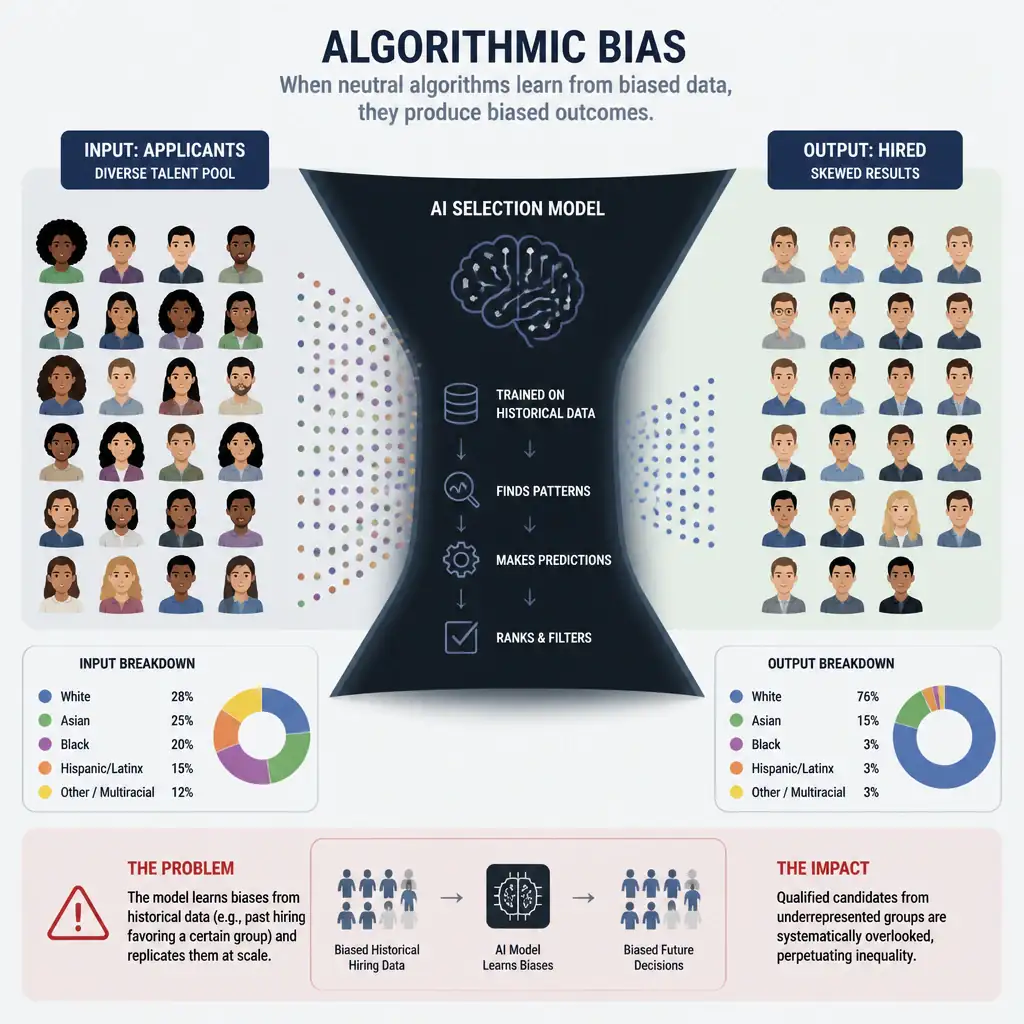
If your automated hiring tool keeps ignoring resumes from a specific demographic, that's algorithmic bias. It's not a programmer hardcoding a mean line of code; it's the system learning unfair patterns from biased data. You fix it by auditing data and checking fairness.
Full Explanation
Algorithmic bias is a significant ethical and operational concern in artificial intelligence deployments. It occurs when a machine learning model produces outputs that systematically and unfairly disadvantage specific demographics or protected groups. This bias typically originates from the training data itself. If the historical data used to train the model contains human prejudices, unrepresentative sampling, or societal inequities, the model will identify and learn these patterns as mathematical rules, thereby reinforcing and replicating them at scale. Common examples include automated hiring algorithms that favor male candidates because historical hires were predominantly male, or facial recognition systems with higher error rates for darker skin tones because the training image set lacked diversity. Correcting algorithmic bias requires continuous data auditing, fairness-aware optimization metrics, and representative dataset curation. The incorrect choices are: the technical trade-off between a model's high bias and low variance is incorrect because the bias-variance trade-off is a fundamental mathematical concept in machine learning that balances a model's simplification assumptions (bias) against its sensitivity to training set fluctuations (variance); high bias in that context leads to underfitting, which is unrelated to demographic discrimination. The syntax error or hardcoded logical preference written directly into the source code is incorrect because algorithmic bias is rarely the result of a software engineer explicitly hardcoding discriminatory logic or syntax errors into the source code; it is an emergent property learned from biased training datasets. The tendency of a model to perform better on synthetic datasets than on real-world inputs is incorrect because performance differences between synthetic and real-world datasets refer to generalization challenges, domain adaptation, or covariate shift, rather than systemic demographic discrimination against human populations.