
What is the primary benefit that makes the Hugging Face Transformers library the industry standard for developing modern natural language processing (NLP) applications?
Select an answer to reveal the explanation.
Short Explanation
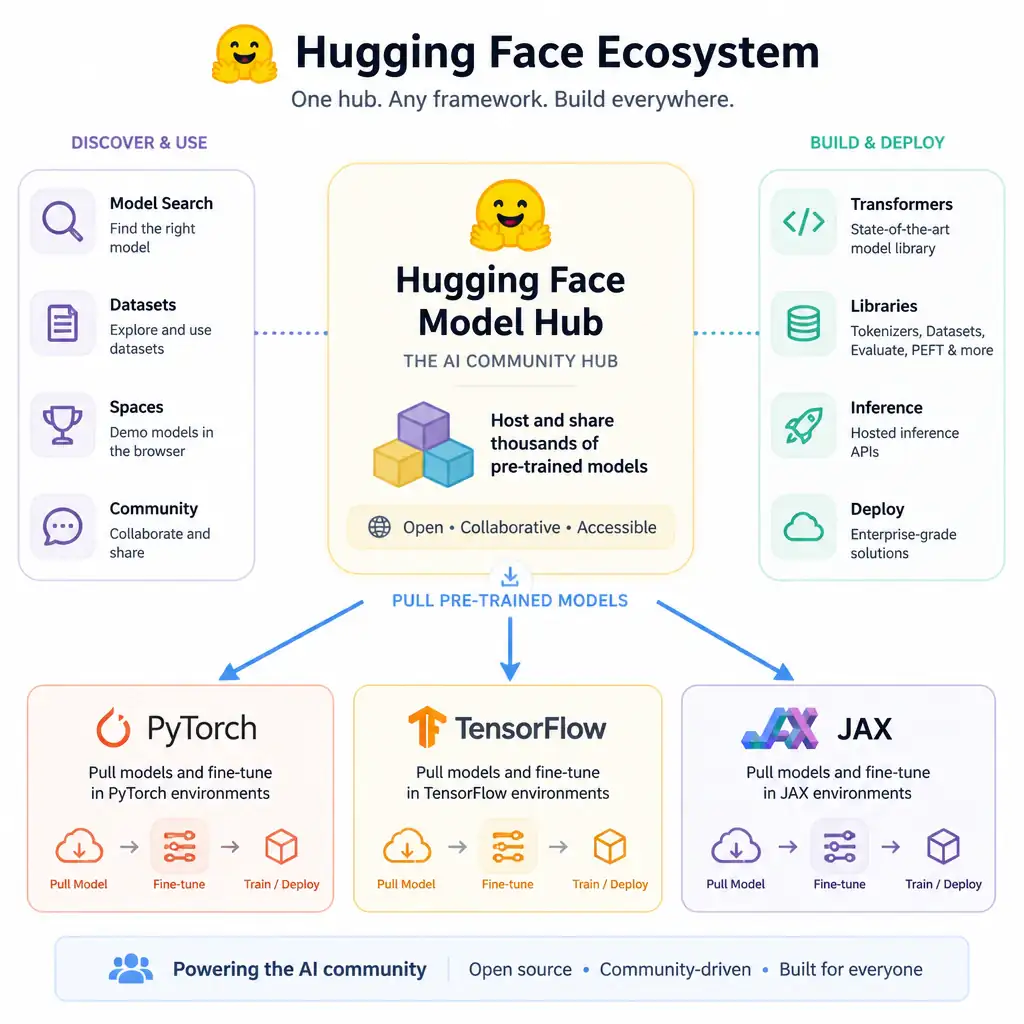
Here's the deal: training a modern large language model from scratch is incredibly expensive, so you want a library that hands you pre-trained models you can load, fine-tune, and share across PyTorch, TensorFlow, and JAX. That's why the vast repository of pre-trained models is the right answer. It saves you weeks of coding and avoids burning cash on GPU clusters.
Full Explanation
The Hugging Face Transformers library has become the industry-standard software library for natural language processing (NLP) and multimodal machine learning. Its primary value proposition is democratizing access to state-of-the-art transformer models (such as BERT, GPT, T5, RoBERTa, and Whisper) through a centralized repository called the Hugging Face Model Hub. Instead of requiring organizations to invest millions of dollars and massive GPU clusters to pre-train foundation models from scratch on billions of tokens, the library allows developers to download pre-trained weights with a few lines of code. Developers can then perform transfer learning, fine-tuning the model on a smaller, domain-specific dataset (such as medical documents or legal contracts) to achieve high accuracy with minimal compute. That is why the choice describing a vast repository of pre-trained models that can be easily loaded, fine-tuned, and shared across multiple deep learning frameworks is correct. The claim that it is locked to a single proprietary framework to ensure high-speed processing is incorrect because the Transformers library is designed from the ground up to be framework-agnostic. It features native, deep integration with PyTorch, TensorFlow, and JAX, allowing engineers to train and evaluate models in their preferred deep learning framework and easily convert models between them. The claim that it is a legacy library restricted to basic, rule-based text classification tasks is incorrect because Hugging Face is the modern industry leader in open-source AI models and frameworks, actively maintained and widely used for cutting-edge generative AI, rather than a legacy rule-based system. The claim that it guarantees zero-latency inference by compiling neural networks directly into machine assembly language is incorrect because the library does not compile neural networks directly to machine assembly code out of the box, nor does it guarantee zero-latency execution. Optimization for inference speed is typically handled by complementary tools like ONNX, TensorRT, or Hugging Face's Optimum library.