
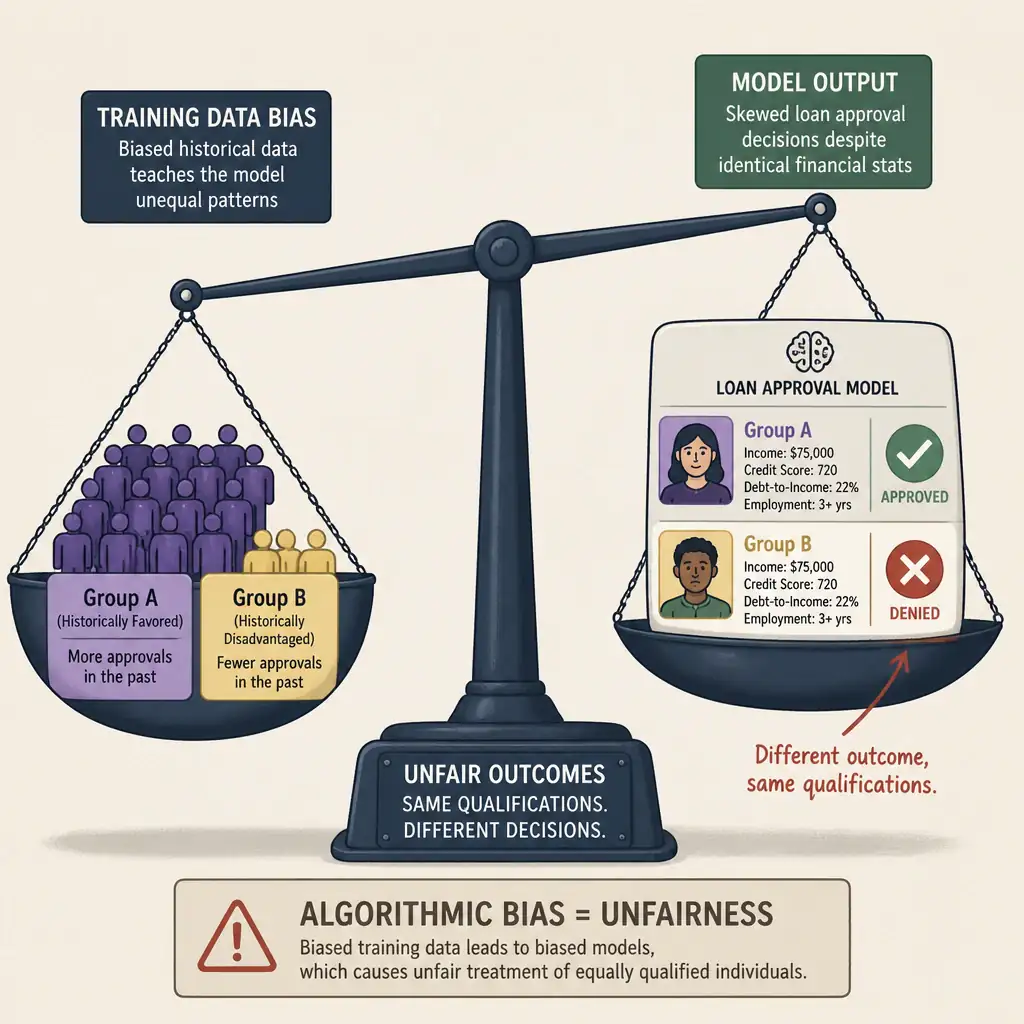
An automated loan approval model consistently rejects applications from a particular demographic group, despite those individuals having high credit scores and meeting all financial criteria. What ethical issue in artificial intelligence does this scenario illustrate?
Select an answer to reveal the explanation.
Short Explanation
Pay close attention here, because if your loan model keeps rejecting a demographic group even when they meet all financial criteria, you've got algorithmic bias. It's usually biased training data or proxy variables, not a security breach or an explainability problem. Audit your datasets and fairness tests before this lands you in hot water.
Full Explanation
Algorithmic bias occurs when a machine learning system reflects the implicit values, prejudices, or systemic inequities of the humans who created it or the historical data used to train it. In this scenario, the systematic denial of loans to a specific demographic group—despite their strong credit profiles—points to biased outcomes. This type of bias can stem from unrepresentative training datasets, historical prejudice embedded in past lending decisions, or the inclusion of variables that act as proxies for demographic identifiers, such as postal codes or educational institutions. Mitigating algorithmic bias requires rigorous fairness testing, data preprocessing, and bias mitigation algorithms during training.
The explainability-of-the-model concern refers to the ability to understand and interpret how a model arrives at its decisions, for example through feature-attribution methods such as SHAP or LIME. While an unexplainable model makes detecting bias difficult, the issue of unfair outcomes itself is classified as algorithmic bias. The data-security-vulnerabilities concern involves protecting the model and the underlying databases from unauthorized access, cyber threats, or malicious modifications. The loss-of-data-confidentiality concern focuses on ensuring that sensitive personal data is kept private and not disclosed to unauthorized parties, which is not the issue when the model produces biased predictions.