
Word embeddings like Word2Vec, GloVe, or FastText represent textual words as dense vector representations. How are these embeddings most commonly utilized in Natural Language Processing (NLP) workflows?
Select an answer to reveal the explanation.
Short Explanation
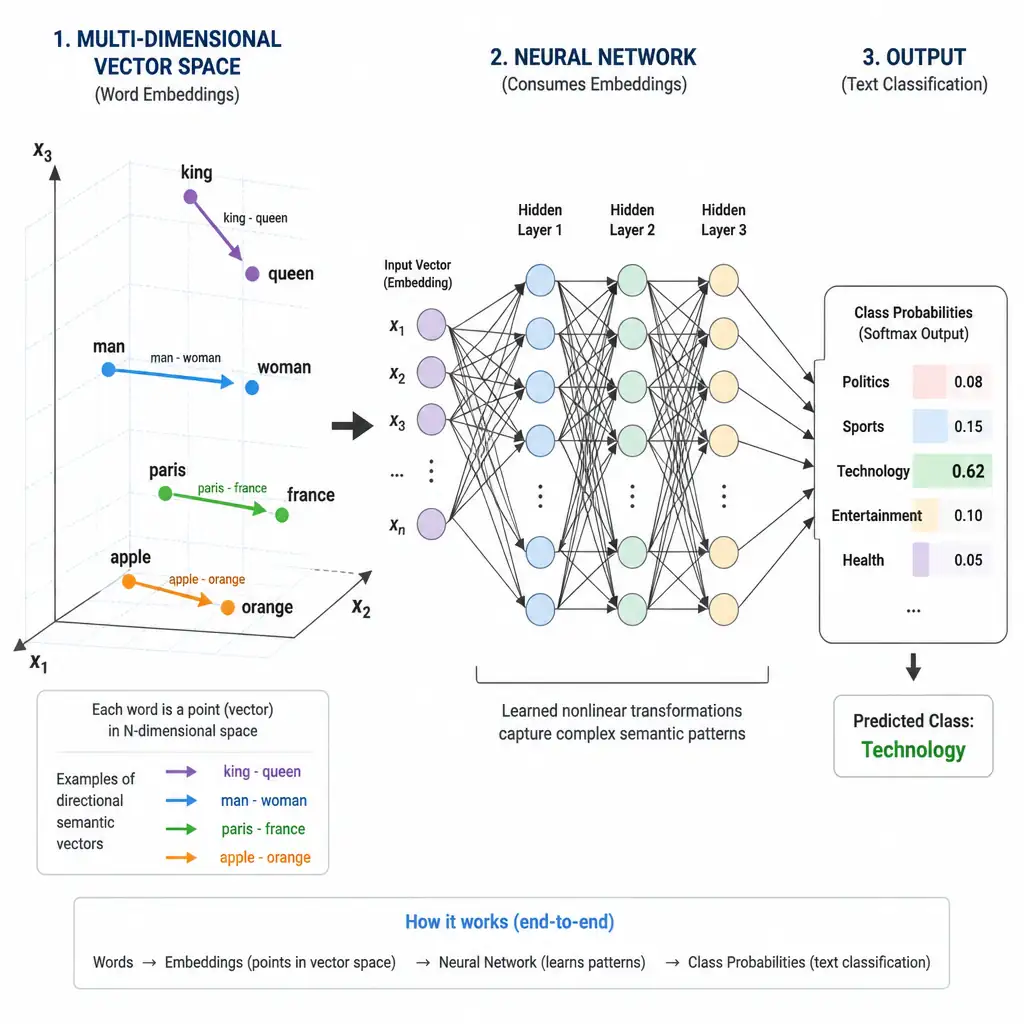
Computers don't understand words, so you turn them into dense numerical vectors that capture meaning. You then feed those vectors into deep learning models to handle text tasks like sentiment analysis or translation.
Full Explanation
Word embeddings are a class of techniques in NLP where individual words are represented as real-valued, dense vectors in a low-dimensional space. Unlike traditional sparse representations such as One-Hot Encoding or Bag-of-Words, word embeddings capture semantic and syntactic relationships between words based on their context in a large text corpus. The primary application of word embeddings is to serve as dense numerical input features for deep learning architectures, such as Recurrent Neural Networks, LSTMs, or Transformers, designed for text-related tasks. By converting words into continuous vector spaces, neural networks can process textual inputs, capture contextual nuances, and perform downstream tasks like machine translation, named entity recognition, and sentiment classification.
The other options do not apply. Using embeddings as temporal sequence identifiers to forecast future values in numerical time-series datasets is not typical, because time series forecasting usually relies on historical sequential numerical data, such as stock prices or temperatures, rather than word vectors. Using embeddings as spatial pixel intensity vectors for training convolutional neural networks on image classification tasks is also incorrect, because image classification uses pixel matrices and convolutional layers to identify visual patterns and does not process word embeddings, which are specific to linguistic structures. Using embeddings as distance-based clustering keys to segment customer transaction histories in relational databases is not the common NLP use case either, because customer segmentation typically relies on behavioral and demographic metrics processed via clustering algorithms, such as K-Means, rather than linguistic representations of vocabulary.