
In a production machine learning pipeline, an engineer sets up an alert system to monitor for "data drift." What is the primary purpose of monitoring and detecting data drift?
Select an answer to reveal the explanation.
Short Explanation
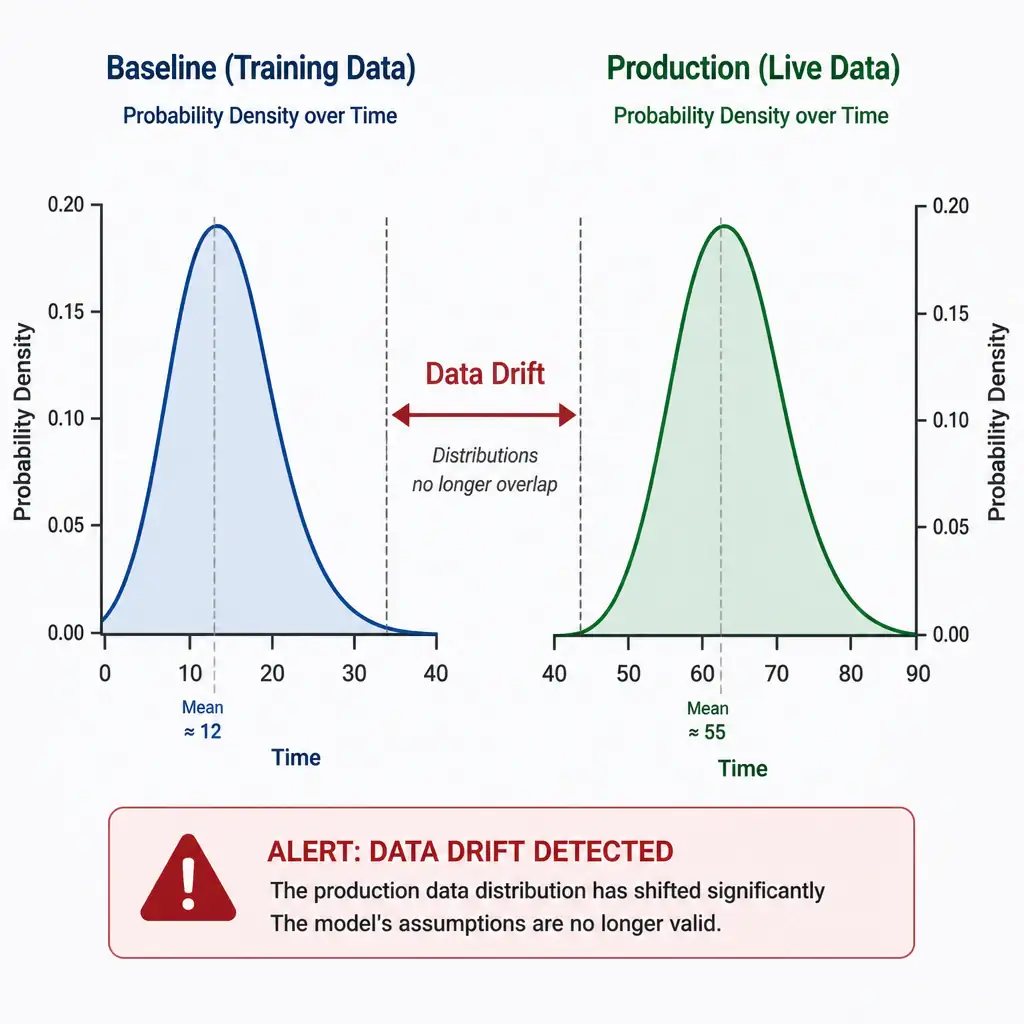
Here's the deal: data drift means your live input data stops matching the training data statistically. You monitor it so you can catch the shift and retrain before predictions go bad.
Full Explanation
Data drift, also called covariate shift, occurs when the statistical properties of the input data change over time compared to the data the model was originally trained on. In production environments, this can happen due to shifting consumer preferences, economic changes, seasonality, or sensor degradation. Because machine learning models assume that the training data and the production data share the same underlying distribution, data drift typically leads to a degradation in model performance, often described as concept drift or model decay. Monitoring for data drift involves comparing the statistical distributions of incoming production data against the baseline training data, using statistical tests such as Kolmogorov-Smirnov, Population Stability Index, or Kullback-Leibler divergence, to trigger retraining before accuracy drops. The correct purpose is to identify when the statistical distribution of real-world input data has shifted compared to the training data. The choice about automatically increasing the size of the neural network by adding more hidden layers is incorrect because enlarging the model is an architectural change that does not address data drift; expanding network complexity without retraining on the new distribution would not solve the drift issue and could lead to overfitting. The choice about deleting old model artifacts and completely resetting the model to its untrained state is incorrect because resetting the model would destroy the model's learned weights. The correct response to drift is retraining or fine-tuning the model on newer data, not resetting it. The choice about measuring the time it takes to train the model on new hardware is incorrect because training time measures computational efficiency and resource utilization, which is a hardware or performance metric, completely unrelated to the statistical properties of the data stream.