
During the training phase of a deep neural network, backpropagation is used to minimize the loss function. What is the fundamental mechanism that backpropagation employs to update the network's parameters?
Select an answer to reveal the explanation.
Short Explanation
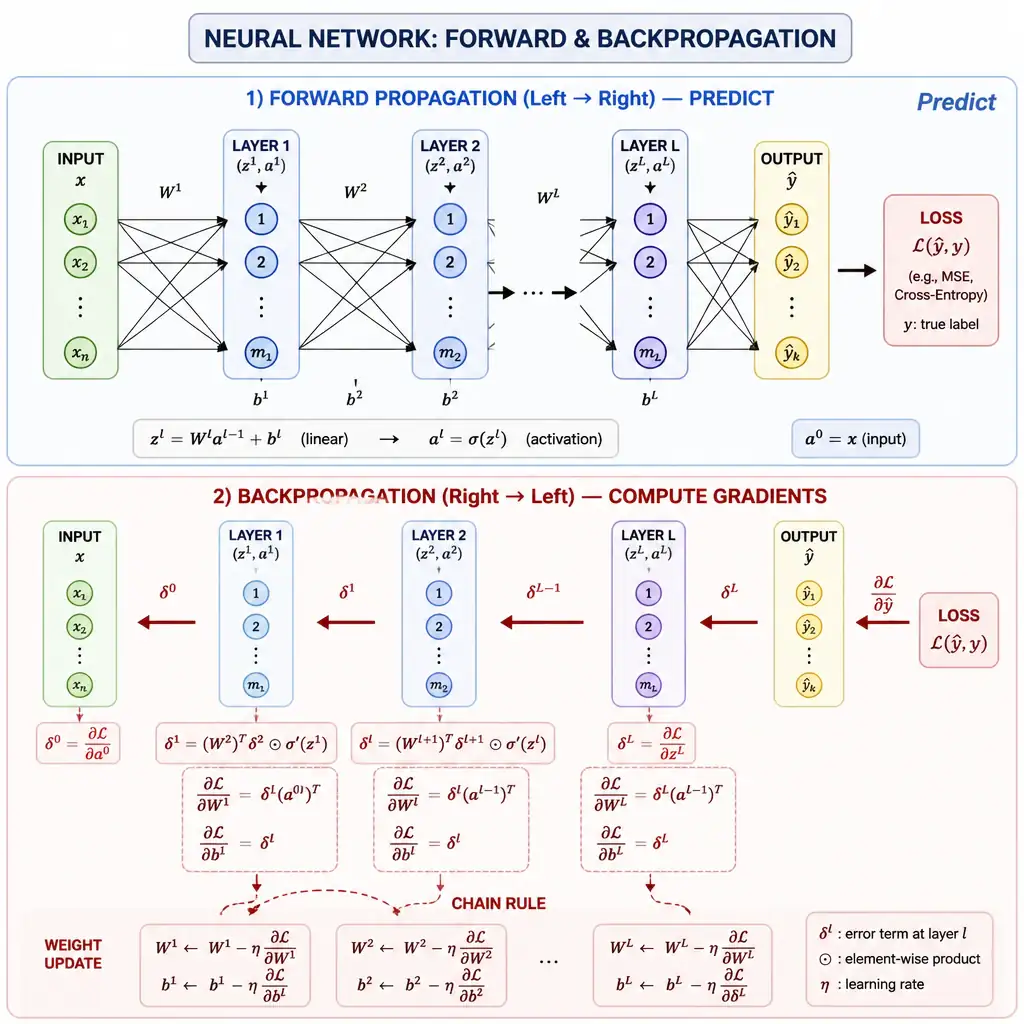
Check this out: when you train a neural network, backpropagation starts with the loss at the output layer and works backward layer by layer. It uses the chain rule to figure out how much each weight contributed to the error, then tells the optimizer how to tweak those weights. Understanding that backward error flow is key for the exam!
Full Explanation
Backpropagation (backward propagation of errors) is the cornerstone algorithm for training artificial neural networks. It is used in conjunction with an optimization method, such as gradient descent, to update the network's weights and biases in a way that minimizes the loss function. The correct mechanism is computing the loss at the output layer and propagating it backward using the chain rule to update weights. The process starts at the output layer, where the network's prediction is compared against the actual target value to compute the loss. Backpropagation then calculates the gradient of the loss function with respect to each weight in the network by applying the chain rule of calculus. This allows the error gradient to be propagated backward through the network's layers, from the output back to the input, determining how much each weight contributed to the total error. The optimizer then uses these gradients to update the weights. Exam caveat: understanding the chain rule and how errors flow backward is absolutely key for the exam.
The incorrect choices are: - Randomly initializing weights across all hidden layers using techniques like Xavier or He initialization is the step performed before training begins to set the initial values of weights. It prevents issues like vanishing or exploding gradients but does not calculate or propagate errors. - Dynamically adding new hidden layers and neurons to the architecture to reduce training error refers to architectural modifications or network expansion, which is a structural design decision or part of dynamic neural architecture search, not the mechanism of backpropagation. - Propagating inputs forward through successive layers to calculate the final predicted values is forward propagation. It is the process where input data travels forward through the network's layers to generate a prediction. It calculates the outputs and the loss, but it does not perform the backward error distribution or weight updates.