
In a mature MLOps (Machine Learning Operations) pipeline, establishing a robust feedback loop is critical. What does this process actually entail?
Select an answer to reveal the explanation.
Short Explanation
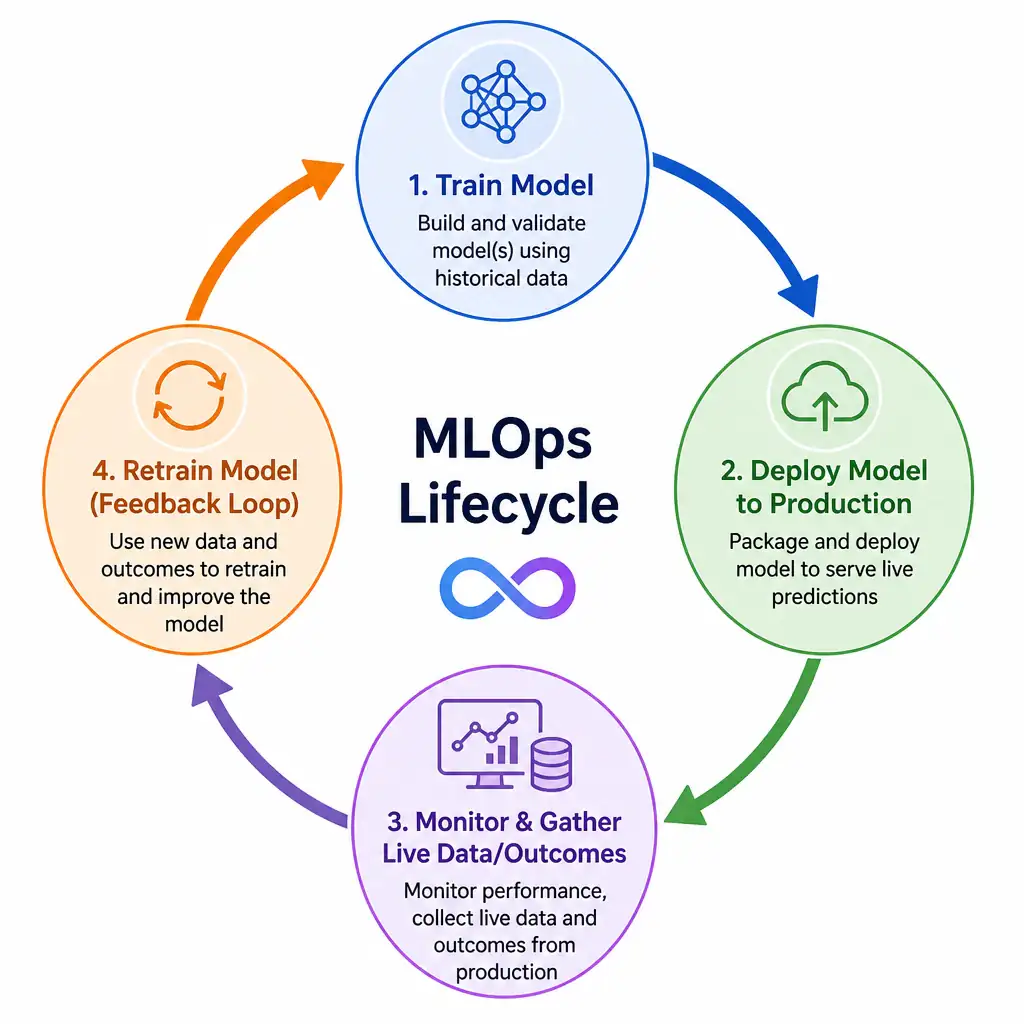
When your model starts losing its edge in production, you don't just walk away. You capture live inference data and real outcomes, then feed them back into retraining so the model keeps improving. That's the feedback loop.
Full Explanation
In Machine Learning Operations, a feedback loop is a continuous cycle designed to maintain and improve model performance after deployment. Once a model is running in production, it interacts with live users and processes real-world data. Over time, the distribution of this incoming data can shift—a phenomenon known as data drift—or the underlying relationships between inputs and outputs can change, causing model degradation.
A feedback loop addresses this by collecting incoming inference requests, model predictions, and, crucially, downstream outcomes or ground-truth feedback, such as whether a user clicked on a recommended item or whether a transaction was eventually flagged as fraudulent. This collected data is cleaned, validated, and stored. It is then fed back into the training pipeline to retrain the model on more recent, representative data. This process can be automated or scheduled, ensuring the model evolves alongside changing real-world conditions and remains accurate.
The incorrect choices fail because they describe different practices. Writing automated scripts to run unit tests on the model source code every time a developer commits to git describes continuous integration and automated testing of source code; that's a standard software engineering practice, but it does not constitute the feedback loop of model retraining based on production data. Halting model execution whenever an anomaly is detected and reverting to a hardcoded rules engine refers to a failover mechanism or circuit breaker pattern, which is used for service reliability and system resilience, not model improvement. Isolating the training environment from production to prevent live data from influencing model weights describes model isolation, which is the exact opposite of a feedback loop; isolating the training environment entirely from production data prevents the model from adapting to new real-world patterns.