
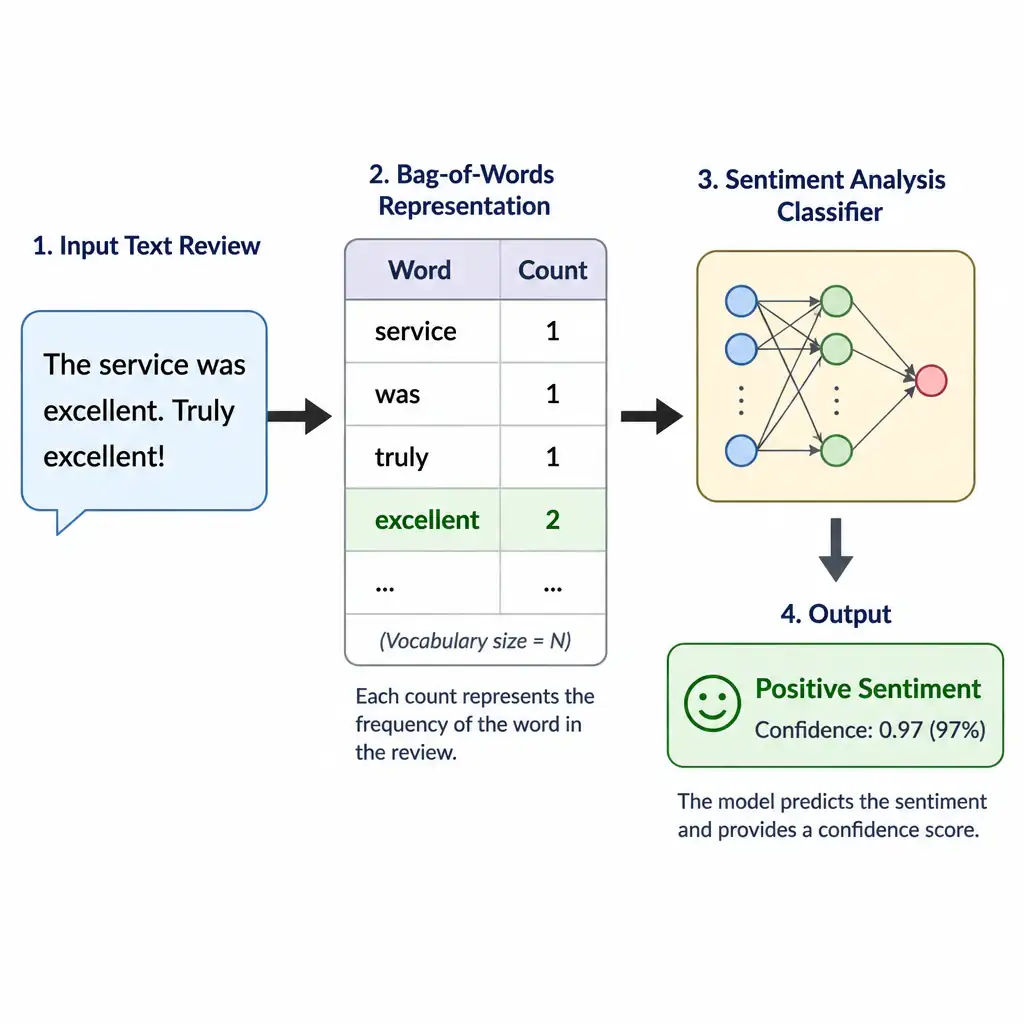
You are analyzing customer reviews for a new product using a Bag-of-Words (BoW) text representation. In one particular review, the word "excellent" has a high frequency count. What does this high value signify in the context of sentiment analysis?
Select an answer to reveal the explanation.
Short Explanation
In a Bag-of-Words model, you're literally counting how many times a word shows up in a single document. If 'excellent' has a high count in a review, that positive word is being repeated, so it's a strong signal the review leans positive. Stop words and typos don't carry that kind of sentiment weight.
Full Explanation
In natural language processing (NLP), the Bag-of-Words (BoW) model is a simplified representation of text where a document is represented as a bag (multiset) of its words, disregarding grammar and word order but keeping track of multiplicity (frequency). Under this framework, each document is converted into a vector where the dimensions correspond to words in a vocabulary, and the values represent the frequency of each word within that specific document.
When you apply a BoW model to sentiment analysis, the frequency of sentiment-bearing words becomes a critical feature for classification algorithms. A word like 'excellent' carries a clear, strong positive semantic orientation. A high value (frequency count) for this word in a document's vector indicates that the author used the word multiple times within that text. Mathematically, this high feature value increases the weight of positive sentiment indicators during model training or inference, serving as a reliable feature for classifiers to predict a positive sentiment label.
The option saying the word represents a stop word (or empty word) that should be filtered out is incorrect because 'excellent' is a high-value sentiment word, not a stop word. Stop words, such as 'is', 'the', and 'at', are functional words that occur frequently across all texts but carry no sentiment and are often filtered out before vectorization.
The option saying the word is a common document-frequency outlier that appears across all documents is incorrect because a high value in a specific document's BoW vector only measures local term frequency (tf), not document frequency (df) across the entire corpus. A word being common to the entire corpus would be reflected in a high document frequency, which actually lowers its unique informational value and is often adjusted using TF-IDF.
The option saying the word represents a typographical error or spelling mistake in the dataset is incorrect because a word with a high count that matches a standard dictionary entry like 'excellent' is clearly a recognized vocabulary word, not a typographical error.