
A development team is building an automated customer service agent for an online portal. The system must analyze incoming customer emails, retrieve relevant information from a knowledge base, and draft a coherent, personalized response to the customer. Which combination of NLP tasks is most critical to this system's architecture?
Select an answer to reveal the explanation.
Short Explanation
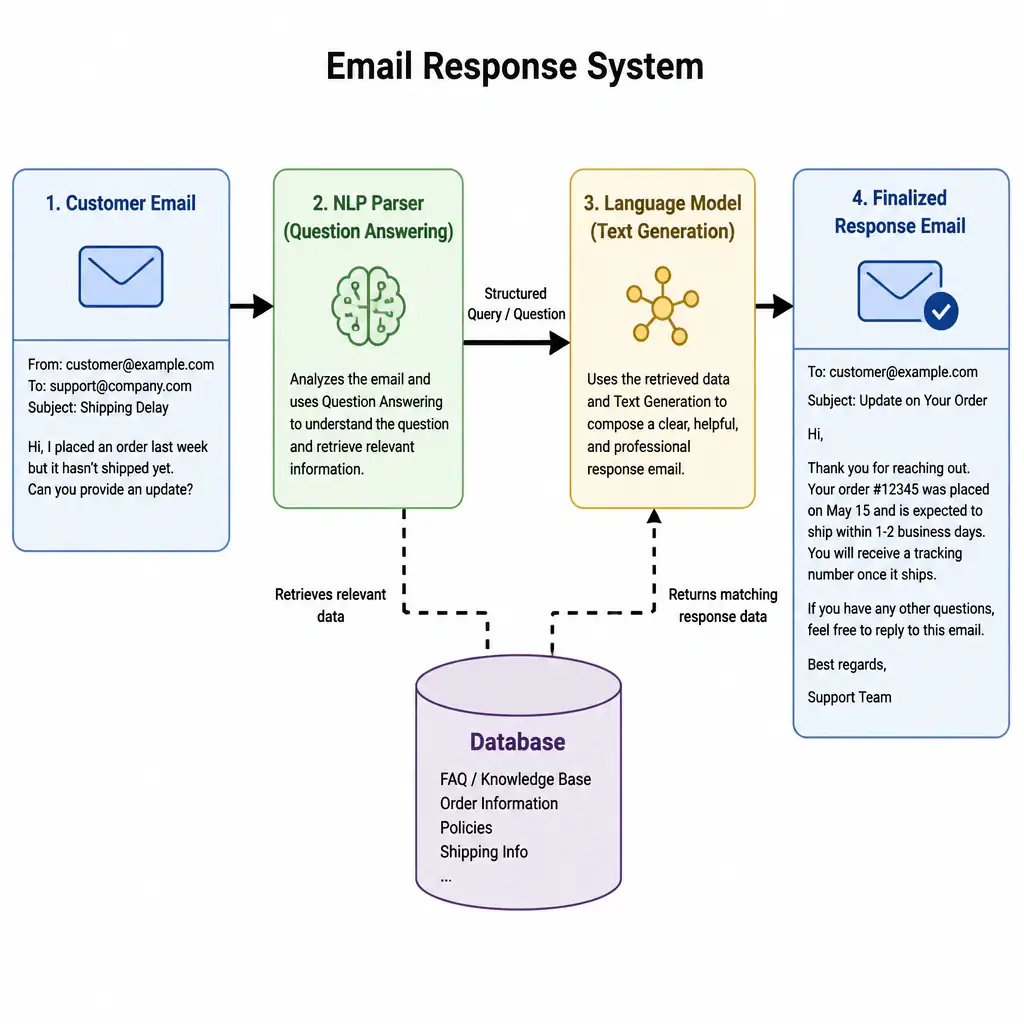
If you're building an auto-responder for customer emails, your system has to understand the request and pull the right answer from a knowledge base—that's Question Answering. It also has to turn that answer into a friendly, coherent reply—that's Text Generation. The other pairs may help around the edges, but they don't drive the core email-answering workflow.
Full Explanation
Building an automated email response system requires combining multiple technologies within Natural Language Processing (NLP), but the core functionality depends on Question Answering (QA) and Natural Language Generation (NLG/Text Generation). That makes Question Answering and Text Generation the most critical combination for this architecture. - Question Answering (QA): The system must parse the unstructured text of the incoming email to identify the user's intent and query. It then searches a structured database or an unstructured knowledge base to retrieve the correct fact, solution, or instructions. - Text Generation (NLG): Once the correct information is retrieved, the system cannot simply dump raw data or code snippets to the customer. It must synthesize a cohesive, grammatically correct response that addresses the user's inquiry, mimicking a human support agent.
Let's evaluate the distractors: - Text Summarization and Part-of-Speech Tagging: Text Summarization can condense long text, and Part-of-Speech (POS) Tagging identifies nouns/verbs. Neither of these can retrieve answers or write a new response email. - Sentiment Analysis and Named Entity Recognition: Sentiment Analysis detects the emotional state of the customer (e.g., angry, happy), and Named Entity Recognition (NER) extracts key entities (like names or order numbers). While useful for routing or personalization, they do not answer the question or draft the text of the reply. - Machine Translation and Tokenization: Machine Translation translates text between languages, which is only necessary if the email is in a different language, and Tokenization is a low-level preprocessing step, not an end-to-end application task.