
In natural language processing, what is the primary mathematical objective of the Term Frequency-Inverse Document Frequency (TF-IDF) representation model?
Select an answer to reveal the explanation.
Short Explanation
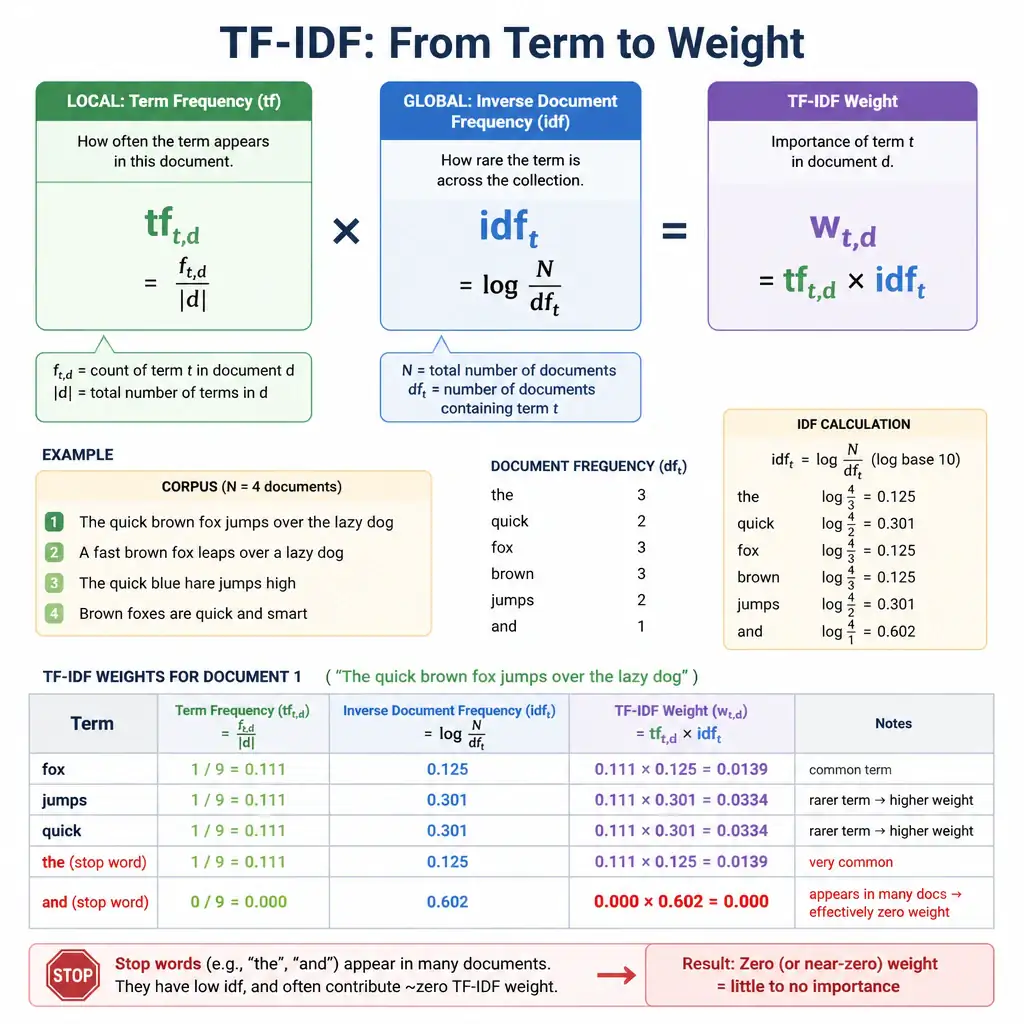
Think of TF-IDF as a searchlight that helps your machine learning model find the most informative words in a mountain of text. It scores each word by how often it appears in that document, then penalizes it if it appears in too many documents across the corpus. That's why the numeric score that scales with local frequency but is penalized by overall corpus frequency is the right answer.
Full Explanation
The mathematical objective of Term Frequency-Inverse Document Frequency (TF-IDF) is to weight terms in a document relative to their informational value. The formula for a term t in a document d within a corpus D is: TF-IDF(t, d, D) = TF(t, d) × IDF(t, D). TF(t, d) represents the frequency of term t in document d (often normalized to prevent bias in longer documents). IDF(t, D) = log(N / |{d in D : t in d}|), where N is the total number of documents in corpus D, and the denominator is the number of documents containing term t. If a term appears in every document in the corpus, the ratio N / |{d in D : t in d}| becomes 1, and its logarithm becomes 0, resulting in a TF-IDF score of 0. This statistical filtering allows classifiers to ignore common stop words and focus on unique keyword features. The correct choice is the one that says TF-IDF calculates a numeric score for each word in a document that scales with its local frequency but is penalized by its overall frequency across the entire corpus. The choice describing a dense, low-dimensional vector space that preserves semantic analogies describes dense word embeddings such as Word2Vec or GloVe, which model semantic similarities, not statistical importance scores. The choice describing text converted into a sequence of binary vectors where each word is represented by a single activated index describes One-Hot Encoding, which yields sparse binary vectors without statistical weighting. The choice describing extracting the root form of words by stripping suffixes and prefixes describes stemming or lemmatization, which are morphological normalization techniques, not a vectorization scoring method.