
When preparing raw natural language text for training or inference with a Transformer model in the Hugging Face transformers library, what is the fundamental purpose of the tokenizer?
Select an answer to reveal the explanation.
Short Explanation
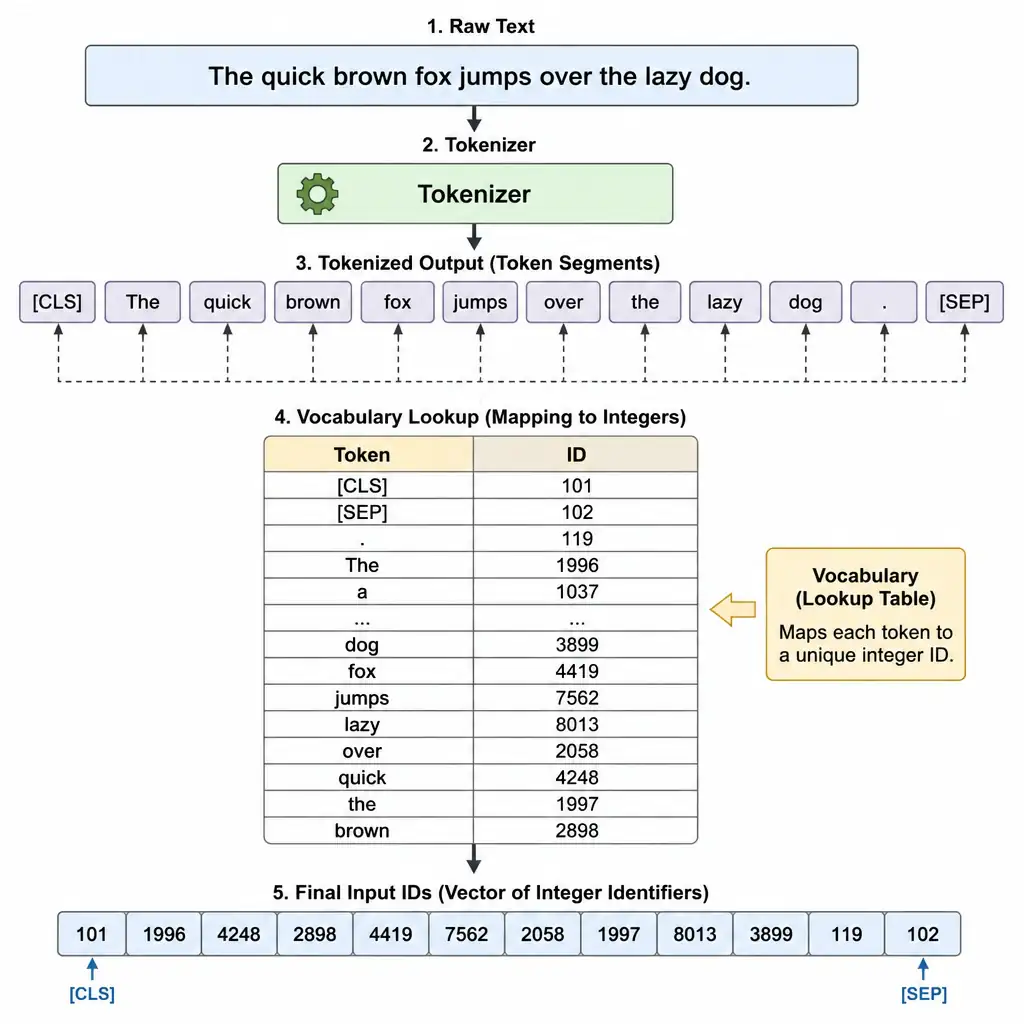
Check this out: computer models are brilliant at linear algebra, but they can't read raw human text. You need the tokenizer to chop text into tokens, map each token to vocabulary IDs, and add special sequence-control tokens so the model knows where text starts and ends.
Full Explanation
In the Hugging Face ecosystem and modern natural language processing workflows, tokenizers are critical preprocessing tools that bridge the gap between raw text and model-compatible tensors. Transformer models, mathematically, operate on multi-dimensional numeric matrices. The tokenization process involves three main phases: 1. Normalization and Pre-tokenization: The text is cleaned (e.g., removing whitespace, lowercasing) and split into preliminary units. 2. Subword Tokenization: The text is segmented into tokens using algorithms such as Byte-Pair Encoding (BPE), WordPiece, or SentencePiece. This subword approach allows the vocabulary to remain relatively small while avoiding out-of-vocabulary (OOV) errors, as unseen words can be broken down into known sub-parts. 3. Numericalization: Tokens are mapped to their corresponding numerical integer IDs based on the model's pre-trained vocabulary. The tokenizer also adds model-specific special tokens (such as [CLS] and [SEP] for BERT, or <s> and </s> for RoBERTa) which act as control markers for classification or sequence boundaries.
The correct choice is the one that says the tokenizer converts human-readable text into a structured numeric format by mapping segments to vocabulary indices and inserting required special sequence-control tokens.
The other choices are wrong: - The choice that says compute high-dimensional contextual embeddings that capture the semantic meanings of words in a sentence is wrong because contextual embeddings are produced by the model's internal embedding and attention layers during the forward pass, not by the tokenizer. - The choice that says perform gradient descent optimization and iteratively adjust the weights of the model's self-attention layers is wrong because optimization and weight updating are tasks performed by the optimizer (e.g., AdamW) and the backpropagation engine, not the preprocessing tokenizer. - The choice that says execute data augmentation techniques, such as synonym replacement, to expand the size of the training dataset is wrong because data augmentation is an optional step in data preparation and is not the core function of a tokenizer.