
When gathering and preparing data to train a state-of-the-art Large Language Model (LLM) from scratch, which of the following represents the most significant data-related challenge?
Select an answer to reveal the explanation.
Short Explanation
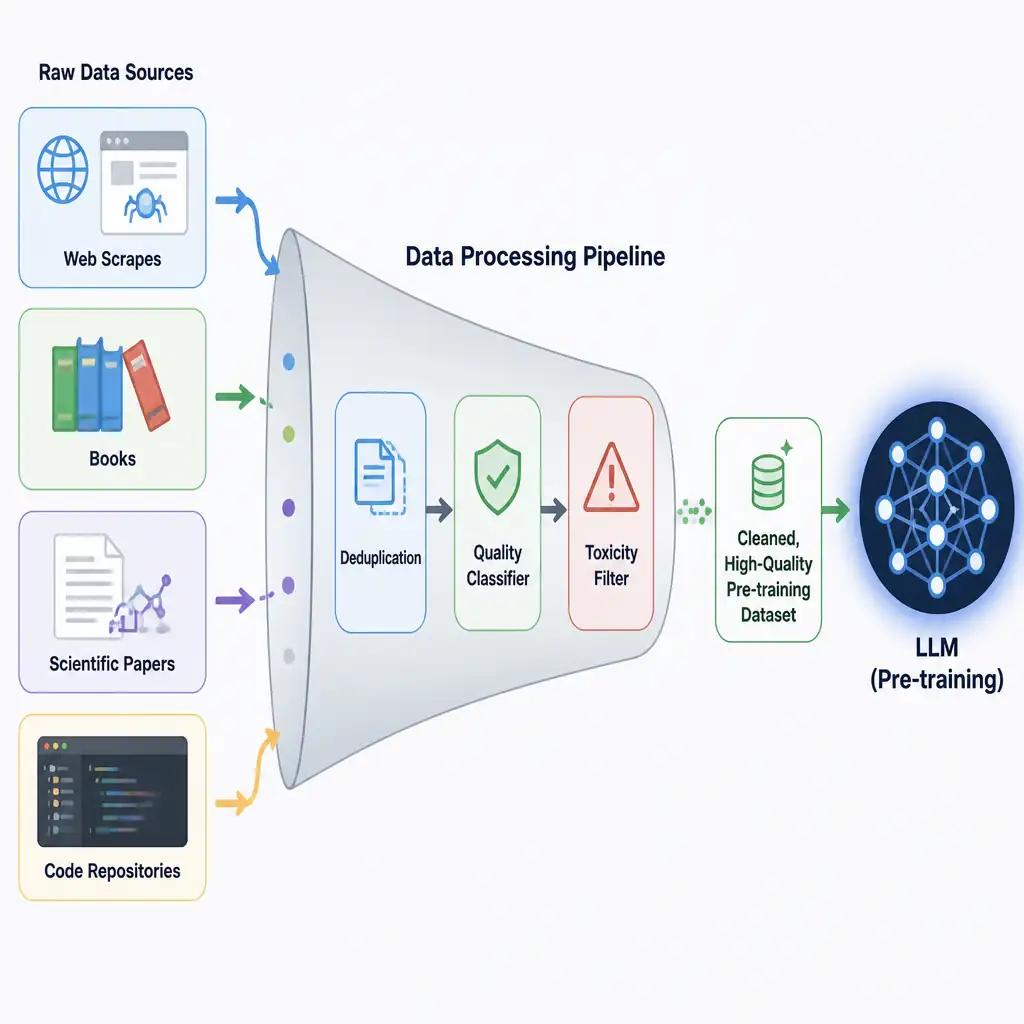
Here's the deal: you need a massive, diverse, high-quality text corpus, usually scraped from the public internet. The hard part is filtering out spam, duplicates, and junk so the model doesn't learn garbage. That scale-and-quality problem is the biggest data bottleneck.
Full Explanation
Training a Large Language Model (LLM) from scratch requires a massive amount of high-quality data to enable the model to learn grammar, syntax, factual knowledge, and reasoning capabilities. This training data is typically collected by scraping vast portions of the public internet, including books, articles, code repositories, and web pages (like the Common Crawl dataset).
The primary challenge lies in the scale, diversity, and quality of this data. Raw web scrapes are incredibly noisy, containing duplicate text, machine-generated spam, offensive content, and formatting errors. Engineers must build complex data cleaning and filtering pipelines to de-duplicate documents, filter out toxic language, and strip away low-quality text. If the training data is low quality or highly biased, the resulting model will inherit those flaws, leading to poor generalization, hallucinations, and safety issues. Therefore, the most significant data-related challenge is procuring an exceptionally large, diverse, and high-quality corpus of text, which involves scraping and filtering massive portions of the public internet.
The claim that the data must be fully structured and stored in a single, unified database table format like CSV or SQL is incorrect because LLM pre-training data is unstructured text (natural language) and is not constrained to rigid, structured formats like CSV or SQL tables. The claim that the dataset must be entirely hand-labeled and annotated by human domain experts to support supervised learning objectives is incorrect because pre-training uses self-supervised learning (predicting the next token), which does not require manual, human-annotated labels for the raw text corpus. The claim that the text data must be restricted to a single dialect and style to prevent the model's neural network from failing to converge is incorrect because exposing the model to diverse dialects, languages, and writing styles is actually beneficial for building a robust, general-purpose assistant.