
While both are fundamental concepts in Natural Language Processing, what is the primary operational distinction between a language model and a text classifier?
Select an answer to reveal the explanation.
Short Explanation
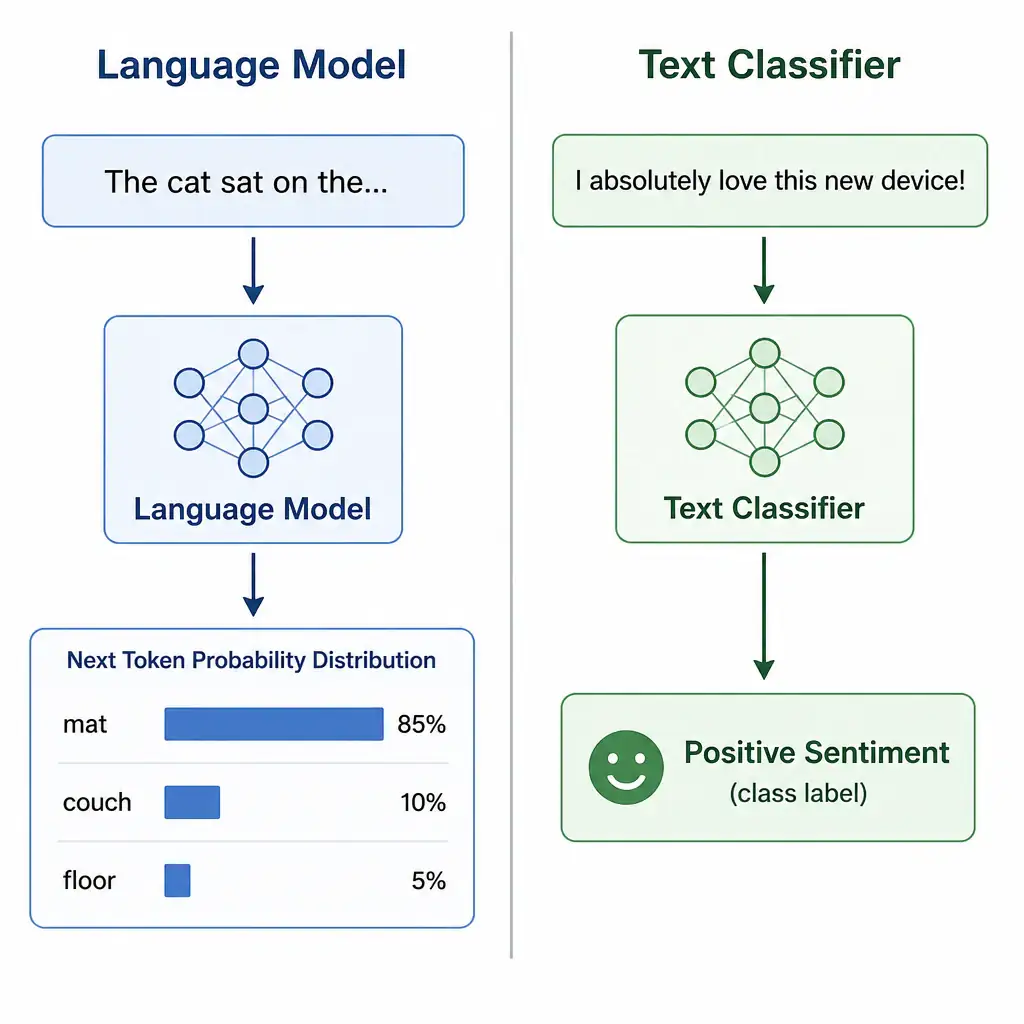
Think of a language model like smart auto-complete: it predicts the next token's probability. A text classifier is more like a mail sorter: it takes the whole text and assigns one label. One generates by guessing what comes next, while the other categorizes what you already have.
Full Explanation
The distinction between a language model and a text classifier lies in their objective functions and output spaces. A language model is trained to model the probability distribution of sequences of words. The classic autoregressive language modeling objective is to predict the next word, or token, given all previous words in the sequence ($P(w_t | w_1, w_2, ..., w_{t-1})$). This allows language models to generate coherent, continuous text, as seen in models like GPT-4 or LLaMA. A text classifier, on the other hand, maps an input sequence of text to a predefined label, category, or set of labels ($P(y | X)$ where $y$ is a class label and $X$ is the input text). Common classification tasks include sentiment analysis, labeling text as positive, negative, or neutral, spam detection, topic categorization, and intent detection in chatbots. The choice that says a language model maps inputs directly to numerical regression values, while a text classifier only processes token frequency distributions, is incorrect because language models do not primarily map inputs to simple regression values, and text classifiers process representations far beyond simple token frequency distributions, such as semantic embeddings. The choice that says a language model is restricted to generating summaries of existing documents, whereas a text classifier is used only to translate text between different languages, is incorrect because language models can do far more than summarization, including translation, code generation, and reasoning, and text classifiers are not used for translation, since translation is a sequence-to-sequence generation task. The choice that says a language model requires unsupervised training data exclusively, while a text classifier can only be trained using self-supervised learning algorithms, is incorrect because both language models and text classifiers can utilize various training regimes, and text classifiers are primarily trained using supervised learning, not self-supervised learning.