When using statistical methods to represent document content, how does a Term Frequency-Inverse Document Frequency (TF-IDF) model improve upon a standard Bag-of-Words (BoW) representation?
Select an answer to reveal the explanation.
Short Explanation and Infographic
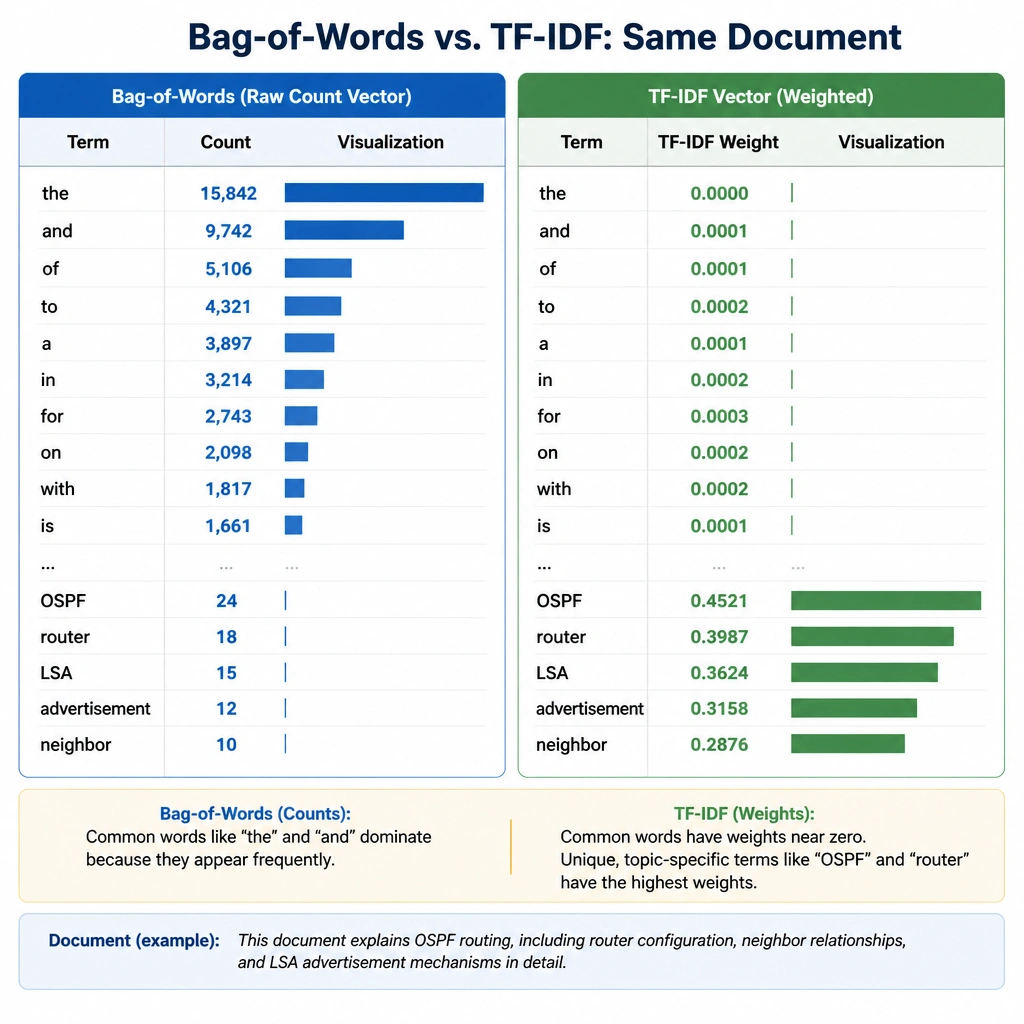
Let's look at why TF-IDF is a major step up from a basic Bag-of-Words model. Imagine you have a collection of networking articles, and you want to classify them. In a standard Bag-of-Words model, you're literally just counting how many times each word appears. But think about it—words like "the," "is," "and," and "network" are going to show up in almost every single article. Because they're so common, the count will be massive, and your model might think they're the most important words in the document. That's a huge distraction! TF-IDF solves this by adding a sanity check. It still counts the terms (that's the Term Frequency part), but then it multiplies that count by the Inverse Document Frequency. If a word like "the" shows up in every single document in your library, TF-IDF penalizes it, driving its weight down to almost zero. But if a word like "BGP" or "subnet" only shows up in a couple of documents, its weight goes way up because it's a key identifier of those specific articles. Trust me, TF-IDF is a simple but brilliant way to make sure your model focuses on the words that actually convey meaning, rather than just filler words!
Full explanation below image
Full Explanation
Both Bag-of-Words (BoW) and Term Frequency-Inverse Document Frequency (TF-IDF) are statistical vector space models used to represent text, but they differ in how they calculate token importance. The BoW model represents a document by creating a vocabulary list and counting the occurrences of each word (Term Frequency). The primary issue with BoW is that it treats all words equally. High-frequency filler words (such as "and," "the," or domain-specific words common to the entire corpus) dominate the representation, even though they carry little discriminative information.
TF-IDF addresses this limitation by introducing a weighting factor: Inverse Document Frequency (IDF). The mathematical formula for TF-IDF is the product of Term Frequency (TF) and Inverse Document Frequency (IDF): $$\text{TF-IDF}(t, d, D) = \text{TF}(t, d) \times \log\left(\frac{N}{|\{d \in D : t \in d\}|}\right)$$ where N is the total number of documents in the corpus, and the denominator is the number of documents containing term t. The IDF term scales down the weight of words that appear frequently across all documents (reducing the influence of stop words and filler words) and scales up the weight of rare terms that appear only in a small subset of documents. This ensures that the resulting vectors highlight terms that are uniquely characteristic of each document.
Let's evaluate the incorrect options: - Option A is incorrect because both BoW and TF-IDF are "bag" models, meaning they discard word order and grammatical structure. - Option B is incorrect because TF-IDF is a statistical, frequency-based representation and does not use neural networks or low-dimensional dense embeddings. - Option D is incorrect because TF-IDF represents documents as flat frequency vectors, not hierarchical trees representing grammatical relationships.