When working with the Hugging Face ecosystem to quickly deploy or prototype NLP features, which of the following best describes the role and behavior of the pipeline abstraction?
Select an answer to reveal the explanation.
Short Explanation and Infographic
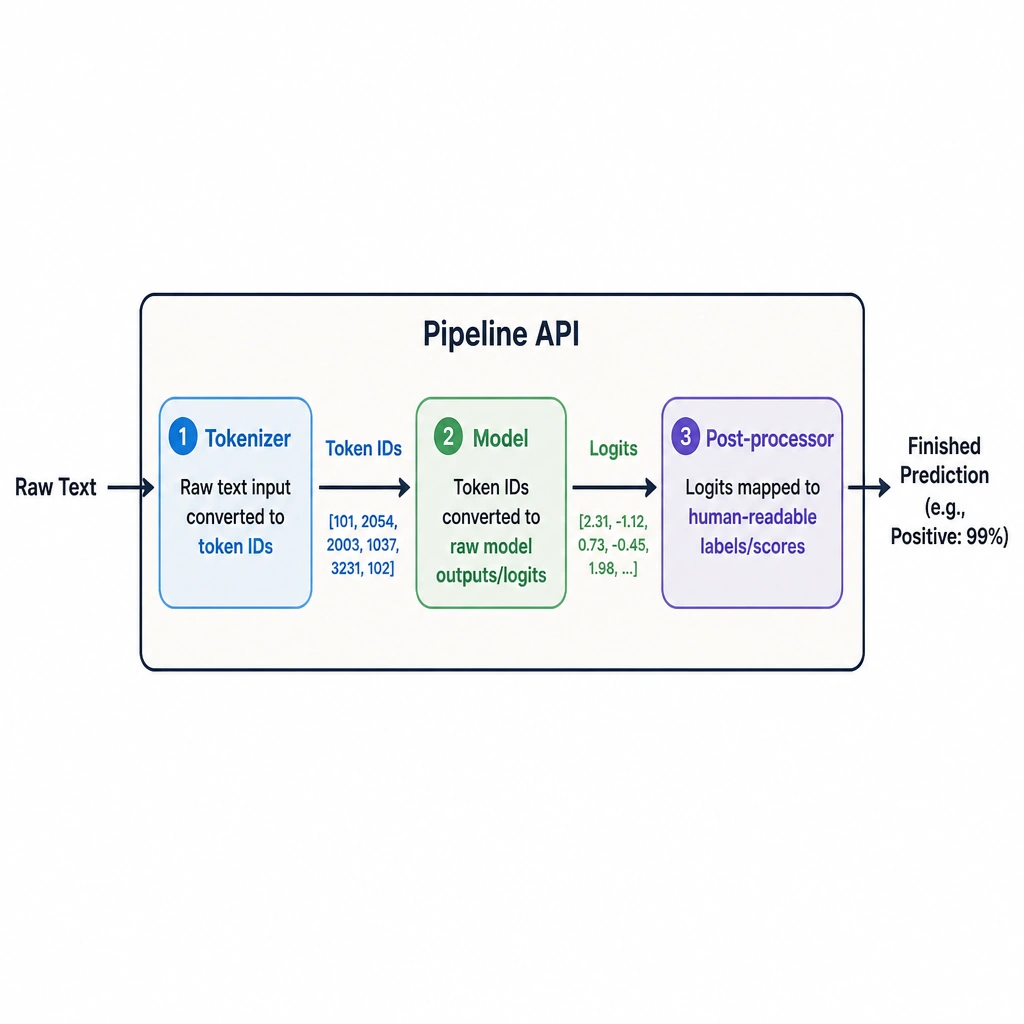
Here's the deal: if you want to get a transformer model up and running in Hugging Face without writing a mountain of boilerplate code, the pipeline is your absolute best friend. Think of it like a drive-through lane at your favorite fast-food joint. You pull up, place your order—say, a block of raw text you want summarized—and the pipeline handles everything behind the scenes. It grabs the tokenizer to break down your text, passes the tokens to the pre-trained model to make the prediction, and cleans up the raw output into something you can actually read. You don't have to worry about manual tensor manipulation or model architectures. It's fast, clean, and gets the job done. Got it? Sweet.
Full explanation below image
Full Explanation
The Hugging Face pipeline function is a high-level API designed to make inference simple and accessible. In typical Deep Learning workflows, performing inference requires several distinct steps: loading a tokenizer, converting raw text into token IDs, mapping those IDs to input tensors, feeding those tensors into the pre-trained model, and then decoding or post-processing the model's numerical outputs into human-readable predictions. The pipeline object abstracts all of these stages into a single unified interface. By specifying a task (such as sentiment-analysis, translation, or summarization) and optionally a model name, Hugging Face automatically instantiates the appropriate tokenizer and model architectures, connects them, and executes the entire pipeline end-to-end.
Let's break down why the other options are incorrect: - Option A is incorrect because the pipeline does not expose low-level architectural layers or weights; instead, it abstracts them away so developers do not have to write custom model architectures. - Option C is incorrect because model parallelization and distributed training are managed by other libraries and classes (like PyTorch Distributed, Hugging Face Accelerate, or DeepSpeed), not the inference-oriented pipeline. - Option D is incorrect because downloading datasets is handled by the datasets library, and local caching is managed automatically or via specific environment variables, not the pipeline object, which is primarily focused on execution and inference.