Because Transformer architectures process all tokens in a sequence simultaneously rather than sequentially, they lack an inherent understanding of word order. How do Transformers solve this issue to preserve the structural meaning of a sentence?
Select an answer to reveal the explanation.
Short Explanation and Infographic
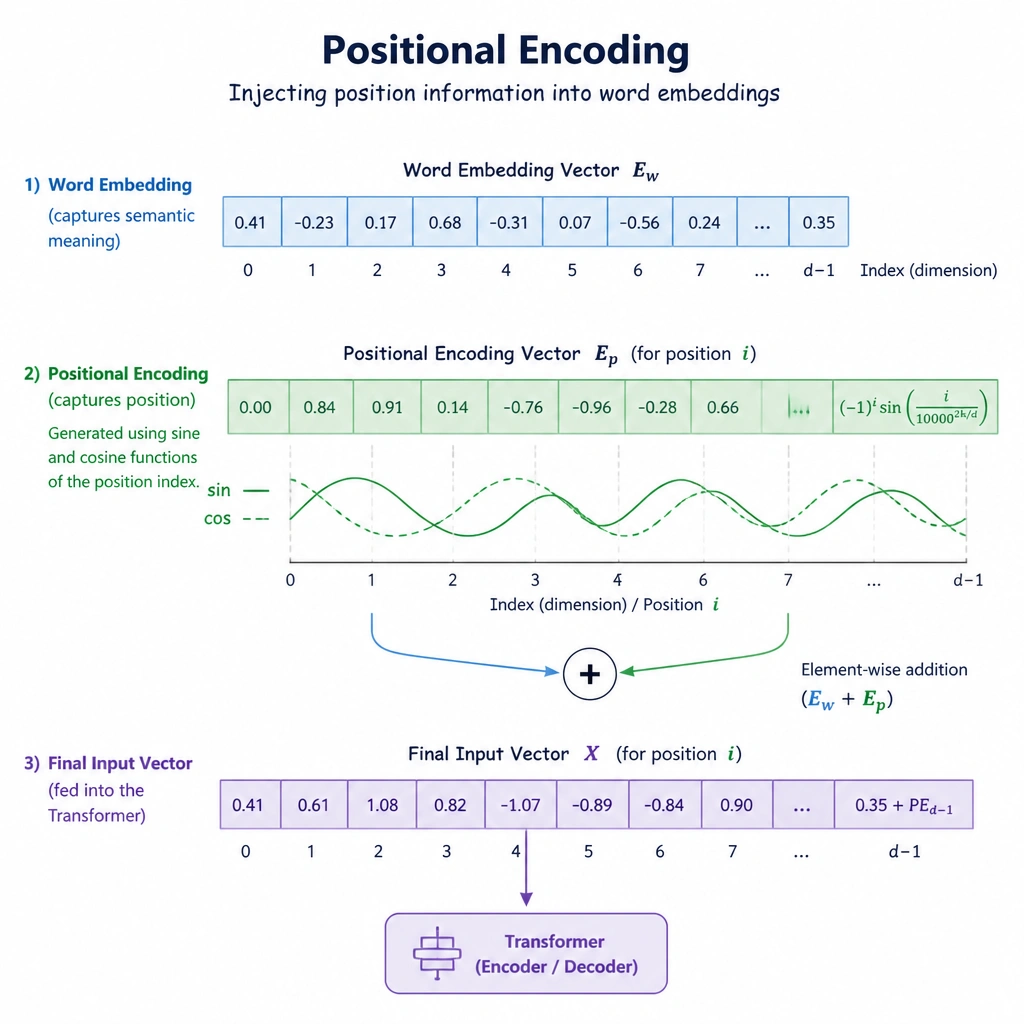
Okay, let's think about this. If I say "The dog bit the man," that means something very different than "The man bit the dog," right? Word order matters a lot in language! Now, remember that a Transformer looks at the entire sentence at the exact same time. It's completely parallel. But here's the catch—because it does everything at once, it has no natural way of knowing which word came first, second, or third. To the Transformer, those two sentences look exactly the same! To fix this, engineers came up with a really clever trick called positional encoding. Think of it like this: before we send our word embeddings into the attention engine, we add a unique mathematical signature—like a timestamp—to each word's vector. This signature tells the model exactly where that word lives in the sequence, either relative to other words or its absolute position. This way, we keep the speed of parallel processing without losing the context of word order. So on the exam, remember: no sequential processing means no natural word order, and positional encoding is the fix that saves the day!
Full explanation below image
Full Explanation
In sequential models like Recurrent Neural Networks (RNNs), word order is implicitly captured because tokens are processed one step at a time. However, the Transformer architecture processes the entire input sequence simultaneously to enable parallel training. While this approach is highly efficient, it makes the model permutation-invariant; without an explicit mechanism, the model would treat "the dog chased the cat" and "the cat chased the dog" as identical sets of words.
To address this limitation, Transformers use positional encodings. These are vectors added directly to the input word embeddings before the data enters the attention layers. The positional encoding vectors contain mathematical values (often calculated using sine and cosine functions of different frequencies) that correspond to the token's absolute or relative position in the sequence. By summing the word embedding vector and the positional encoding vector, the model receives a combined input that represents both the semantic meaning of the word and its specific location in the sequence.
Let's evaluate the incorrect options: - Option A is incorrect because recurrent hidden states are a feature of RNNs, not Transformers. - Option C is incorrect because sorting words alphabetically would destroy the grammatical structure of the sentence, not preserve it. - Option D is incorrect because static grammatical labels do not provide information about the actual sequential positioning of words in a sentence.