
An engineer needs to quickly deploy a text classifier to sort customer reviews into categories. Because they lack a labeled training dataset, they want to utilize a pre-trained Large Language Model (LLM) without performing any traditional training or weight updates. Which methodology is best suited for this task?
Select an answer to reveal the explanation.
Short Explanation
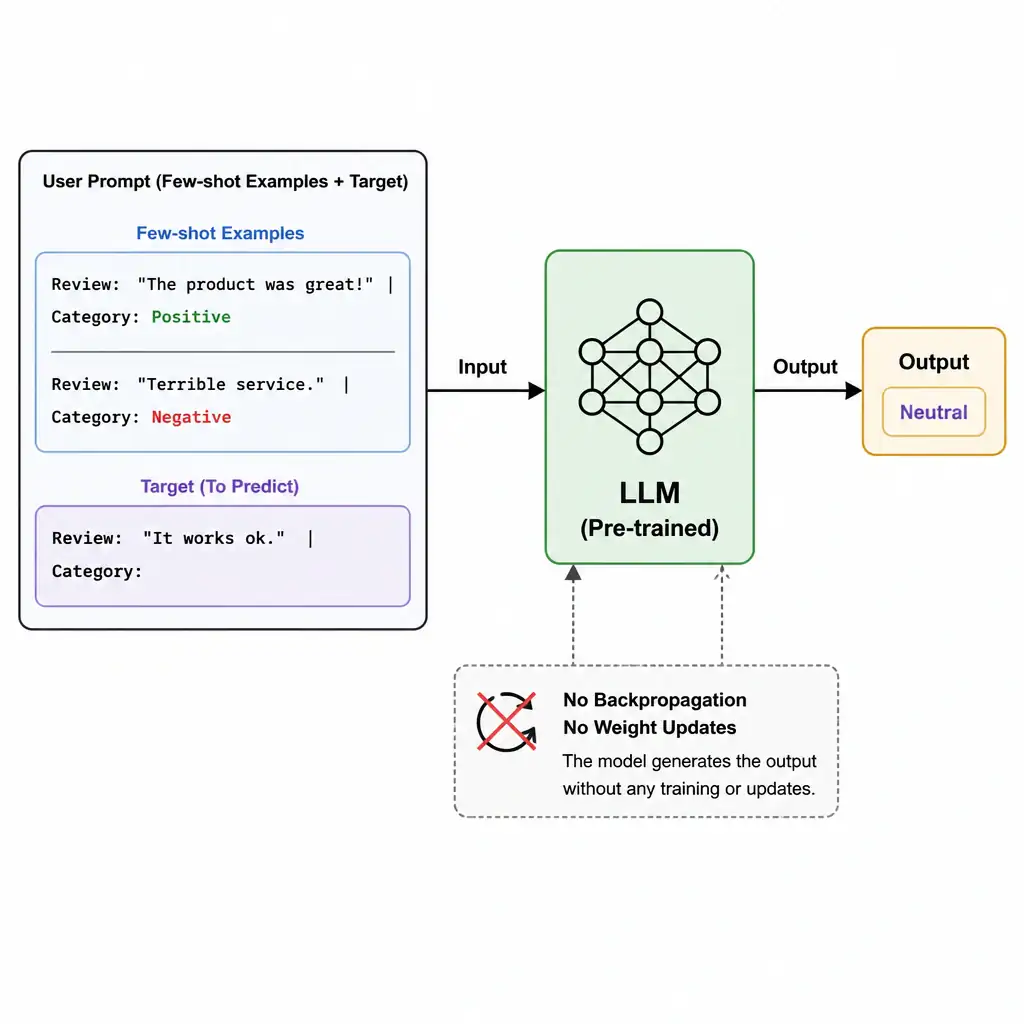
Check this out. If you need to classify customer reviews without labeled data or weight updates, you use zero-shot or few-shot prompting with a pre-trained LLM. You just describe the categories, maybe add a couple examples, and it starts classifying right away.
Full Explanation
When developers need to implement a machine learning solution but lack the labeled data or computational resources required to train or fine-tune a model, zero-shot and few-shot learning are highly effective techniques. These approaches leverage the general-purpose capabilities of pre-trained Large Language Models (LLMs). Because these models have been pre-trained on massive, diverse datasets, they possess a broad understanding of language, semantics, and context. In zero-shot learning, the model is given a prompt describing a task (e.g., 'Classify the sentiment of this review as Positive or Negative') and performs the task immediately without having seen any specific examples of it. In few-shot learning, the developer includes a small number of examples (usually 1 to 5) directly in the prompt context to guide the model's output. Neither technique requires modifying the model's underlying weights, making them extremely fast and easy to deploy. Let's review the incorrect approaches: Fine-tuning the pre-trained model's parameters on a custom validation dataset requires a labeled dataset and computational power to run backpropagation and update the weights of a pre-trained model, which doesn't fit the constraint of not wanting to train on a dataset. Designing and training a fresh neural network architecture from scratch using random initialization requires initializing a model with random weights and training it on a massive labeled dataset, which is the most data-intensive and computationally expensive option. Training a simple linear regression model on raw character counts is a regression technique used for predicting continuous numerical values, not categorizing text, and it still requires a training dataset to find its coefficients. For the exam, associate zero-shot and few-shot learning with performing tasks on a pre-trained LLM using prompts without updating the model weights.