
Within a Natural Language Processing (NLP) development pipeline, what is the primary function of gathering and preparing a text corpus?
Select an answer to reveal the explanation.
Short Explanation
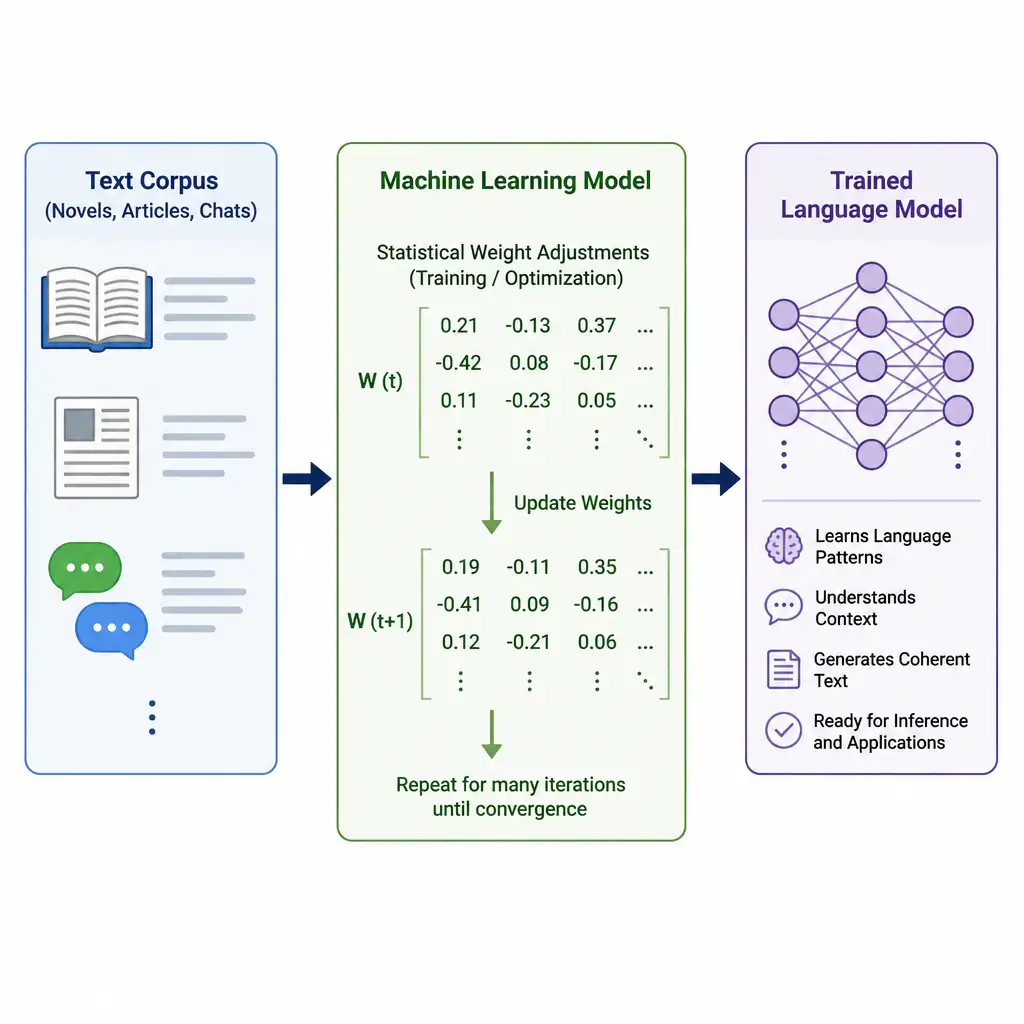
Check this out: a machine learning model doesn't start with built-in knowledge of how humans speak. You have to feed it a text corpus so it can learn vocabulary and statistical language patterns. It's the textbook for the model, not a rulebook, cache, or stop-word list.
Full Explanation
In Natural Language Processing (NLP), a corpus serves as the fundamental training dataset. Machine learning algorithms, particularly deep learning models like transformers, learn by discovering statistical associations and structural patterns within text. A corpus provides the large-scale linguistic representation needed to teach these models how words are distributed, how they form sentences, and how context influences meaning.
Without a robust, representative corpus, an NLP model cannot generalize to real-world language. For example, to train a medical chat assistant, developers compile a corpus of clinical notes and medical textbooks so the model learns domain-specific jargon and phrasing.
The correct choice is the one that says the corpus provides the source training data from which a machine learning model learns vocabulary and language patterns.
The choice about defining exact grammatical rules and logical templates that a chatbot must follow is incorrect because it describes a rule-based system. Modern NLP models are statistical, not rule-based; they learn patterns from data rather than following hardcoded grammatical rules.
The choice about serving as a high-speed database for caching user search queries in production environments is incorrect because it describes a database or memory store for a production system, which is a software architecture component, not a training dataset.
The choice about supplying a static lookup dictionary of junk words to be excluded during data preprocessing is incorrect because it refers to a stop word list, which is a preprocessing tool used to filter out common words (like 'and', 'the', 'is'), not the corpus itself.
Remember for the exam: the corpus is the raw material (training dataset) from which models extract patterns and build their linguistic capabilities.