
When implementing a custom training pipeline using the Hugging Face Transformers library, a developer decides to use the built-in Trainer class. What is the primary purpose of this class?
Select an answer to reveal the explanation.
Short Explanation
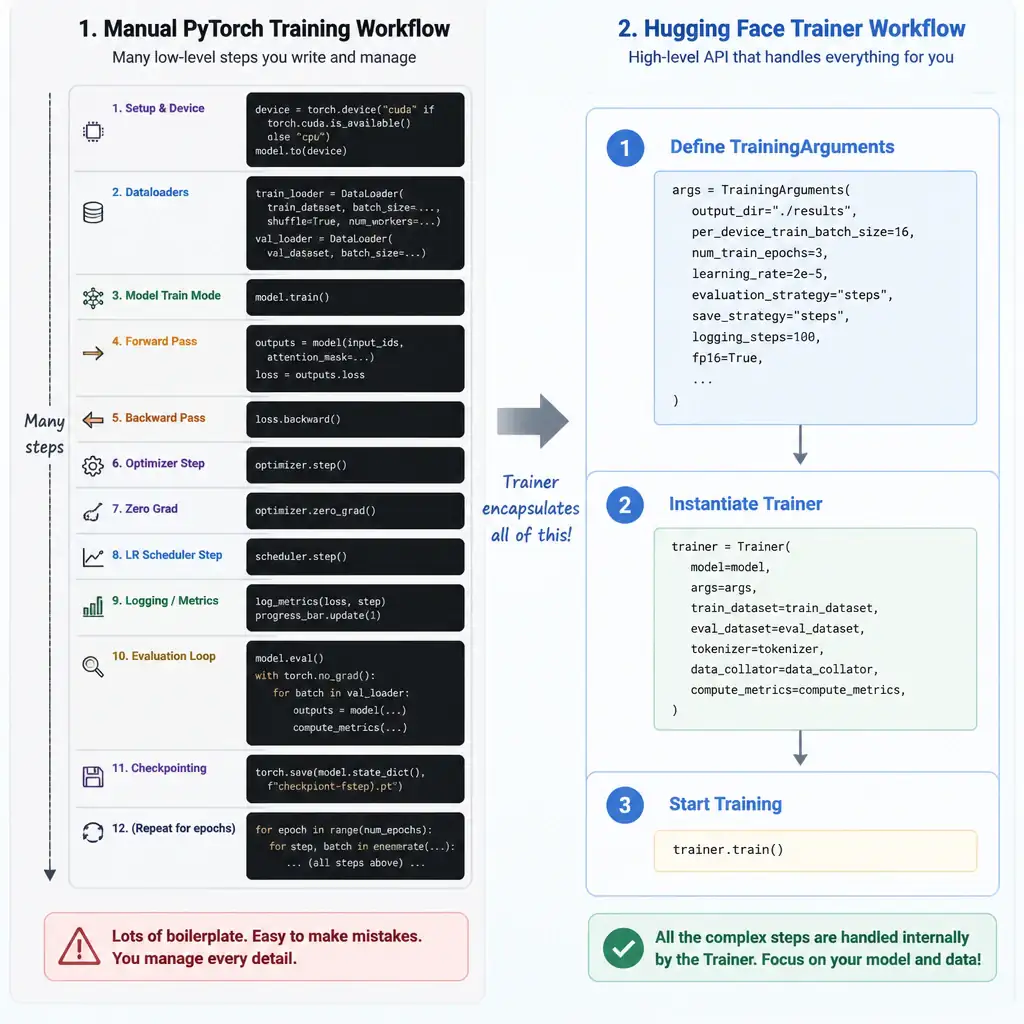
Here's the deal: if you've ever written a training loop in raw PyTorch or TensorFlow, you know it's tedious. The Trainer class automates the standard training and evaluation loop, so you can focus on your model and data instead of repetitive infrastructure code.
Full Explanation
In the Hugging Face ecosystem, the Trainer class is a high-level API designed to handle the complex mechanics of training and evaluating PyTorch-based transformer models.
Without the Trainer class, a developer must write a manual loop that includes: - Iterating over epochs and batches. - Transferring tensors to the appropriate device (CPU, GPU, or TPU). - Performing the forward pass to calculate loss. - Calling loss.backward() to compute gradients. - Invoking optimizer.step() and lr_scheduler.step() to update model weights and adjust learning rates. - Handling evaluation, logging, checkpointing, and saving the model.
The Trainer class abstracts these tasks. By passing a model, training arguments (configured via TrainingArguments), training/validation datasets, a tokenizer, and a data collator to the Trainer, the developer can start fine-tuning with a single method call: trainer.train(). It also supports advanced features out-of-the-box, such as mixed-precision training (FP16), distributed training (DDP), DeepSpeed integration, and automatic logging to platforms like TensorBoard or Weights & Biases.
The correct choice is the one that says the class simplifies and automates the standard training and evaluation loop, abstracting away manual boilerplate code.
The option about locating, downloading, and loading pre-trained model architectures and weights from the Hugging Face Hub is incorrect because that is handled by the AutoModel classes (e.g., AutoModelForSequenceClassification.from_pretrained()), not the Trainer. The option about running optimized batch inference and returning predictions on production datasets is incorrect because while the Trainer has a predict() method, its primary purpose is training and evaluation; standalone production inference is typically handled using Pipeline or direct model calls. The option about executing tokenization, padding, and truncation steps on raw text datasets is incorrect because tokenization and data preprocessing are performed by the AutoTokenizer classes, not the Trainer.