
In the lifecycle of deploying Large Language Models (LLMs), a team decides to utilize "fine-tuning" for their domain-specific application. Which of the following best defines this process?
Select an answer to reveal the explanation.
Short Explanation
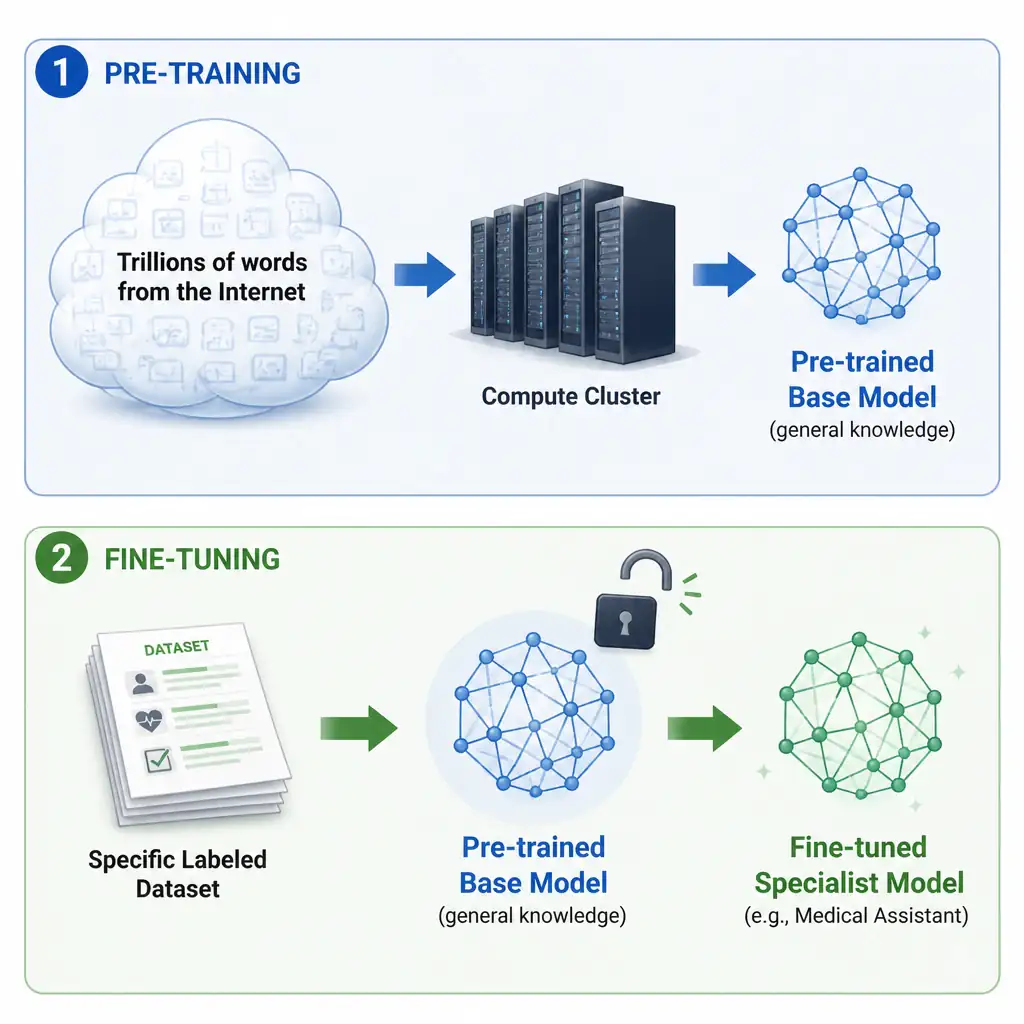
Here's the deal: fine-tuning takes a model that's already learned general language and trains it a bit more on a smaller, labeled dataset for your specific task. You're not starting from scratch or just shrinking the model—you're making an existing expert smarter for your domain.
Full Explanation
In Large Language Model development, fine-tuning is a form of transfer learning. The process begins with a "pre-trained" base model that has been trained on a massive, diverse corpus of web text (often containing trillions of tokens) using self-supervised learning. This pre-training phase allows the model to learn grammar, syntax, reasoning capabilities, and general knowledge about the world. Fine-tuning adapts this pre-trained model to a specific task (such as sentiment analysis, medical text generation, or coding assistance) by continuing the training process. During fine-tuning, the model's weights are adjusted using a much smaller, curated, and labeled dataset. Because the model already understands language, fine-tuning requires significantly less data and computational time than pre-training, making it accessible for organizations to build high-performing, domain-specific AI models. The choice describing conversion of a model's weights and architecture into a different runtime format for edge deployments is wrong because it describes serialization or compilation, such as exporting a PyTorch model to ONNX or TensorRT format for deployment optimization, not fine-tuning. The choice describing pruning and quantizing the model's parameters to reduce its overall memory footprint is wrong because it describes compression techniques: pruning removes unimportant connections, and quantization reduces the precision of numerical values; these are separate optimization processes. The choice describing initialization of a neural network with random weights and training from scratch on a massive, general-purpose text corpus is wrong because it describes the pre-training or training-from-scratch phase, which is extremely expensive and starts with random initial weights.