
You are tasked with adjusting a pre-trained language model so that its generated output adopts the specific tone, vocabulary, and writing patterns of a particular individual or brand, without changing the underlying meaning of the message. What is this process called?
Select an answer to reveal the explanation.
Short Explanation
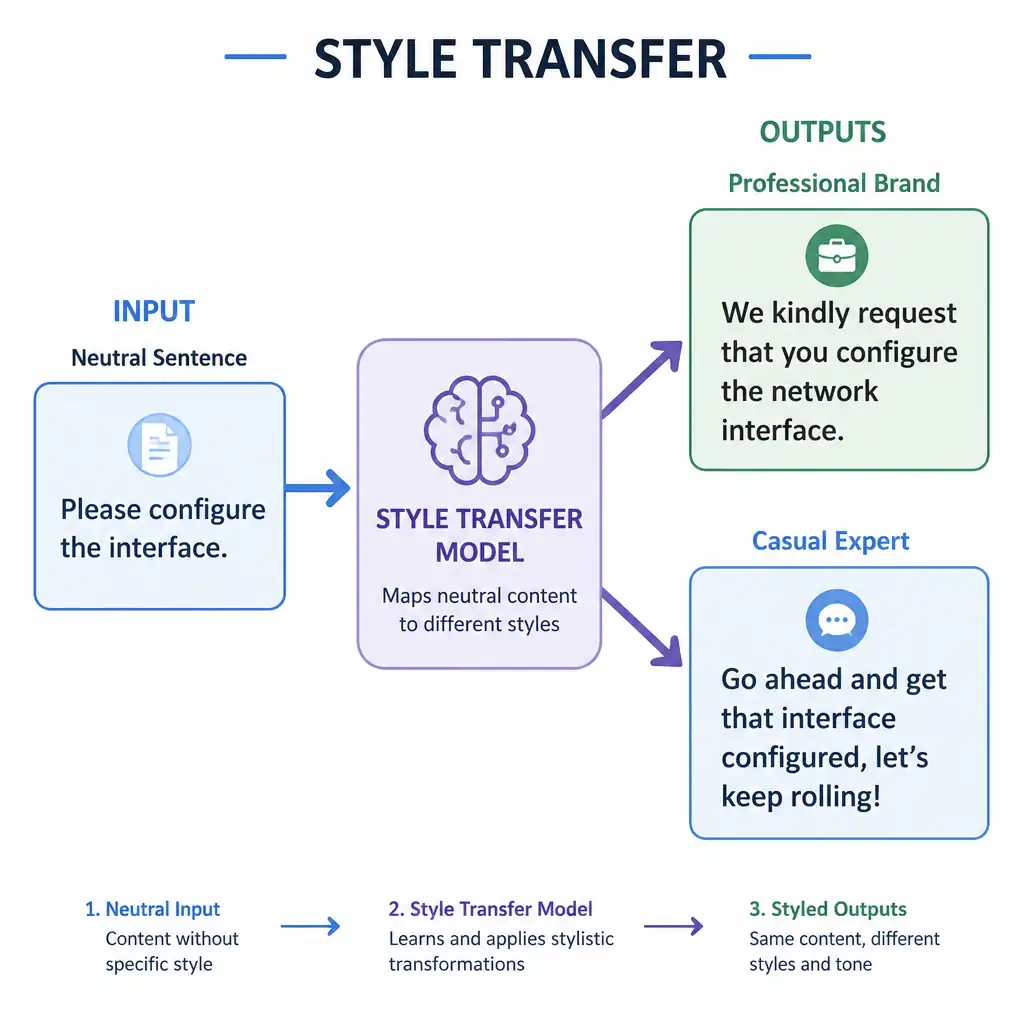
If your boss says, 'Make this bot sound like Todd Lammle,' you use style transfer. You're not teaching it new facts; you're changing its personality while keeping the message intact. It's like repainting a house—the foundation stays the same, but the look changes.
Full Explanation
Style transfer in natural language processing refers to the task of modifying the stylistic properties of a text, such as tone, formality, sentiment, or persona, while preserving its semantic meaning.
When fine-tuning a language model for style transfer, the model is trained on a dataset containing examples of text written in the target style. The objective is to map input text, which might be neutral or in a different style, to output text that reflects the target style's linguistic features, including sentence structure, word choice, and conversational rhythm. This is widely used for creating personalized virtual assistants, adapting content for different target audiences, such as translating academic text to layman's terms, or maintaining brand voice consistency across automated customer service channels.
The data augmentation choice is a technique used to artificially increase the size of a training dataset by applying transformations, such as synonym replacement or back-translation, to existing data. It does not refer to adapting a model's writing style.
The reinforcement learning choice is a machine learning paradigm where an agent learns to make decisions by performing actions in an environment to maximize a cumulative reward. While Reinforcement Learning from Human Feedback can be used to align model behavior, the specific task of changing writing styles is called style transfer.
The few-shot learning choice is an inference-time technique where a model is shown a few examples of a task in the prompt to guide its generation. It is not the name of the fine-tuning process used to systematically shift text styles.